What are the methods and precautions for whitewashing fruit trees?
As temperatures gradually drop and winter is about to arrive, you will see fruit growers in various orchards whitewashing their fruit trees. Many people are curious: what is the purpose of whitewashing fruit trees? What should be noted when whitewashing? Let's take a look together below.
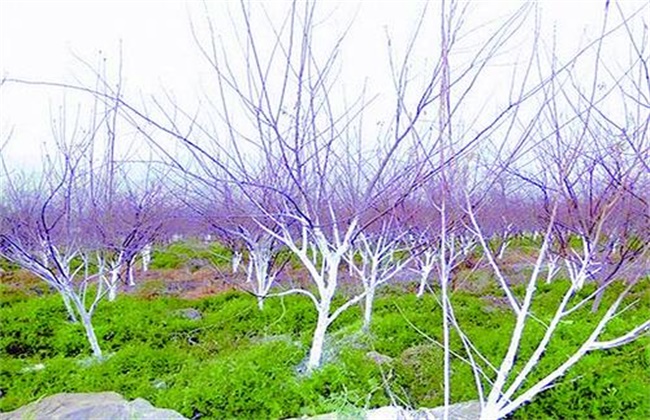
1. The purpose of whitewashing fruit trees
Whitewashing fruit trees can reduce the heat radiated by the sun that the trees absorb, preventing sunburn or frostbite. In winter, the main purpose of whitewashing is to prevent low-temperature frost damage. Whitewashing can also deal with pests and pathogens that harm the base of the trunk, because the whitewash is generally made with lime, which has excellent sterilizing and disinfecting effects and can prevent pests from laying eggs. Whitewashing can also cover wounds, prevent further infection by pathogens, reduce the occurrence of trunk diseases, and can dissolve the waxy layer on the outer skin of insects and the reproductive bodies of fungi, making it easier for the agent to enter the tree body, effectively controlling pests.
2. Timing of whitewashing fruit trees
Generally speaking, based on the purpose of whitewashing fruit trees, it is mainly to resist severe cold and control pests and diseases, so fruit tree whitewashing is generally carried out from late November to mid-February of the following year. Because temperatures are lower during this period and cold air sinks severely, the trunk is highly susceptible to frost damage, and pests and pathogens also overwinter in the cracks of the trunk. Whitewashing the trunk at this time can effectively reduce the base number of pests and diseases, achieving twice the result with half the effort in pest and disease control the following year.
3. Precautions for whitewashing fruit trees
When making the whitewash, use quicklime that is white and free of impurities; the sulfur powder should be very fine, and it is best to add some neutral washing powder. Also, the whitewash is alkaline, so it should not be mixed with pesticides that are unstable to alkali, and it must not be mixed with Bordeaux mixture. Trunk whitewashing can be done year-round, but note that different purposes require different whitewashing times: to prevent sunscald, whitewash can be done in May-June; to prevent pests from laying eggs, whitewashing should be done in April-May. When whitewashing fruit trees, it is best to treat the plant first, for example by bandaging cracked areas, and the whitewash should be used as soon as it is mixed. When applying, stir it thoroughly until it is evenly thin or thick, so that it is appropriate when it does not flow downward on the trunk, does not form lumps, and can adhere in a thin layer.
The above is an introduction to fruit tree whitewashing methods and precautions. We hope it helps you. To learn more related knowledge, please stay tuned to us.