How to trellis a dragon fruit? Detailed explanation of trellising methods
Dragon fruit is a very popular fruit in our country, with a very large market demand, and its price is also relatively affordable. When growing dragon fruit, trellising work is very important, and reasonable trellising has a great impact on the yield of dragon fruit and the quality of the fruit. So how should dragon fruit be trellised when growing it? Today the editor brings you the trellising methods for dragon fruit, let's take a look below!
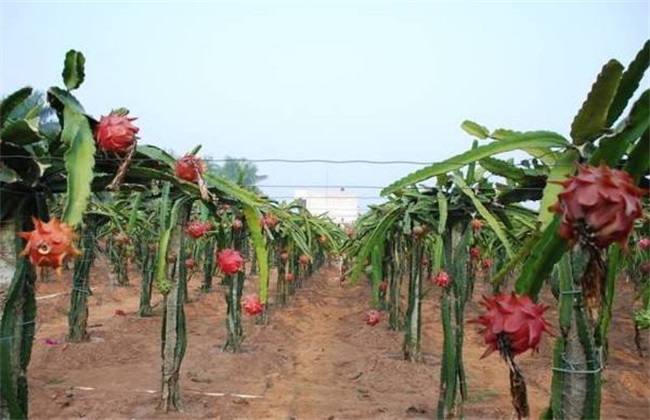
1. Trellis height and angle
When trellising, the first thing we need to pay attention to is controlling the height of the trellis. The vertical distance from the top of the trellis to the ground should be kept at about 180 cm, so that the length of the branches hanging down from the top can be guaranteed to be no less than 150 cm, promoting the formation of fruiting branches, and also making later agricultural operations convenient. Then the angle must be controlled well, because the downward-hanging growth direction will grow at a certain angle with the top trellis. If the angle is too small, it is easy to pull and press the branches, causing them to break and be damaged. Usually the large radius of the upper trellis is about 1/5 of the vertical height; if it is disc-shaped, then the radius of the disc should be kept at about 35 cm.
2. Trellis materials
The growth period of dragon fruit is very long; at its longest, the growth cycle of a single dragon fruit plant can reach 20 years or even more. Because dragon fruit grows vigorously and the soil also needs to remain moist for a long time, it is not suitable to choose materials such as wood and bamboo that rot easily; instead, hard, pressure-resistant and corrosion-resistant reinforced concrete prefabricated parts should be mainly used. It is also not suitable to use steel alone as the trellis material, because in summer the temperature is very high, and steel is a material with strong thermal conductivity, which can easily cause burns to the attached stems and leaves.
3. Trellis stability
The way the trellis is built is by burying the bottom of the main post in the soil. But because the soil remains moist for a long time, the soil texture is relatively soft, which easily affects the stability of the post. Moreover, the trellis is also relatively tall and has a large number of dragon fruit branches attached to it, so the pressure is very great. If affected by external environmental factors such as strong wind, it is easy to lose its center of gravity and cause the post to topple. Therefore, the depth to which the bottom of the trellis main post is buried in the soil should be determined according to the soil texture and changes in the surrounding environment. Usually it should be kept at about 50 cm at the shallowest, and then the upper hanging branches should be kept evenly distributed.
4. Trellis density
Trellis density is also very important; reasonable density is the basic guarantee for the growth and shaping and pruning of dragon fruit. Because dragon fruit is a perennial tropical fruit with strong sprouting ability, and its growth ability becomes stronger and stronger as the growing years increase. So under normal circumstances, the plant and row spacing should be controlled at about 2*2.5 m. In the early stage of dragon fruit growth, because the growth speed of dragon fruit is relatively slow, many people increase the density. This causes the later growth of dragon fruit to become chaotic and disorderly, not only reducing air permeability, but also having a very great impact on the flowering and fruiting of dragon fruit.
The above is a brief introduction to dragon fruit trellising methods. That is all for today's introduction. This article is for reference only, and I hope it can be helpful to everyone.