How to effectively prevent and control the low survival rate of strawberries after transplanting?
Strawberry cultivation generally uses the method of raising seedlings and then transplanting them, and late August is the strawberry transplanting period. The quality of transplanting has a great impact on the growth and management of strawberries. However, many growers often encounter the problem of a low survival rate after transplanting strawberries, so how should it be prevented and controlled? Let's find out together.
1. Insufficient or excessive base fertilizer
If excessive organic fertilizer or compound fertilizer is applied before transplanting strawberries, or if undecomposed organic fertilizer is used, it will cause seedling burn after transplanting, gradually causing the strawberry plants to die. Therefore, the amount of base fertilizer applied before planting is quite critical. Farmyard manure and organic matter must be fully decomposed before application. Under normal circumstances, about 3000 kg of organic fertilizer is applied per mu, evenly spread on the soil surface, then deeply plowed and rotary tilled. If seedling burn occurs, the amount of watering needs to be increased. On the one hand, this is to lower the soil temperature, and on the other hand, it is to settle excess nutrients and improve the soil environment.
2. Transplanting depth
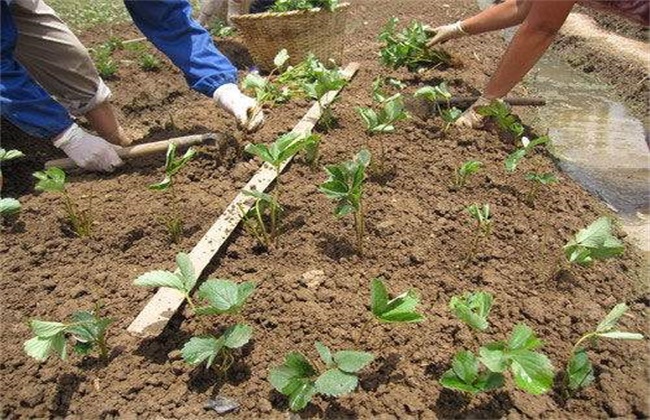
Strawberry is a shallow-rooted crop, and its main root group is distributed in the soil layer at about 20 cm. When transplanting, old leaves and necrotic roots should be removed, and the crown of the strawberry seedling should be level with the soil surface. If strawberries are transplanted too deeply, it will cause the crown to be buried, affect the extension of new leaves, and lead to poor aeration, causing seedling death. If planted too shallowly, the root crown is exposed on the soil surface, which is not conducive to producing new roots. The new crown is exposed to the sun, which easily causes the seedlings to dry up and die. For seedlings transplanted too deeply, the seedlings can be gently lifted, but be sure to control the force to avoid breaking the root system, thereby reducing the survival rate. At the same time, use Qingkulike at 150-300 times + Diliwang at 300-500 times for spraying or root drenching to prevent root rot. In addition, supplement nutrients to revitalize the plant body, which is conducive to recovering from transplanting. Soil can also be adjusted to improve soil structure and increase aeration.
3. Excessive water
Strawberries are neither drought-tolerant nor waterlogging-tolerant. Their root water absorption capacity is relatively weak, and they are relatively sensitive to water. Under normal circumstances, it is only necessary to maintain about 60% of the soil water-holding capacity. On the day of transplanting, irrigation should be carried out immediately, and attention should also be paid to the amount of watering during the seedling recovery period. Too much watering is not conducive to root growth and can also cause root rot.
4. Before the seedling recovery period ends, do not tidy the plants
During the seedling recovery period, new roots have just formed and the root system is weak. Tidying the plants easily damages the roots, thereby affecting seedling growth. At the same time, the wounds caused by tidying are likely to lead to infection by pathogens and pests, thereby reducing plant vigor. If diseased leaves are found, they can be cut off with scissors at 2/3 of the petiole, and the leaves must not be directly torn off. Spray Chinese herbal medicine to repair the wounds and kill pathogenic bacteria.
The above is an introduction to related content about the low survival rate of strawberries after transplanting. We hope it can help you. If you want to learn more related knowledge, please stay tuned to us.