Detailed Explanation of Papaya Planting Techniques and Yield Analysis per Mu
Papaya is a fruit belonging to the Rosaceae family, and the plant is a small tree. The main producing areas are in temperate, subtropical and tropical regions such as Shandong, Shaanxi, Henan, Hubei, Jiangsu and Guangxi. How should papaya be planted, what kind of growing environment does it need, and how should we manage plant growth after planting? Also, if one mu of papaya is planted, how much yield is there? Will it be proportional to the input? So next, we will mainly introduce the issues everyone cares about.
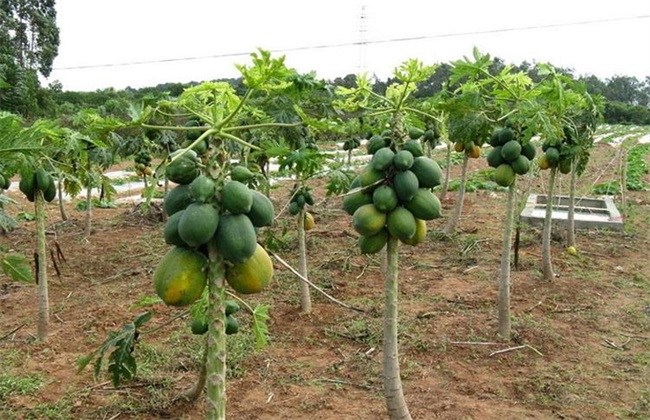
I. Yield per Mu
For papaya planting, if the growth requirements are met, management is proper and the climate is suitable, under normal circumstances the yield of papaya planted on one mu of land is about 60 to 100 jin per tree. Then about 120 to 150 trees are planted per mu. The yield is about 7,200 to 15,000 jin. However, this is only a rough reference figure, since the density on sloping land and flat land is different, and the yield of each tree is not absolute.
II. Planting Techniques
1. Planting Density
Papaya is generally planted in spring; where winter temperatures are somewhat higher, it can also be planted in autumn. In places with colder winters, it can be planted in autumn, but there is an extra winter of management, and the loss outweighs the gain. Generally, planting on sloping land and flat land is different; flat land is planted more sparsely, and sloping land is planted more densely. The common suitable spacing is 3 m between rows and 4 m between plants on flat land, and 2 m between rows and 3 m between plants on sloping land.
2. Fertilization and Water Control
Papaya planting requires emphasis on applying base fertilizer twice, and the amount of base fertilizer applied accounts for more than 60% of the annual fertilization amount, which can ensure soil fertility and a continuous supply of nutrients, and can meet the fertilizer needs over a long period. After applying base fertilizer, irrigate once to dilute the fertilizer and dissolve it into the soil. Afterward, during the flowering and fruiting period, it is enough to topdress twice more. Once before flowering, and once at fruiting. After fertilizing, water, or directly dissolve it in water and apply.
3. Flowering and Fruiting
Topdress once before flowering; using quick-acting fertilizer can promote flower bud differentiation, and applying farmyard manure can continuously supply nutrients throughout the flowering period. Do not fertilize during the flowering period. During the flowering period, pollen can be collected and artificial pollination carried out to ensure pollination and fertilization. Or keep bees to help with pollination. Some flowers are incomplete and superfluous and should be thinned in time. After fruiting, fruit-setting agents can be sprayed to protect the fruit.
4. Plant Training
Papaya plants are commonly kept in a cylindrical or spindle shape. This makes management convenient, so after planting and growth, the trunk should be headed to cultivate branches. Gradually train it into a tree shape. After the shape is formed, usually only branches such as dense branches, weak branches, superfluous branches, diseased and pest-infested branches, and water sprouts need to be pruned. Reducing unnecessary nutrient consumption is enough.
There is also a certain amount of particularity in papaya planting methods. The planting method, management and growing conditions determine the final planting yield, or rather, they are certain influencing factors.