What are the growing environment requirements for rambutan? Detailed planting conditions
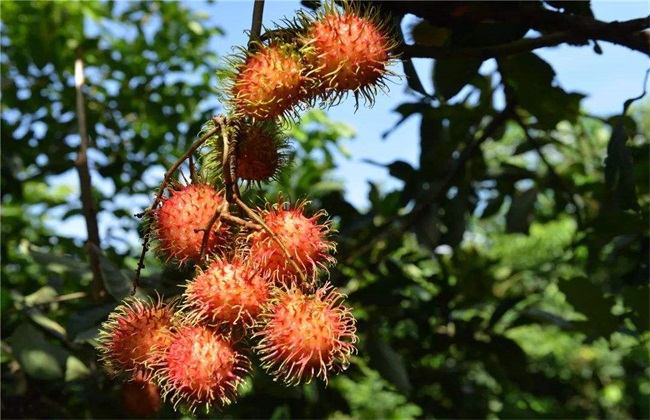
Rambutan, also called hairy lychee or red hairy fruit, is mainly cultivated in Southeast Asia. It is now also cultivated in Hainan Province, China. In fact, it can be cultivated in any tropical region, as long as the growing conditions for rambutan are met. So what exactly are the specific growing environment factors for rambutan, what standards apply, and how can the requirements of a suitable growing environment be met? Let us introduce them below.
1. Temperature
It grows well between 20°C and 32°C. It can tolerate short periods of low temperature at 17°C. At temperatures above 24°C, it grows quickly and develops well. Above 35°C, growth may be slightly disadvantaged. Below 5°C, the trees will suffer frost damage, so it can only be planted where it is warm all year round. Flowering and fruiting both require high temperature and rainy conditions.
2. Water
It likes a humid environment and requires sufficient annual rainfall. Then, the soil must be kept moist at all times. During the flowering and fruiting period, it needs a large amount of water, and at this time rainfall is needed to meet the water requirement. Its root system is small and shallowly distributed. If there is drought, it will lose water and die. If there is no rain, you need to irrigate it yourself. As long as rain does not cause waterlogging, it is fine.
3. Soil
It has strong adaptability and can survive in most soils, but acidic yellow soil is best, with a pH of 5.5 to 6 being optimal. It cannot be planted in alkaline soil. Other soils such as red soil, yellow soil, sandy loam, gravel, and clay loam can all be adapted for planting.
4. Nutrition
Apply more farmyard manure and less chemical fertilizer. Yellow soil and barren land should receive more application, while sandy land can use small amounts applied multiple times so that nutrients are not lost and can be absorbed. Macronutrient fertilizers of nitrogen, phosphorus, and potassium are indispensable. You can also turn in some weeds or other plants as green manure to supplement nutrients. The plants are prone to nitrogen deficiency, so urea can be sprayed to make the leaf color dark green. Adding sucrose to urea for spraying can reduce toxicity caused by high biuret content. Spraying monopotassium phosphate can promote flower bud differentiation.
5. Light
Vegetative growth requires sufficient light. It grows well under short-day conditions, and long-day conditions are not necessary. Strong light is very helpful for flowering and fruiting. Under weak light, growth is poor. Light can promote rapid growth of the root system and tree body and rapid shoot growth, allowing fruiting branch groups to be renewed in time.
The planting environment for rambutan is the most suitable environment composed of the appropriate factors above. Thank you for reading and supporting. I hope that after reading, it can be of some help to friends in need. Understanding rambutan can also be gained specifically from its growing environment.