Detailed Explanation of Sea Buckthorn Field Management Techniques
Sea buckthorn is a common wild fruit tree in the southwestern and northwestern regions, able to survive on saline-alkali land. Its fruit is rich in vitamin C, so it is favored by the market, and some have begun to cultivate it as an economic fruit tree. Due to the particularity of its growing environment, its planting and management work differs from that of many fruits, and if planted in different regions there are different management contents. Today we will specifically talk about management after growth.
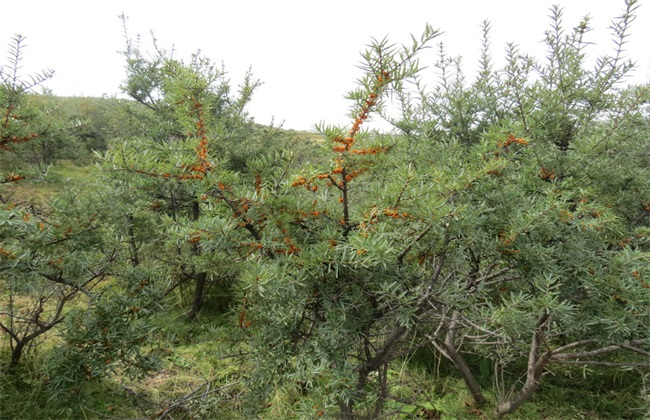
1. Pruning
Sea buckthorn branches are relatively scattered, and it is mostly a shrub with no obvious trunk, so the tree shape must not be allowed to become too messy, to facilitate management. When it grows to more than 2 m, it must be pruned, mainly cutting off crossing and horizontally growing branches. In dense parts, strong branches should be selected and kept, and the rest cut off. Generally, where branches are lacking, branches should be cultivated, and branches should be renewed in time, replacing them with new fruiting branches. Cut off diseased and pest-infested branches in time, and scrape off disease spots on the trunk.
2. Protecting Flowers and Fruits
In order to achieve a high yield of fruit, it is necessary to promote flower bud differentiation and more flowering, so that more fruit can set. New shoot growth should be controlled; before fruiting, fewer new shoots may be retained, and too many should not be kept. In addition, flowers should be thinned; for clustered flowers, some should be thinned out. During the flowering period, when there are extremely many flowers, the branches can be gently shaken. After fruiting, some of the densely clustered fruit clusters should be cut off, to avoid the phenomenon of alternate bearing, or excessive flowering and fruiting leading to severe fruit drop due to malnutrition.
3. Pests and Diseases
The main disease is shrinkage disease, a devastating disease. The pathogen invades through wounds and the root system, so human-made wounds should not be caused. Before planting, varieties with the strongest resistance and good adaptability to the environment should be selected. When the disease occurs, mainly use 40% carbendazim suspension concentrate at 500 times dilution or thiophanate-methyl at 800 times dilution for root irrigation treatment. Once a month, carried out multiple times. The main pest is the apple small leafroller; use 25% methomyl at 2500 times dilution or 20% fenvalerate at 3000 times dilution as a spray for control.
4. Other Management
Although the soil is tolerant of poor fertility, it is sensitive to the need for phosphate fertilizer, so phosphate fertilizer can be applied as a top dressing. It is best not to plant too densely; plant spacing 1.5 m, row spacing 2 m, and it can also be adjusted by oneself. Sea buckthorn is dioecious, so pollinator trees should be arranged between rows, roughly one male tree for every 3 female trees. Harvest in time to avoid the fruit being eaten by birds. Harvest when the color darkens, the flesh softens, and there is a fragrance. After harvesting, store at a low temperature of 1 to 5 °C.
The management details that should be done well after planting in a sea buckthorn orchard are the parts above, but in practice there will be some changes under different environments, and more details should be noted. At present, these are mainly the important contents. For anything not taken into consideration, you can consult experienced fruit growers yourself.