What to Do About Deformed Watermelons? Cause Analysis and Control Methods
Many cucurbit crops produce deformed fruit, and watermelons are no exception. Watermelons develop deformed fruit when poor growth is caused by certain factors. There are many causes of deformed fruit, which will be introduced one by one below. There are three main types of deformation commonly seen, and the content below will cover them specifically. The preventive measures against deformed fruit should be determined according to the cause. So let's take a look together now.
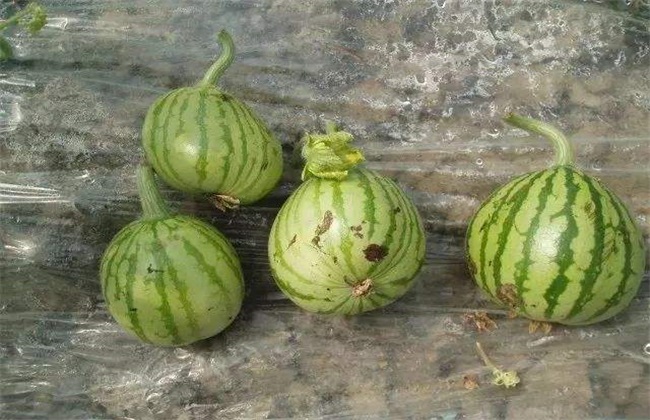
I. Deformation symptoms and causes
1. Lopsided melon
It often takes on a one-sided appearance: generally one side swells while the other side fails to keep up in development, which produces this phenomenon. There are two causes. First, when the flower forms, low temperatures cause incomplete flower development, which then affects the fruit and deforms it. Second, poor fertilization means the seeds grow on one side, and the seedless area does not swell, forming a deformity.
2. Flat melon
This easily occurs in round-fruited varieties. In the early stage the fruit grows lengthwise, and in the later stage it grows crosswise. If low temperatures are encountered during one of these stages, growth slows down, while normal temperatures during the other stage allow rapid growth; such uneven development forms a flat deformity. The rind also becomes thicker, and the stem end becomes sunken.
3. Gourd-shaped melon
The direct sign is that the section near the stem end fails to develop while the other section swells, making the shape resemble a gourd. This phenomenon is generally caused by uneven supply of fertilizer and water: usually there is drought in the early stage with insufficient water and fertilizer, and after conditions improve, the early growth has already been completed and cannot be reversed. This results in this shape deformity.
II. Control measures
For open-field planting, plant only after the temperature has risen and stabilized, so the flowering period does not encounter low temperatures, or use plastic film mulching cultivation. In protected cultivation, no matter what the outside temperature is, the internal temperature must be adjusted to the most suitable range for the flowering period. In addition, when outside temperatures are low, ventilate less, and ventilate on sunny days. During the fruiting period, maintain a temperature above 25 degrees; automatic regulation is best, and the nighttime temperature must not fall below 23 degrees so that low temperatures are avoided and growth rate is not affected. Then deformed fruit will not appear. Fertilizer and water supply must be maintained throughout the entire growth cycle. In the early stage of plant growth, apply more nitrogen fertilizer to maintain plant vigor, and ensure watering keeps humidity at around 60%. Then during the flowering and fruiting period, apply heavy fertilizer and water, fertilizing once a month and irrigating once a week.
Deformed watermelons mainly form three types of deformity: lopsided melons, flat melons, and gourd-shaped melons. The causes of deformation are mainly low temperatures affecting flower development, or low temperatures affecting the growth rate of the fruit. Another cause is insufficient nutrients and water causing deformity. By taking preventive measures during the flowering and fruiting period according to the causes, the problem of deformed watermelons can basically be avoided.