How to Grow Passion Fruit? A Detailed Guide to Cultivation and Management Techniques
Passion fruit, whose scientific name is egg fruit, is a herbaceous vine fruit that generally grows in mountain valleys and forests and can only be grown in tropical regions. The plant is a perennial with a very long lifespan. Besides being edible, it also has certain medicinal value, and its seeds can be pressed for oil. Its economic value is relatively high and its cultivation returns are fairly good, so many regions choose to plant it. For planting, high-yield cultivation techniques and post-planting cultivation management are very important, and this is also the main content this article will discuss.
I. Cultivation Techniques
1. Site Selection
Passion fruit needs relatively high growing temperatures, so land should be chosen for planting in low-altitude areas; the planting site should preferably be flat, broad land that is easy to manage and transport from; its root system is average, so soil that is deep, loose, and permeable and well-draining should be chosen, and since it likes fertilizer, the planting site should be fertile.
2. Planting
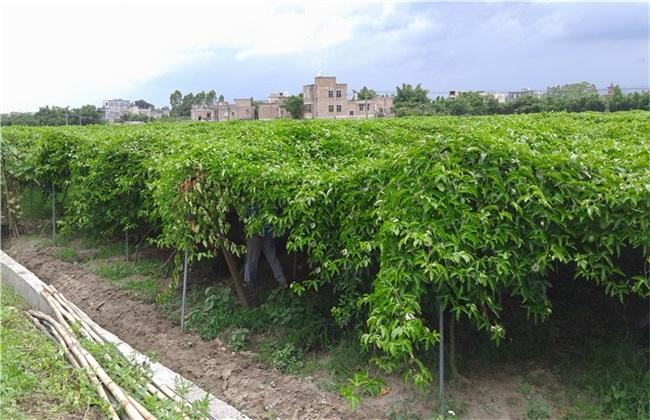
In the tropics it can be planted year-round, while in the subtropics it is planted in spring and autumn. Planting requires trellises; generally a small trellis 3 m long and 3 m wide is suitable for planting 10 plants, and not too many, as crowded vines affect photosynthesis and growth. Before planting, each planting pit should be given sufficient base fertilizer and farmyard manure, with a plant spacing of about 30 cm, watered thoroughly, and covered with rice straw to retain moisture and warmth.
II. Management
1. Fertilizer and Water
Before fruiting, young trees should be given a nitrogen fertilizer topdressing once a month to keep the plants growing well, sprouting and sending out shoots, retaining branches, and preparing fruiting branches. For mature trees, base fertilizer is applied in early spring, with a ring-shaped trench dug 30 cm from the roots for fertilization; about 2 to 5 jin of farmyard manure is applied per plant, and after covering with soil, water is applied to aid absorption. During the fruiting period, a topdressing should be applied once, mainly compound fertilizer diluted with water for quick absorption; after harvesting, fertilizer should be replenished, mainly barnyard manure, along with other mild fertilizers, to keep warmth and protect the roots. After the second fruiting, another topdressing is applied. The root system is shallow and fears both drought and waterlogging; besides normal watering, drainage must be carefully ensured after rain, as waterlogging easily causes root rot and even death; but a lack of water also causes water loss, slow growth, small flowers, and fruit drop.
2. Pruning
Before sprouting, heavy pruning should be carried out, generally cutting off all dead and diseased branches, then removing the side branches beyond 60 cm of the main trunk and all tangled branches. Light pruning can be done in all four seasons; during vigorous growth, remove excess branch tips and weak branches; after picking the fruit, cut off most of the new shoots, leaving a few strong branches with good node positions. Prune branches that have already borne fruit, diseased and insect-damaged branches, and dense branches.
3. Pest and Disease Control
The main disease is damping-off, for which 800-times liquid of cudao likuling or 800-1000-times liquid of miaojundi can be used; for mosaic disease, 1000-1500-times liquid of xiaoye huangjue or 1500-2000-times liquid of bingduling can be used as a spray treatment. The main pest is the leaf miner, for which 1000-times liquid of 40% dimethoate emulsifiable concentrate or 1000-1500-times liquid of 40% diazinon emulsifiable concentrate can be used; for thrips, a 1000-times spray of 25% imidacloprid or root drenching with 3000-5000-times 25% thiamethoxam water-dispersible granules can be used.
The above are the cultivation and management techniques for passion fruit. I hope that after reading this, it can be of some help to everyone. Specifically, you can learn from experienced growers or accumulate practical experience yourself, so that you can fully understand the content of cultivation and management.