What are the key points for managing kiwifruit during the flowering and fruiting period?
Kiwifruit is a fruit that most people like. April and May are exactly the flowering and fruiting period of kiwifruit. At this time, management measures have a great impact on kiwifruit, so special attention should be paid. So how should kiwifruit be managed during the flowering and fruiting period? Let us understand together.
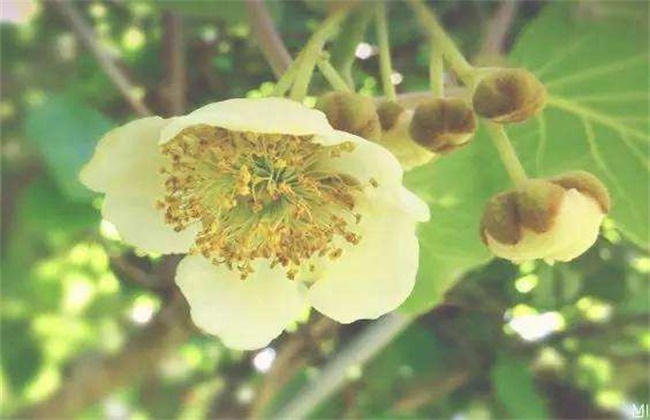
I. Flowering period management
1. Flower thinning
Kiwifruit flowers have a high fruit-setting rate and easily set fruit under normal climate. If there is too much fruit set and more fruit drop occurs, nutrient consumption will be excessive, which will seriously reduce fruit yield and quality. Therefore, flowering period management aims at high yield, stable yield, and high quality. First, flower thinning should be carried out. When the fruiting branch grows to more than 50 cm, the flower buds can open. At this time, the flower thinning method is to thin the sparse middle and outer sides, that is, remove the weak buds at the base and tip of the fruiting branch, as well as the poorly developed flower buds on the same inflorescence.
2. Supplementary pollination
In order to improve the fruit-setting rate and increase yield, supplementary pollination can be carried out. Supplementary pollination is generally chosen to be carried out on sunny mornings. Generally, each orchard is pollinated 3-4 times, once every 1-2 days. There are many methods of supplementary pollination. The common three are hand pollination, bee pollination, and pollinator pollination. Hand pollination is to collect male flowers that have just opened that morning, gently smear the stamens of the male flowers onto the stigmas of the female flowers. Each male flower can pollinate 7~8 female flowers; bee pollination is to place bees in the orchard. Generally, a 2-mu kiwifruit orchard should have 1 box of bees, with no fewer than 30,000 bees per box; pollinator pollination is to load pollen into a syringe-contact special kiwifruit pollinator, dip it on a flower, and gently dip it onto the stigma of the female flower.
II. Management after fruit setting
1. Fruit thinning
If kiwifruit bears too much fruit, the plant's nutrition cannot keep up, which will cause a large number of fruits to grow poorly. Therefore, timely thin out some deformed fruits, small fruits, and diseased and weak fruits to save nutrients and promote the growth of other fruits. In addition, if the fruit load exceeds the target number of fruits to be retained, remove the fruits at the base or tip of the fruiting branch to ensure the balance of the tree.
2. Apply fruit-strengthening fertilizer well
Fruit growth and development require a large amount of nutrients. Insufficient tree nutrition will not only cause poor fruit growth, but also cause premature aging and death of the plant. Therefore, fruit-strengthening fertilizer must be applied well. For fruit-strengthening fertilizer, decomposed farmyard manure can be selected as the base fertilizer. Kiwifruit growth requires relatively high chlorine elements, so chlorine-based compound fertilizer can also be used, and potassium chloride can be applied more in topdressing.
3. Fruit bagging
After bagging the fruit, it can avoid sunburn, prevent dust and pesticide contamination, reduce fruit drop, extend storage time, and improve fruit appearance, thereby increasing commodity value. It is recommended to choose paper bags with good air permeability, low water absorption, and soft texture. The bagging time must be grasped well. If bagging is too early, it is easy to damage the stems, affect fruit growth, and form low yield. If bagging is too late, the effect is not obvious. Generally, bagging can be done after flowering, and bagging should stop about 25 days after flowering.
The above is an introduction to the key points for managing kiwifruit during the flowering and fruiting period. I hope it can help you. If you want to learn more related knowledge, please follow us.