Detailed Explanation of Key Points for Greenhouse Nectarine Cultivation and Management
Nectarine is an excellent variety of peach. To improve yield and quality, many fruit growers mostly adopt greenhouse cultivation, and greenhouse nectarines differ slightly from open-field cultivation. So how should greenhouse nectarines be managed? Let's take a look together with the editor.
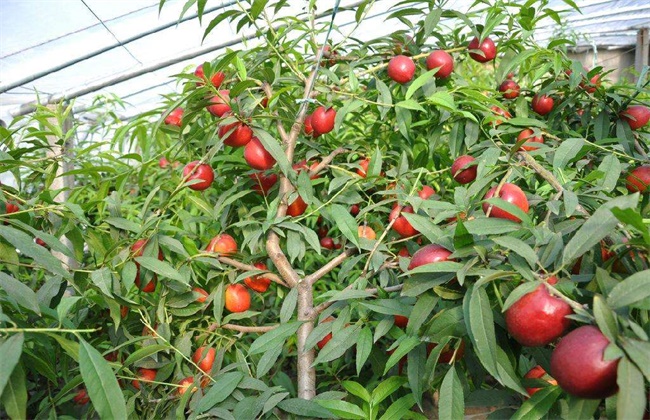
1. Site Selection and Greenhouse Construction
The nectarine greenhouse should preferably be built in a place that is sheltered from the wind and faces the sun, with dry terrain, convenient drainage and irrigation, and fertile, loose soil. It can be built within a peach orchard, or the greenhouse can be built first and then the trees transplanted, depending on the actual situation. For greenhouse construction, choose a bamboo and wood structure, with the back wall made of hollow water cement bricks. The height, length and width of the greenhouse depend on the actual situation. Use polyethylene non-drip film for the greenhouse film. Ventilation holes should be made in the back wall, generally leaving one about 30 cm in diameter every 10 m, and a skylight should likewise be made in the center of the greenhouse roof.
2. Seedling Transplanting
If the greenhouse is built within a peach orchard, no transplanting is needed; only stronger fertilizer and water management is required. For a newly built greenhouse, before transplanting, the soil should be deeply plowed, and each greenhouse should be applied with 4000-5000 kg of organic fertilizer, 20 kg of compound fertilizer, and 10 kg of potassium sulfate as base fertilizer. The seedlings selected for planting should have well-developed root systems, robust growth, and plump buds. When planting, control the spacing between plants and rows at 1.5 m × 4 m, and the ratio of the main variety to pollinator varieties at about 10:1. When planting, keep the root system spread out, water thoroughly once after planting, and cover with film to preserve heat and moisture.
3. Training and Pruning
For greenhouse nectarine training and pruning, a group structure with a north-high and south-low sloping surface is generally adopted. If the tree form is spindle-shaped, control the tree height at about 1.5 m; if the tree form is open-center, control the tree height at 1 m. Pruning before covering the greenhouse should focus mainly on thinning branches, leaving long branches and letting them extend, thinning out diseased and pest-damaged branches, drooping branches, water sprouts, and flowerless branches, while strengthening nutrient branches to maintain air and light penetration between plants.
4. Fertilizer and Water Management
One month before covering the greenhouse, each greenhouse should be applied with 3000 kg of organic fertilizer, 25 kg of diammonium phosphate, and 10 kg of urea, and at the same time watered thoroughly once, then shallowly hoed to break the soil surface and covered with plastic film. During the young fruit stage, spray a low-concentration urea solution once. At the pit-hardening stage, in addition to the urea solution, spray a potassium dihydrogen phosphate solution once more. From covering the greenhouse to petal fall, watering should not be done, and the humidity inside the greenhouse should be controlled below 60%. During the fruit stage, generally water twice, once at the pit-hardening stage and once at the fruit expansion stage, but pay attention to the watering amount, which should not be too much, so as to avoid excessive growth of new shoots, causing physiological fruit drop and affecting yield.
The above is an introduction to the key points of greenhouse nectarine management. We hope it can help you. To learn more related knowledge, please stay tuned to us.