Detailed Explanation of Lychee Air Layering Propagation Techniques, Beginners Can Easily Learn
Lychee is a tree plant of the Sapindaceae family, widely distributed across southern China. Lychee has an extremely high sugar content and a delicious flavor, making it very popular among many people. The main planting areas are concentrated in provinces such as Guangdong and Fujian. When growing lychee, the seedling propagation work is very important. The common propagation method for lychee is mainly air layering, and below the editor brings you the air layering propagation techniques for lychee. Let's take a look!
1. Propagation Time
Lychee air layering propagation has no great demands on timing; it can generally be done at any time within a year. However, if you want to increase the rooting rate of the branches, then it is best to do it around March. And we should also choose the propagation time according to the variety. For example, if it is an early-maturing variety, then it should be done about one month earlier, while for mid-maturing varieties it is best to do it around Qingming Festival. Because this is the peak growth period of the lychee tree, the sap flows quickly within the tree, and the peeling work on the phloem is also relatively simple. Moreover, the wound after girdling heals quickly, and the rooting rate and survival rate are also relatively high.
2. Branch Selection
The selection of branches for lychee air layering is very important. We should select branches from robust, high-quality-variety, high-yielding fruiting trees. Then, likewise on the mother plant, select about 3-year-old healthy branches free of pests and diseases as the air layering branches. Keep the diameter at about two cm; such branches can effectively increase the rooting rate. And the cultivated lychee trees have strong growth ability, and the fruiting rate is also very high. If the branch selection is improper, not only will the survival rate be insufficient, but the growth ability of the seedlings after survival will also be very poor.
3. Girdling the Branches
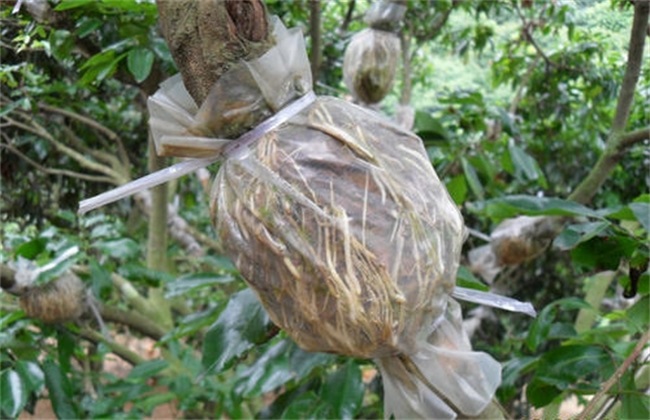
After selecting the branches, we need to begin the girdling work. First, make 1-2 girdling cuts on the selected branch, with the depth of the girdling reaching the xylem of the branch. The distance between the two cuts should not be too close; keep it at about 3cm. Then peel off the bark in between, and be careful to clean off the cambium on the xylem completely. After girdling, let the wound dry for about 7 days to promote the death of the cambium cells. When you find a tumor-like growth appearing at the girdled area, apply a layer of rooting agent to the wound, then wrap a layer of wet mud, and tie it tightly with a plastic bag to promote sprouting.
4. Substrate Preparation
The substrate preparation after the branches have rooted is very important, as it determines the survival rate. The substrate is mainly made of garden soil and an appropriate amount of farmyard manure, then add an appropriate amount of water so that the moisture content remains at about 60%. When wrapping the branch, take the area above the girdled spot as the center and tie the wet mud tightly. Prevent the wet mud from loosening, which would affect the branch's nutrient absorption. After about two months, white roots appear above the cut. At this time, keep about 40cm, cut off the air-layered seedling, and plant it at the appropriate time.
The above is a brief introduction to lychee air layering propagation techniques. There are many propagation methods for lychee, including sowing, grafting, and more. Air layering is relatively simple to carry out, and the survival rate is also relatively high, so air layering is mostly used. That's all for today's introduction. This article is for reference only, and we hope it can help everyone!