Opportunities and Challenges of Food Scrap Composting: Local Decentralized Production Has Reached Daan Forest Park
Text by Upstream and Downstream reporters Cai Jiashan and Duan Yaxin
Taiwan produces about 1 million tons of cooked food scraps (surplus food edible by humans) each year, of which 770,000 tons are steamed again and fed to pigs for disposal. If feeding food scraps to pigs were completely banned, does the country have the capacity to handle 770,000 tons of pig-feed food scraps?
The Environmental Protection Administration planned three options, including composting, incineration and landfill. But incinerating salty food scraps together with plastic carries the risk of producing dioxins and affects incinerator performance, while landfill sites are hard to find and cannot digest large amounts of food scraps, so both are considered "last-resort measures to be avoided." Currently there is only one biomass energy plant in all of Taiwan, but it can only take in raw food scraps. Two more biomass energy plants, in Taichung and Taoyuan, are coming, and only the Taoyuan one can accept cooked food scraps, with completion and commissioning expected no sooner than 2020.
Considering that none of the above options can dispose of food scraps in large quantities, the Environmental Protection Administration treats "composting" as the top priority and highest-capacity first choice for food scrap disposal. But cooked food scraps contain oil and salt, and composting requires space and time for piling and maturing. If African swine fever breaks out urgently, can 770,000 metric tons of food scraps be digested? Upstream and Downstream interviewed the Environmental Protection Administration, Sun Shulin, chairman of the Taiwan Food Scrap Resource Development Association, Liu Lixue of Linhai Farm, who has long made compost from cooked food scraps, and Yang Qiuzhong, academician of Academia Sinica and professor in the Department of Environmental Soil Science at National Chung Hsing University, to explore feasible options for food scrap composting.
Liu Lixue of Linhai Farm: Cooked food scraps are more suitable for composting than raw food scraps, and break down faster
"There is absolutely no technical problem with making compost from cooked food scraps, and the process is faster." Liu Lixue, head of Linhai Farm, who has long promoted food scrap composting, said that when their farm first started, they used food scraps from school lunch programs, and the production process was less prone to smelling bad because the temperature rose quickly after fermentation, so it took only three months to make fertilizer. Raw food scraps, by contrast, require adding more rice husks and wood chips to compost and smell worse.
Regarding the claim that the salt and oil in cooked food scraps hinder composting, Liu Lixue also refuted it: "No problem!" Because the compost goes through fermentation, and the vegetables grown actually have a natural salty taste, and the soil has no salinization problem.
The Environmental Protection Administration now promotes draining the water from food scraps first, but Liu Lixue believes the water in food scraps can actually also serve as liquid fertilizer: "Pump oxygen into it to turn it into liquid fertilizer, and it is even better for watering vegetables."
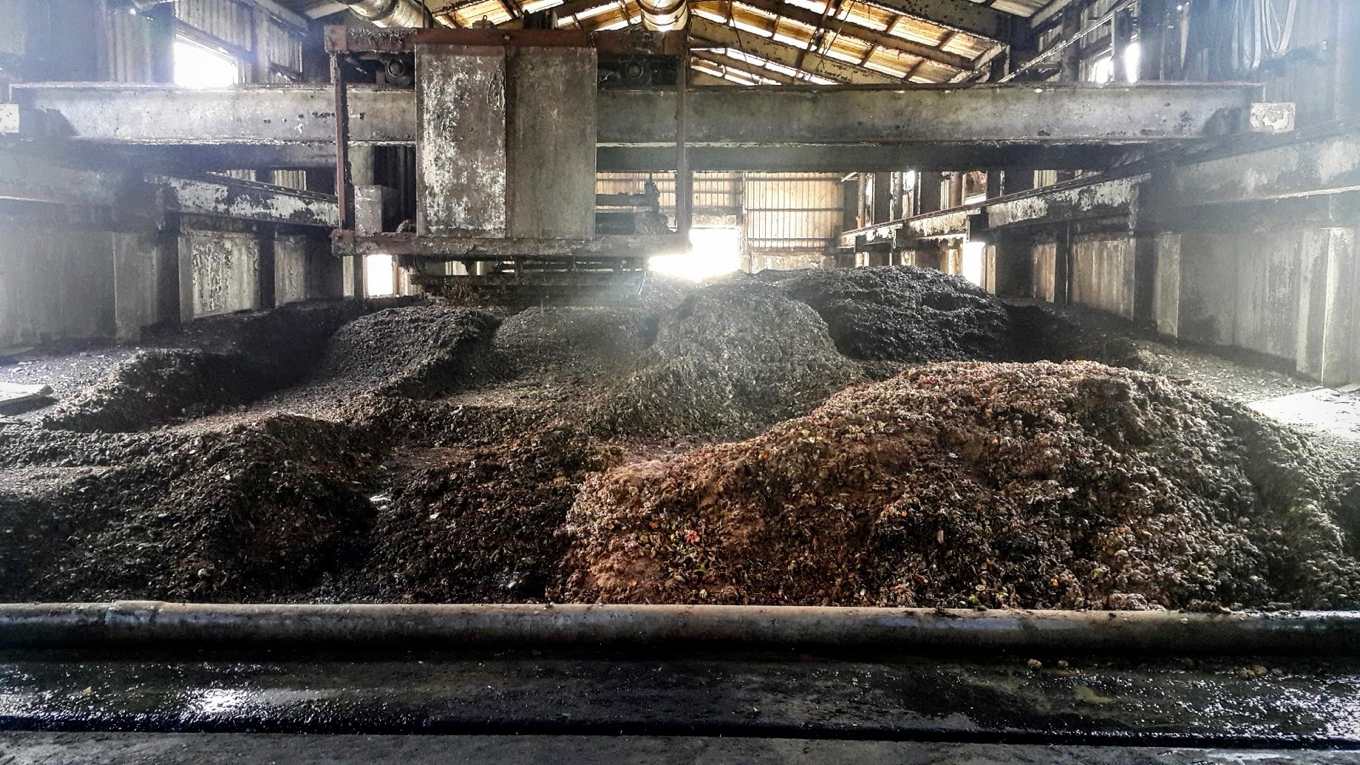
Linhai Farm's 200-ping composting site can process 50-100 tons of food scraps per month
Liu Lixue's production processes for solid fertilizer and liquid fertilizer both require no added microorganisms. But does the composting process smell bad? He said it smells for the first few days, and once heating and fermentation begin, it turns into a slightly sour smell, though it may still draw complaints from neighbors.
Liu Lixue has single-handedly promoted food scrap composting through private efforts for more than ten years, but because pig farmers used to collect cooked food scraps, no one paid attention to this area, and few in academia were willing to do research on it: "Doing this gets your hands dirty."
At present, the site Linhai Farm uses for food scrap composting is about 200 ping, and it can process 50 to 100 tons of food scraps a month. On average, each ton of food scraps can produce 300 kg of solid compost and 600 kg of liquid fertilizer, enough to serve a farm of three to four fen of land.
Liu Lixue suggested that the government should now push food scrap composting with greater force and set up composting sites widely in various places. If one composting site could have an area of 1,000 to 2,000 ping and five to six workers, it could process 500 to 1,000 tons of food scraps a month, benefiting nearby farms or residents growing flowers.