Symptom Identification and Integrated Control Methods for Strawberry Bud Blight
Strawberry bud blight is a soilborne fungal disease with a worldwide distribution. It is strongly saprophytic in soil and is an important root disease of many crops. In addition to strawberry, it also affects more than 160 species of cultivated and wild plants, including cotton, soybean and vegetables. On strawberry, it mainly damages buds, new shoots, stipules and the bases of leaf petioles, causing seedling-stage damping-off...
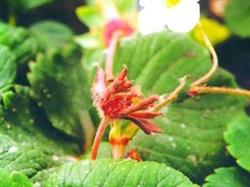
Strawberry bud blight is a soilborne fungal disease with a worldwide distribution. It is strongly saprophytic in soil and is an important root disease of many crops. In addition to strawberry, it also affects more than 160 species of cultivated and wild plants, including cotton, soybean and vegetables. On strawberry, it mainly damages buds, new shoots, stipules and the bases of leaf petioles, causing seedling-stage damping-off, and in the mature-plant stage, stem and leaf rot, root rot and fruit rot.
I. Symptoms
The pathogen of strawberry bud blight is Rhizoctonia belonging to the Deuteromycotina, whose sexual stage is in the Basidiomycotina, genus Thanatephorus.
When the plant base is affected, dull brown spots first appear on the part near the ground, gradually become sunken, and produce milky-yellow to light-brown spiderweb-like mycelium, which can sometimes bind several leaves together. When the petiole base and stipules are attacked, the diseased part shrinks and dries, and the upright leaves wilt and droop. If damaged before flowering, the inflorescence loses vigor and gradually wilts and collapses; in acute cases it shows sudden collapse. After buds and new shoots are infected, they gradually wilt, appearing green-wilted or suddenly collapsed, and then turn dark brown and die. When the stem base and roots are affected, the cortex rots, and the aboveground part dries up and is easy to pull out. From young fruit and green fruit to ripe fruit, all can be attacked; dark brown irregular patches appear on the surface of the diseased part of the affected fruit, which becomes hard, and eventually the whole fruit dries and rots. At high temperatures, the above-mentioned mycelium can grow. When colored berries are affected, the diseased part turns brown, and a relatively wide brownish-white band often develops around it; the red part slightly turns carmine red, creating a strong and vivid color contrast, causing wet rot or dry rot, but no gray mold, which is the difference from gray mold fruit rot.
II. Disease Development Pattern
The pathogen of strawberry bud blight is Rhizoctonia belonging to the Deuteromycotina. It overwinters in the soil as mycelium or sclerotia with diseased residues, and is mainly spread by diseased seedlings and diseased soil. In open-field cultivation, spring is the main period of occurrence, and the suitable temperature for disease development is 22-25°C; it is prone to occur under conditions of excessive fertilizer and high water. In protected cultivation, high temperature, poor ventilation, high humidity and overly dense planting easily lead to the spread of the disease.
III. Control Methods
1. Try to avoid raising seedlings and planting strawberries in areas where damping-off occurs; otherwise, solar soil disinfection must be carried out.
2. Plant appropriately sparsely, irrigate reasonably, ensure ventilation, and reduce environmental humidity.
3. In protected cultivation, ventilate and exchange air in a timely manner, and ventilate quickly after irrigation to reduce indoor humidity.
4. Remove diseased plants promptly, and strictly prohibit using diseased plants as mother plants to propagate strawberry seedlings.
5. Chemical control. Suitable agents include 10% polyoxin wettable powder at 500-1000 times dilution, 10% lilingling aqueous suspension at 300 times dilution, and captafol water-soluble formulation at 600 times dilution. Starting from the bud emergence stage, spray once about every 7 days for a total of 2-3 times. In greenhouse or plastic tunnel cultivation, use 110-180 g of 5% chlorothalonil dust per mu, place it in 5-6 spots, ignite it in the evening, keep the tunnel closed overnight, fumigate once every 7 days for 2-3 consecutive fumigations.