Detailed Explanation of Pollution-Free Cultivation Techniques for Strawberries in Plastic Greenhouses
(1) Variety selection: Choose varieties with early flower bud differentiation, shallow dormancy, and good cold resistance in low-temperature seasons, such as Chunxiang, Fengxiang, Lihong, Mingbao, Jingbao, Nyoho, and Hokowase. (2) Cultivating strong seedlings: 1. Carefully select mother plants. In March-April of the current year, select plants from the strawberry production greenhouse with vigorous growth, good inflorescence fruiting, few deformed fruits, well-developed root systems, and no pests or diseases as mother plants. Plant them in a dedicated seedling nursery to cultivate and propagate runner seedlings. Apply 2000-3000 kg of organic fertilizer and 10 kg of compound fertilizer per mu in the nursery. Make beds 2 m wide, with a planting row spacing of 1 m and a plant spacing of 0.3-0.4 m. After they establish, apply nitrogen fertilizer as early as possible, keep the soil moist, and remove all inflorescences that appear to promote runner growth.
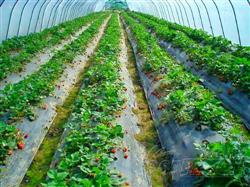
(1) Variety selection
Choose varieties with early flower bud differentiation, shallow dormancy, and good cold resistance in low-temperature seasons, such as Chunxiang, Fengxiang, Lihong, Mingbao, Jingbao, Nyoho, and Hokowase.
(2) Cultivating strong seedlings
1. Carefully select mother plants. In March-April of the current year, select plants from the strawberry production greenhouse with vigorous growth, good inflorescence fruiting, few deformed fruits, well-developed root systems, and no pests or diseases as mother plants. Plant them in a dedicated seedling nursery to cultivate and propagate runner seedlings. Apply 2000-3000 kg of organic fertilizer and 10 kg of compound fertilizer per mu in the nursery. Make beds 2 m wide, with a planting row spacing of 1 m and a plant spacing of 0.3-0.4 m. After they establish, apply nitrogen fertilizer as early as possible, keep the soil moist, and remove all inflorescences that appear to promote runner growth.
2. Use nutrient pot seedling cultivation. Cultivate excellent runners. In early to mid-May, mother plants begin to send out runners. To cultivate strong seedlings, generally keep 4-5 runners per mother plant, and propagate 2-3 excellent daughter seedlings per runner. To promote early flower bud differentiation, nutrient pot seedling cultivation is also needed. From late May to late June, without cutting the runners, transplant runner daughter seedlings that have already rooted and have 2 unfolded leaves into plastic nutrient pots (size 10-12 cm x 10 cm) filled with nutrient soil. When all seedlings have survived and the number of seedlings has reached the requirement, cut the runners, then immediately move the nutrient pot seedlings into the seedling greenhouse. Strengthen fertilizer and water management, water frequently, keep the pot soil moist, and lower the soil temperature. Apply nitrogen fertilizer. Starting in early to mid-July, apply it once about every 1 week, and stop in mid-August. To promote flower bud differentiation, from mid-August to mid-September, cover the greenhouse frame with black shade netting for shading treatment, which can promote flower bud differentiation and formation 5-10 days earlier.
(3) Planting and field management
The planting period is from mid-to-late September to early October. Half a month before planting, apply 3000-5000 kg of organic fertilizer, 40-50 kg of superphosphate, and 50 kg of compound fertilizer per mu. Open deep furrows and build high beds. For a 6 m wide greenhouse, make 5-6 beds, with a bed width of 1-1.2 m. Plant double rows per bed, with a row spacing of 25 cm x 18 cm. After planting, water once thoroughly. After the seedlings recover, pay attention to fertilizing, irrigating, removing old leaves, removing axillary buds, and cultivating and weeding. Cover with plastic film in late October. In addition to the main planted varieties, pollination varieties should also be arranged in the greenhouse, in principle no fewer than 3-4 varieties, and the distance between 2 varieties must not exceed 25 m.
(4) Temperature management
Immediately after planting, quickly raise the greenhouse temperature to 30°C. By the end of October, when the average temperature drops to 16°C, begin heat preservation at the appropriate time. In the early stage of heat preservation, 28-30°C during the day and 12°C at night; at the bud stage, 25-28°C during the day and 10°C at night; from fruit enlargement to harvest, no higher than 25°C during the day and maintain 3-5°C at night. After 3 days of greenhouse heat preservation, when more than 30% of flower buds have appeared, spray 5 mL of 5-10 mg/kg gibberellin solution per plant, focusing on the heart leaves, which can make the terminal inflorescence bloom earlier. In December, the temperature drops sharply. If the nighttime temperature inside the greenhouse falls below 0°C, heat preservation must be carried out again. Use small arched tunnels inside the greenhouse, or hanging film inside the greenhouse.
(5) Water and fertilizer management
Generally water once a week to keep the soil moist. Ensuring water supply at the beginning of heat preservation, during fruit enlargement, during the peak harvest period, and after the interval between harvests are key measures related to whether strawberry growth is good or poor.
From planting to the start of heat preservation, apply 1-2 topdressings, especially apply 1 before laying plastic film, using 8-10 kg of compound fertilizer per mu. Apply 1 time each during fruit enlargement and early harvest, using 400-500 times diluted compound fertilizer by drip irrigation or pouring. Apply 1 time in mid-February before growth resumes. Apply 2 times from axillary flower bud emergence in early spring to fruit enlargement. A total of 7-8 topdressings, with the principle of applying little but often, applying 1500-3000 kg of liquid fertilizer per mu each time. In addition, from the bud stage to the flowering stage, foliar spray 2-3 times with boric acid, copper sulfate, ammonium molybdate, or Plant Power 2003, etc.
(6) Supplementary pollination
Use bees for supplementary pollination. Before the terminal inflorescence opens at the end of November, place one box of bees per greenhouse. Alternatively, after strawberries bloom, use a new brush for artificial pollination. Pollination time is 9:00-11:00 in the morning and 2:30-4:30 in the afternoon. During full bloom, do it once every 2 days.
(7) Flower and fruit thinning
Each strawberry plant generally has 5-6 inflorescences. Before flowering, during the flower bud differentiation stage, appropriately thin buds on higher node-order flowers, leaving no more than 12 fruits per inflorescence on average. Fruit thinning is done when young fruits are green, removing deformed fruits, pest- and disease-damaged fruits, and late small flowers and small fruits.
(8) Artificial supplementary lighting
Use artificial supplementary lighting to create long-day conditions to inhibit strawberries from entering dormancy. The method is to install incandescent lamps as light sources in the greenhouse from late November to mid-February of the following spring, hanging 1 100-watt incandescent lamp every 4 m, set 1.5 m above the ground, from 17:00 at sunset each evening to 23:00, or from 2:00 in the morning to 8:00 in the morning. Ventilate in a timely manner, remove old leaves, and reduce the number of irrigations to reduce humidity in the greenhouse. On sunny days, the temperature inside the greenhouse rises quickly, and ventilation can begin at 28°C.
(9) Pest and disease control
The main insect pest is red spider mite. During its occurrence period, alternately spray 800 times diluted mite solution and 1000 times diluted Keshade, for a total of 6 applications. Entering mid-March, gray mold is prone to occur. Alternately spray 50% carbendazim 1000 times diluted solution and 70% thiophanate-methyl 800 times diluted solution, for 2 consecutive treatments, once every 7 days. Note that pesticide application should stop 10 days before harvest.