Strawberry Container Cultivation Techniques and Management Methods
Strawberry is a perennial herbaceous plant of the genus Fragaria in the rose family (Rosaceae). Its flowers are white and its fruit red, the plant is short, with leaves growing in clusters, and green leaves set off the red fruit as it creeps along the ground, full of charm. In warm-climate regions it does not shed its leaves in winter, and its flowering and fruiting period is long; from November to May of the following year it has both flowers and fruit, and it can be used to arrange flower beds and flower borders. When the fruit of a potted strawberry is bright red...
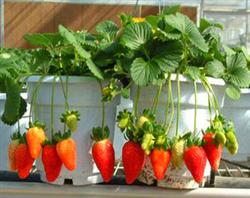
Strawberry is a perennial herbaceous plant of the genus Fragaria in the rose family (Rosaceae). Its flowers are white and its fruit red, the plant is short, with leaves growing in clusters, and green leaves set off the red fruit as it creeps along the ground, full of charm. In warm-climate regions it does not shed its leaves in winter, and its flowering and fruiting period is long; from November to May of the following year it has both flowers and fruit, and it can be used to arrange flower beds and flower borders. When the fruit of a potted strawberry is bright red, especially during New Year's Day and the Spring Festival, placing it on a table or hanging it in a basket indoors or on a balcony makes it both a fine ornamental-fruited plant and a good source of fresh fruit for tasting, greatly adding to the joyful festive atmosphere. As people's living standards rise, the demand for flowers will grow day by day, and two-purpose flowers that can both be enjoyed and provide delicious fresh fruit are especially favored. Therefore, developing potted strawberry cultivation is a land-saving and highly efficient cultivation technique with broad prospects.
1. Selecting suitable varieties. For potted strawberries, one should first choose varieties with excellent quality, upright leaves, well-formed and large fruit, and good ornamental value. Different regions should also decide according to local climatic conditions. Generally, warm-winter regions should choose varieties with shallow or relatively shallow dormancy, such as Fengxiang, Chunxiang, Lihong, Mingbao, Shimei No. 2, Kinuama, Nyoho, etc. Relatively warm regions should choose varieties with relatively shallow or deeper dormancy, such as Minglei, Libao, Mingjing, Xinming, Shimei No. 1, etc. Cold regions should choose deeply dormant varieties, such as Quanmingxing, Xinmingxing, Baojiao Zaosheng, Hani, Zaohongguang, etc. If a deeply dormant variety is cultivated in a warm region, because the amount of low temperature below 5°C needed to break dormancy is insufficient, the plant will remain completely dwarfed; although it can flower and bear fruit, poor vegetative growth makes the fruit smaller and affects its ornamental value. If a shallowly dormant variety is cultivated in a cold region, because there is too much low temperature below 5°C, vegetative growth in spring is excessive, even leggy, with few inflorescences and susceptibility to disease, and the fruit set is low, which also affects its ornamental value.
2. Cultivating strong seedlings. The final ornamental value and yield of potted strawberries depend on the quality of the seedlings, which is closely related to the nutritional status of the plant and the development of the root system. Therefore, cultivating strong seedlings is key. Experiments have shown that the most ideal method for raising strawberry seedlings for potting is high-mountain seedling cultivation, that is, raising seedlings in high-cold areas at an altitude above 800 m. The higher the altitude, the lower the summer temperature, which is beneficial to the growth and development of the nutritional seedlings, giving strong vitality, a good root system, robust young plants, and more and plump flower bud differentiation. The nursery plot should be chosen from areas where strawberries have not been grown, with sufficient base fertilizer applied. After preparing the land and making beds, robust planting stock should be selected as mother plants. When the temperature reaches 18-20°C, they can be planted out; the planting spacing for mother plants is 40 cm x 80 cm. Management should be strengthened after planting. By June to July, large numbers of runner seedlings will be produced, flower bud differentiation can occur in August, and by late September seedlings can be collected and potted.
3. Potting soil preparation. The root system of potted strawberries grows in a very small pot. Under limited soil conditions, to cultivate strawberry plants with large fruit and lush leaves, there are relatively strict requirements for soil fertility and permeability. If only natural soil is used, it is very difficult to satisfy the nutrients and other conditions needed for strawberry growth and development, so cultivated soil should be used. So-called cultivated soil is made by mixing natural soil (generally garden soil) with other materials in a certain proportion, and it has the characteristics of sufficient nutrients, rich humus, good aggregate structure, strong water and fertilizer retention capacity, and good aeration.
3.1 Common basic materials for cultivated soil
3.1.1 Garden soil (vegetable garden soil): This is the surface mature soil of vegetable fields, with good aggregate structure and fertility. After winter freezing and weathering or summer sun exposure, it is crushed and sieved to remove rubble, stones, earthworms and soil-dwelling pests, then stored for later use. When taking soil, avoid using garden soil where strawberries have been grown.
3.1.2 Leaf mold: Made by piling and fermenting fallen leaves until decomposed; it is loose in texture and somewhat acidic, with a relatively high humus content.
3.1.3 Compost soil: Made by piling weeds, straw, fallen leaves, ash-product waste, etc. with human feces and urine, superphosphate (1%-2%) and an appropriate amount of plant ash to ferment and decompose.
3.2 Preparation of cultivated soil: There is no fixed standard for preparing strawberry cultivated soil. Generally, a mixed soil made of 3 parts leaf mold, 2 parts compost soil and 5 parts garden soil, with a pH between 6.5 and 6.8, gives a relatively ideal effect.
4. Timely transplanting and potting
4.1 Flower pot selection: Generally, clay pots, plastic pots and porcelain pots with a diameter of 25-30 cm and a height of about 20 cm can all be used. However, they differ according to use: production mostly uses clay pots and plastic pots, while decorative outer pots are mostly porcelain. It is appropriate to fill the pot with cultivated soil to about 80% full.
4.2 Potting period: The potting period for strawberries should be considered according to the growth status of the seedlings, the level of temperature and humidity, and whether the seedlings have sufficient time for growth and development after planting. Generally, seedlings that are short and sturdy, with a well-developed root system, many primary roots, large green leaves, a root crown thicker than 1 cm, and 4-5 green leaves are easy to establish after potting. In northern China, potting in late September to early October is appropriate; in southern China, potting in late October to early November is appropriate. Each pot can hold 3-4 plants. When planting, the swollen curved side of the base of the strawberry plant's shortened stem (that is, the arched back) should face the outer side of the pot edge, to facilitate future fruit set. The base of the seedling crown or the underground stem should be level with the soil surface, neither too shallow nor too deep. After planting, check for seedlings with exposed roots or buried crowns, and remedy promptly if any are found.
5. Maintenance and management
5.1 Plant management. Strawberries like light; insufficient light makes the plants grow thin and weak, reducing yield and quality. Therefore, potted plants should be placed in a sunny place; urban residents can put them on a balcony. During the growth period, turn the pot once every 7-10 days so that the plant receives sufficient light and grows, flowers and fruits better. To make strawberries grow robustly, excess runners, old leaves and diseased leaves should be removed to reduce nutrient consumption. During the flowering period, the small flowers that open later on the inflorescence generally do not set fruit and should be removed; only 4-6 flower buds should be kept on each inflorescence, and the rest should be thinned out to ensure large and attractive fruit.
5.2 Fertilizer and water management. Strawberry roots are shallow, the leaves are dense, transpiration is strong, and it is afraid of drought. In the first week after potting, water once a day; afterward, water once every 2-3 days, and especially during flowering and fruit ripening, water must not be lacking. In summer, water every day; on balconies with high temperature and dry air, also spray water on the leaves; in winter, when moved indoors, reduce the amount of watering. Strawberries do not need much nitrogen fertilizer; increasing phosphorus and potassium fertilizer can promote flowering and fruiting. After sprouting in spring until before flowering, a 0.3%-0.5% potassium dihydrogen phosphate solution can be used for watering, and foliar spraying several times can make flowers abundant and fruit plentiful.
5.3 Pest and disease management. The main diseases of potted strawberries include brown spot, gray mold, powdery mildew, root rot, yellow dwarf disease, etc. Usually, fertilizer and water management should be strengthened, and old leaves, dead leaves and diseased leaves should be removed promptly. When the damage is severe, chemical control should be combined, spraying 2% agricultural antibiotic 120 aqueous solution at 200 times, or 0.4% equal-amount Bordeaux mixture, or 50% carbendazim at 1000 times. The main insect pests include strawberry leaf mite, aphids, greenhouse whitefly, red spider mite, leaf beetle, tobacco cutworm, etc. Once found, they should be controlled as soon as possible. For strawberry leaf mite, 1.8% abamectin emulsifiable concentrate at 3000 times, or 80% dichlorvos emulsifiable concentrate at 1000-1500 times can be sprayed. For aphids at the early stage of occurrence, 50% pirimicarb wettable powder at 2000 times, or 3% acetamiprid at 1000-2000 times can be sprayed for control. During the occurrence period of greenhouse whitefly, spraying 12% buprofezin emulsifiable concentrate at 1000 times, or 2.5% bifenthrin emulsifiable concentrate at 3000 times both have good effects. For red spider mite, at the initial stage of strawberry inflorescence, 0.3 degrees Baume lime sulfur mixture can be sprayed; when it occurs, spray 75% propargite at 3000 times, or 20% pyridaben wettable powder at 3000 times, taking care to spray the undersides of the leaves, and at the early stage of occurrence spray 2-3 times consecutively at 3-4 day intervals. For strawberry leaf beetle, at the seedling stage and leaf-emergence stage, if the damage is severe, 90% trichlorfon at 800-1000 times, or 2.5% deltamethrin at 2000-2500 times can be sprayed for control. For tobacco cutworm control, manual removal of egg masses and larval clusters can be used; chemical control should be carried out before the 3rd instar, spraying 50% cyanophos at 800-1200 times, or 50% fenitrothion at 1000-1500 times to kill them.