Detailed Guide to Potted Apple Cultivation Techniques: A Step-by-Step Tutorial on Growing Apples Well
Potted apples are a new phenomenon, and their emergence has been welcomed and valued by leisure agriculture, urban agriculture, sightseeing tourism, and landscaping. Their development and popularity are a sign of the improvement of our country's social economy and people's living standards, as well as a close-up of the pursuit of beauty in life and environment. Rural courtyards, in front of and behind houses...
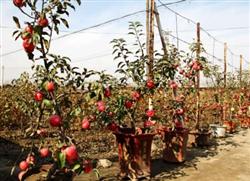
Potted apples are a new phenomenon, and their emergence has been welcomed and valued by leisure agriculture, urban agriculture, sightseeing tourism, and landscaping. Their development and popularity are a sign of the improvement of our country's social economy and people's living standards, as well as a close-up of the pursuit of beauty in life and environment. They can be placed anywhere in rural courtyards, in front of and behind houses, on urban balconies, in meeting rooms, hotels, and so on. Because of their attractive shape, long fruit-bearing period, and convenient management, they can also enter supermarkets and be placed on counters, both decorating the frontage and improving economic returns.
For farmer production, on 667 sq m, 1,500-2,000 pots with a diameter of 26-33 cm can be placed, with 2.5-4.0 kg of fruit per pot and a yield of more than 5,000 kg per 667 sq m. Pots with a diameter of 40-60 cm can accommodate 400-500 pots, with 10-15 kg of fruit per pot and a yield of around 5,000 kg per 667 sq m. Plant trees in the first year, achieve a certain yield in the second year, and reach full production in the third year. Because potted apples make it easy to control temperature and water manually, a better cultivation environment can be created, increasing the sugar content of the fruit, making the fruit color more vivid and the aroma stronger, and raising the selling price of apples. With proper management, potted apples can continue to produce abundantly for more than 10 years, with relatively high economic returns. If early and delayed production methods are further adopted, economic returns can double again. Potted apples are truly a good project for farmers to become prosperous. Picking the fruit and selling it gives a higher yield than open-field cultivation, and selling the fruit on the plant together with the pot multiplies the returns. Generally, a three-year-old potted apple sells for 200-300 yuan per pot, and some for several thousand yuan.
1. Variety selection: choose Hanfu and Hanxiang.
Hanfu: cold-resistant and high-yielding, a new large-fruited high-quality variety. The largest single fruit in pot cultivation exceeds 0.5 kg. It has a certain yield in the second year after planting and reaches full production in 3 years. The peel is fully red, the fruit shape is regular and attractive, the flesh is pale yellow, sweet and sour in moderation, with good flavor, high firmness, and good storage and transport tolerance. If not picked in pot cultivation, the fruit does not easily drop.
Hanxiang: cold-resistant, with aromatic fruit flavor and especially attractive bright peel. It is a new strain selected in recent years. Planting it together with Hanfu allows mutual pollination, significantly increasing the fruit-setting rate.
2. Preparation of nutrient soil
Formula 1: sand, black soil, and horse manure at 1/3 each, plus a small amount of decomposed chicken manure powder, no more than 2 grams per pot.
Formula 2: 2 parts field topsoil, 1 part decomposed crushed firewood and grass, 1 part perlite, 1 part cattle and horse manure.
Formula 3: 2 parts aged rice husks, 1 part garden soil, 1 part barnyard manure.
3. Water and fertilizer management
(1) Watering. For potted apples, water and fertilizer management is crucial. It is the main factor determining yield and quality and the key to achieving high or low returns. For large-scale production, a dedicated person must be responsible and manage carefully, supplying water according to weather changes, watering when dry and withholding when wet, and stopping once thoroughly watered. Do not irrigate heavily or repeatedly, so as to avoid diluting the nutrients in the pot, wasting manure, or causing root rot.
Large, thick, dark green leaves indicate that fertilizer and water are appropriate. If the heart leaves show yellowing, it means watering has been too frequent and should be adjusted in time. If heavy rain occurs after watering, the flower pot should be laid on its side to prevent rain, and only set upright again after confirming the weather is clear. Both too much and too little water are unsuitable for the growth of potted apples. This must be grasped correctly.
(2) Fertilization
Potted apples should be fertilized according to the fruit and leaves. When the leaves are small and there is much fruit, apply more fertilizer; otherwise apply less, following the principle of applying little but often. Choose high-quality, fully decomposed farmyard manure with strong effect as topdressing, such as chicken manure, pig manure, sheep manure, and so on. The amount of fertilizer is determined by pot size. For a 26-33 cm pot, applying 4-5 grams of urea per pot is appropriate; when applying compound fertilizer, slightly increase the amount; farmyard manure 100-150 grams, with larger pots increased as appropriate. Water promptly after fertilizing. Apply topdressing five or six times each year. In the early stage, nitrogen fertilizer should dominate, while in the later stage, phosphorus and potassium fertilizer should be greater. During the growing season, spray foliar fertilizer. In the early stage, spray 0.2%-0.3% urea; in the later stage, when the fruit is coloring, spray 0.2%-0.3% monopotassium phosphate three or four times, at an interval of 10 days. For foliar spraying, it is best to choose a cloudy day or evening to aid absorption.
4. Temperature management
(1) Early promotion management.
In early January, potted apples in the Shenyang area have passed their natural dormant period; in the south, this may be postponed as appropriate. Move potted apples that have completed dormancy well into a greenhouse. The greenhouse temperature should be a maximum of 10°C during the day and around 0°C at night, and the temperature can be increased by 1-2°C each day. Before flowering, the maximum temperature should not exceed 20°C; during the flowering period, the temperature is best controlled at 18-20°C. The minimum should not be lower than 0°C. After fruit setting, gradually raise the temperature, to 25-28°C during the day. The maximum should not exceed 32°C. High temperatures of 35°C are harmful to many plants, so high temperatures should be avoided. A day-night temperature difference of 10-15°C is appropriate. When open-field apple trees have a large number of new leaves, greenhouse potted apples can be acclimated by rolling up 1/3 or 1/4 of the plastic during the day. After 5-7 days, remove the plastic, and the temperature will be the same as that of open-field apples.
(2) Delayed management.
For the late-maturing large-fruited "Hanfu" and "Hanxiang" apples, by delaying flowering in the first year, the fruit maturity period can only be delayed to mid-November or early December. If a later maturity is needed, delayed domestication treatment must be carried out. The method is to keep the soil in the flower pot moist as much as possible before picking the fruit, maintain a temperature above 10°C, and prevent the leaves from falling. Even after the fruit is picked, let the leaves continue to grow, and only allow dormancy after the leaves fall. Each year, extend leaf growth by at least more than half a month. In this way, for two or three consecutive years, the maturity period can be delayed until after New Year's Day. The later potted apples mature, the more popular they are, and the higher the economic returns.