Key summer management techniques after reshaping apple trees
After reshaping, most tree forms in the Weibei area became open-center trunk forms. The open-center trunk form has only 3-5 main branches, a great reduction compared with the large branch count before reshaping, but because the root system below is still fully functional, in the year of reshaping the trees generally (except weak trees) produce vigorous shoots. Therefore we must pay attention to reshaping...
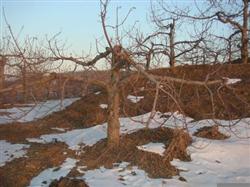
After reshaping, most tree forms in the Weibei area became open-center trunk forms. The open-center trunk form has only 3-5 main branches, a great reduction compared with the large branch count before reshaping, but because the root system below is still fully functional, in the year of reshaping the trees generally (except weak trees) produce vigorous shoots. Therefore we must pay attention to summer management of the trees in the year of reshaping to prevent excessive growth and shoot dieback. If management is improper, it can cause alternate bearing or even no flowers and no fruit the following year. Practice has proved that scientific summer management of the trees is the main way to achieve high yield, high quality and high efficiency. The specific measures are as follows:
I. Carry out supplementary branch bending at the right time
On the basis of spring branch bending, 1-2 supplementary bendings can be done according to tree vigor. For vigorous branches more than 1 year old and less than 3 years old that bear no fruit or little fruit in the current year, (F-type) branch spreaders can be used to help bend them to the horizontal or vertical position, to inhibit their vegetative growth and promote flower bud differentiation. For vigorous branches more than 3 years old that bear no fruit or little fruit, the "three consecutive saw cuts" method can be used for branch bending.
II. Handle new shoots carefully and rationally renew fruiting branch groups
In the year of reshaping, more new shoots should be retained, and excessive and overly dense new shoots should be appropriately thinned. Keep one new shoot every 15-20 cm on the main branches; keep one medium or weak shoot on the upper side every 30-40 cm on the main branches to prevent sunburn. If the tree is relatively vigorous, retain moderate to slightly weak new shoots; if the tree is relatively weak, do the opposite. After fruit drop, 1-3 new shoots on the "living stub" can be retained according to tree vigor, and when the remaining branches grow to 60 cm, (E-type) branch spreaders can be used to open them to the horizontal position.
When the current year's new shoots grow to half-lignified, select moderate shoots for shoot twisting. For overly vigorous new shoots, the branch kneading method can be used to injure them so they stop growing and form flowers and fruit earlier. New shoots that have not stopped growing before September should be pinched according to the situation. For fruit-drop branch groups more than 3 years old, rational renewal can be carried out according to the situation.
III. Control vigor and promote flowering
For temporary trees and temporary branches, use girdling to promote flowering. For overly vigorous main branches with few fruits, girdle 20-30 cm from the trunk, with a width of 0.5 cm. For overly vigorous trees with few fruits, girdle on the trunk 50-60 cm above the ground, with a width of 1 cm. For fruiting branch groups on vigorous trees, use the multi-cut ringing method 1-3 times from early May to early July.
IV. Topdress at the appropriate time
From mid-to-late May to late June, the trees enter the vigorous growth period, flower bud differentiation period and fruit enlargement period. During this period the trees have a relatively high demand for nutrients, so compound fertilizer should be supplemented in time at 1-1.2 kg per tree. A 0.2%-0.3% urea solution and monopotassium phosphate can also be sprayed on the leaves to supplement nutrients and meet the trees' needs.