Dryland Cultivation Model of Apple and Alfalfa on Hilly Dry Land
To make young apple trees bear fruit earlier, on the basis of strengthened fertilizer and water management, the following technical measures should also be adopted. Notching buds: In spring (early March), notch the buds on the branches. Use a hacksaw blade to draw back and forth right next to the tip of the bud, reaching deep into the xylem, with a width slightly wider than the bud. Through bud notching, the bud sprouting rate can reach 85...
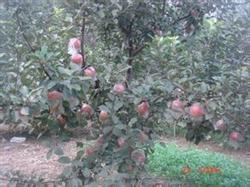 1 Apple
1.1 Variety selection. High-quality, high-yield, storage-resistant mid- and late-maturing varieties such as Red Fuji should be selected as the main planted varieties.
1.2 Land preparation. In the rainy season of the year before apple planting, dig planting pits with a specification of 80 cm x 100 cm. This is to catch natural precipitation and improve seedling survival rate.
1.3 Planting time and density. Apples can be planted in both spring and autumn, generally with a row spacing of 2 m x 4 m or 3 m x 5 m, planting 44-83 trees per mu.
1.4 Planting. Before planting, apply 2 kg of expanded chicken manure and 0.5 kg of diammonium phosphate to each pit and mix thoroughly with soil, prune the root system of the saplings, soak them in clean water for 12-24 hours, then dip the root system in a 50-100 mg/kg solution of ABT No. 3 rooting powder for 3-5 minutes, plant them in the pits and water, and after the water has seeped through, cover well with soil.
1.5 Plastic film covering of pits. After the saplings are planted, cover the planting pits with plastic film, make a hole in the middle, and press the edges firmly with soil, forming a pot-bottom shape to facilitate the infiltration of accumulated water.
1.6 Trunk heading, soil mounding, and bagging. After the saplings are headed, apply paint or vaseline to the cut surfaces to prevent water loss from the cuts. For autumn planting, tie grass bundles before the soil freezes to prevent frost damage, and when the saplings sprout, untie the grass bundles and burn them. For spring planting, use special film bags to cover the saplings and tie them well to prevent water loss; check promptly when the saplings sprout and remove the film bags to prevent scorching the buds.
1.7 Training and pruning. After planting, when the plant height reaches 80 cm, carry out training. Generally, the open-center layered form is adopted, leaving 3 lateral branches per tree. At the same time, branch bending is carried out according to the plant shape. After entering the fruiting stage, winter pruning and summer pruning should be carried out promptly according to the tree shape, removing diseased branches and dead branches to ensure healthy growth of the tree.
1.8 Mulching grass and film on the tree basin. Every spring or autumn, level the tree basin and cover it with plastic film; the mulching area equals the vertical projection area of the canopy. Press the joints of the plastic film firmly with soil, and press soil strips on the film between plants. Alternatively, after autumn each year, cover the area around the tree basin with grass, using about 20 kg of grass per tree, and press it firmly with soil after covering to prevent wind and fire. Grass can be selected from wheat straw, corn stalks, rice straw, etc.
1.9 Soil improvement. Combined with fertilization, every year during the rainy season, dig ring-shaped trenches 50-60 cm wide and 80 cm deep under the tree basin, and carry out deep plowing and hole expansion for 3 consecutive years to improve soil structure and increase the soil's water storage and moisture conservation capacity.
1.10 Promote water-saving drip irrigation. Build water cellars, ponds, etc. to store natural precipitation, equip drip irrigation facilities, and implement drip irrigation.
1.11 Use biochemical agents. To improve the drought resistance and water retention capacity of soil and fruit trees, promote the use of moisture-increasing agents and drought-resistant agents. First, apply 5 g of strong soil moisture-increasing agents such as LPA-1, LPA-2, and LSA-2 to the soil under each fruit tree; second, spray the leaf surface 2-3 times with a 500-fold solution of "FA Dryland Dragon"; third, according to the growth of apples and drought conditions, apply regulators such as Lüheng, Tianbao high-efficiency yield-increasing agents, and multi-element foliar fertilizers as appropriate to enhance the stress resistance of apples.
2 Alfalfa
2.1 Variety selection. Select varieties with cold resistance, drought resistance, high yield, strong regrowth, and high crude protein content, such as L323 from the United States and FD4 from Canada.
2.2 Fertilization and land preparation. In spring and autumn, between the apple tree rows, apply 2000-3000 kg of farmyard manure per mu, 13-26 kg of diammonium or 50-100 kg of superphosphate, and 5-10 kg of potassium sulfate, broadcast on the soil surface, then deep plow and harrow finely until the ground is level, the soil is fine, and there are no clods, with no missed plowing or harrowing.
2.3 Seed treatment. Before sowing, carefully select the seeds and spread impurity-free seeds in the sunlight to dry for 3-5 days, which can promote seed maturity and increase the germination and seedling emergence rate.
2.4 Sowing
2.4.1 Sowing period. Alfalfa can be sown all year round, but spring sowing (March-April) and autumn sowing (August to mid-September) are the best sowing periods. Spring sowing should be done promptly while there is soil moisture; autumn sowing occurs right after the rainy season, when the temperature is suitable, which is conducive to germination, seedling emergence, and root development. Sowing too late is not conducive to safe overwintering.
2.4.2 Sowing form. The distance between alfalfa and apples is 50-60 cm. Sowing is mainly in drills; drill sowing produces uniform seedlings and facilitates management such as intertillage, weeding, and fertilization. The row spacing is generally 30-40 cm.
2.4.3 Sowing depth. Alfalfa seeds are small, with a thousand-grain weight of about 2 g, and should not be sown deeply. The sowing depth is generally 1-1.5 cm; slightly shallower when the soil is wet and slightly deeper when the soil is dry. After sowing, press the soil so that the soil and seeds are in close contact, facilitating water absorption and germination.
2.4.4 Sowing rate. The sowing rate can be larger for forage fields and smaller for seed production; the sowing rate can be larger on low-fertility plots. The sowing rate per mu should be controlled at 0.75-1 kg.
2.5 Field management
2.5.1 Topdressing. During the growth period of alfalfa, topdressing is mainly phosphorus and potassium fertilizers, which can be broadcast, banded, or foliar sprayed. In spring, apply 15-20 kg of phosphate fertilizer per mu or 10 kg of diammonium while there is soil moisture; foliar topdressing is 0.1%-0.5% potassium sulfate. The topdressing time is before greening each year or after each harvest.
2.5.2 Weed control. Weeds compete with alfalfa for water, fertilizer, and light, reducing alfalfa yield and quality. Therefore, for alfalfa over one year old, weeds can be hoed before early spring greening, which also achieves the purposes of loosening the soil, raising temperature, and conserving moisture. After each harvest, intertillage can be carried out to eliminate weeds, and timely harvesting can reduce the amount of residual weed seeds.
2.5.3 Drainage. Alfalfa is drought-tolerant and afraid of waterlogging; once water accumulates, it will cause massive death of the root system. Therefore, in the rainy season, accumulated water should be drained promptly to ensure continuous robust growth of alfalfa.
2.5.4 Pest and disease control. For alfalfa pest and disease control, the principle of giving priority to biological control or physical control, with chemical control as a supplement, is advocated to achieve control of pest and disease damage.
2.6 Harvesting
2.6.1 Harvesting period. The best harvesting period is from the full budding stage to before flowering. The last harvest should be no later than the end of September; too late will affect safe overwintering and the next year's yield.
2.6.2 Harvesting frequency. Spring-sown alfalfa can be harvested once in the same year; autumn-sown alfalfa is not harvested in the same year. From the second year, it can be harvested 3-4 times per year. The first harvest is in mid-to-late May, then once every about 40 days, and the last harvest is in early late September.
2.6.3 Stubble height. The crown of the alfalfa root crown is the growing point of regrowth grass; the stubble height affects the yield and quality of the next harvest. The harvesting height is close to the root crown above the root crown, not less than 5 cm, and the final harvest height is not less than 10 cm to facilitate safe overwintering.
2.7 When apples enter the full fruiting stage, alfalfa can be turned under as green manure to increase soil fertility and improve soil structure.