How can young apple trees be made to bear fruit earlier?
In current production, some orchards have relatively good soil conditions and fairly adequate fertilizer and water, but the planting density is too high, and management after planting cannot keep up. In particular, pruning techniques are not correctly applied to promote early flower bud formation and fruiting, resulting in overcrowded populations with a canopy coverage rate of 90%, or even 110%, and a canopy intersection rate greater than 20%, with branches per mu...
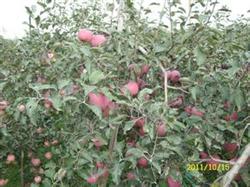 To enable young apple trees to bear fruit earlier, the key in the early stage is to supply sufficient soil, fertilizer, and water, thereby ensuring all the nutrients needed for vegetative growth, expanding the canopy as quickly as possible, and developing reasonable fruiting branch groups; in the later stage, the main task is to transform vegetative growth into reproductive growth, while producing nutrients through effective photosynthesis with a suitable tree shape, and through supplementary measures such as bud notching, shoot twisting, and branch bending to moderate tree vigor and allow new shoots to develop more fully and lignify better.
1 Reasonable soil, fertilizer, and water management to promote tree growth
1.1 Large-hole planting, sufficient fertilizer and water. Before planting saplings, it is best to dig the tree pits 2-3 months in advance and sterilize the pit body through direct sunlight. The planting hole should be 80-100 cm long and wide, and about 80 cm deep. When planting, the bottom of the hole should first be filled with topsoil and organic fertilizer. For soil prone to compaction, it is best to mix in 1/3 new sand and apply 0.2 kg of compound fertilizer. The uppermost layer should be filled with subsoil, and water should be applied as appropriate according to soil moisture. Large-hole planting is extremely beneficial to seedling growth. Under normal circumstances, for 1-year-old seedlings after planting, root growth is more than 1 times the growth of new shoots. Loose soil with sufficient fertility is favorable to root growth, while hard and barren soil is unfavorable to root growth. In addition, after large-hole planting, combining autumn base fertilizer application with yearly hole expansion is also key to early fruiting and early high yield of young trees.
1.2 Apply base fertilizer early. Observations in the Jinzhong region show that from mid-August to early October is the peak period of root activity for young apple trees. Within this period, the earlier the base fertilizer is applied, the greater the number of absorbing roots before overwintering. When base fertilizer was applied in mid-August and observed in early November, the average growth of absorbing roots was about 25 cm, with the longest being 45 cm; when fertilizer was applied in early September, the growth of absorbing roots observed in the same period was 15-18 cm. Therefore, we believe that in the Jinzhong region, autumn base fertilizer application from late August to the end of September has the best effect.
2 Select a suitable tree shape according to site conditions
2.1 Sparse-layered spreading form. This tree shape has a relatively obvious central leader, with 5-7 main branches divided into 2-3 layers. It is suitable for deep, fertile soil and varieties with upright branches. The key points of training are: the trunk height at heading is about 1 m, and when soil conditions are poor, the trunk should be left appropriately lower; the distance between main branches should be 1-1.5 m, and their positions and directions must be appropriate; the first lateral branch of the three basal main branches should be about 0.6 m from the trunk. If too close, it will form a gate-like lateral branch. The farther toward the outer canopy, the more the distance between lateral branches should be reduced. Back branches should be properly controlled. Methods for handling back branches are: when a back branch is similar to the extension branch, remove the back branch in time; when the original branch tip is very weak and the direction and angle of the back branch are better, use the back branch to replace the original tip; when the back branch grows well and has already formed flower buds, its growth can be controlled and it can be allowed to bear fruit.
2.2 Natural open-center form. This tree shape has an inconspicuous central leader, with 2-3 main branches in a 2-fork or 3-fork structure. It is suitable for varieties with thin soil and an open canopy. In poor soil areas, keep 3 lateral branches on each main branch; in good soil areas, select and keep another 1-2 secondary lateral branches on each lateral branch. During training, tree vigor should be balanced, lateral branches at all levels should retain a certain growth advantage, and space should be used reasonably.
2.3 Upright cylindrical form. The main and lateral branches of the upright cylindrical form are relatively short and arranged in layers or spirals on the central trunk. This can make full use of space and is suitable for areas with high mountains, deep gullies, and insufficient light, as well as for varieties with strong upright growth.
3 Other supplementary measures
In spring, for varieties that produce few new shoots, bud notching can be carried out to increase the germination rate and lay the foundation for producing a large number of fruiting branches. After mid-April, when new shoots grow to about 20 cm, twist them 180° at the red-green boundary of the new shoot to weaken growth vigor and promote flower bud formation. In mid-September, according to the requirements of the tree shape, pull the required main branches flat with thin strings. Before pulling, first soften the branches by pulling. Other useless branches should be removed during winter pruning. By pulling branches, the apical dominance of the branches is weakened, so that tree nutrients are distributed evenly to each bud.