Detailed Explanation of Dwarfing Grafting and Cultivation Techniques for Sweet Cherry
Cherry trees are tall and not suitable for growing in greenhouses; under natural conditions they need 5 to 6 years to bear fruit, and only after 10 years do they enter the full production period, resulting in a long investment-return period and high management costs. After years of exploration, fruit tree experts in China developed a method using Nanking cherry (Prunus tomentosa) as the rootstock, FL-80 plum as the interstock, and grafting sweet cherry varieties onto it, ...
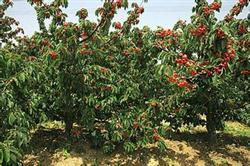
Cherry trees are tall and not suitable for growing in greenhouses; under natural conditions they need 5 to 6 years to bear fruit, and only after 10 years do they enter the full production period, resulting in a long investment-return period and high management costs. After years of exploration, fruit tree experts in China developed a method using Nanking cherry (Prunus tomentosa) as the rootstock, FL-80 plum as the interstock, and grafting sweet cherry varieties onto it. This method offers the advantages of early fruiting, high and stable yields, disease resistance, and a dwarfed tree body, providing a favorable foundation for protected cultivation and container cultivation of sweet cherry.
Advantages of dwarf sweet cherry:
1. Planted in the same year, flower buds form in the same year, and more than 95% bear fruit in the second year, 3 to 5 years earlier than standard sweet cherry; in the fourth year it enters the semi-full production period, and in the fifth year the yield per 667 sq m can reach 2000 kg; this dwarf sweet cherry easily forms flower buds, has a high fruit-setting rate, and is very stable in yield.
2. The tree body is short and compact, with a tree height below 2.5 m, making pruning, spraying, fruit-cracking prevention, and harvesting all convenient; no paclobutrazol is needed for control, reducing tree injury and tree death; suitable for close planting.
3. Using the root system of Nanking cherry, which is well developed, cold-resistant, drought-resistant, waterlogging-tolerant, not demanding regarding soil pH, and highly resistant to crown gall, thereby expanding the cultivation area.
4. Improves fruit quality and solves the problem of low yield and poor quality in facility cultivation of dwarfed nursery stock. Because no paclobutrazol is used, the fruit taste is noticeably enhanced, with sugar content 1% higher than that of standard cherry.
Nursery stock cultivation of dwarf sweet cherry:
1. Rootstock selection Wild cherry root systems are the preferred root system, because they have the advantages of resistance to gnawing by underground pests, strong cold resistance; strong tolerance to drought and waterlogging, relatively strong tolerance to acidity and alkalinity, tolerance to root injury from fertilization, tolerance to fertilizer damage, good resistance to ***, well-developed root systems, and long tree lifespan. Wild apricot and wild peach root systems can also be used, but these two root systems are less tolerant to waterlogging and are only suitable for cultivation on plots that do not become waterlogged. The above 3 root systems are all superior to Shandong Cao Ying, Da Qing Ye, Benxi Mountain Cherry, and Colt, thoroughly solving the difficult problem of serious tree death caused by poor root systems.
2. Nursery stock grafting Sow Nanking cherry (also called wild cherry) seeds in spring. In August to September of the same year, use Nanking cherry as the rootstock, and graft a current-year plum scion of a thickness comparable to the rootstock onto the rootstock at 2 to 4 cm above the ground, with the T-shaped budding method giving the best results. After 6 to 7 months, that is, in March to April of the second year, cut the rootstock at 0.5 to 1 cm above the upper end of the junction between the plum bud and the rootstock and remove the binding rope from the bud, then promptly wipe off any newly sprouted shoots from the rootstock. In June to July of the same year, use the plum bud as the interstock, and graft a current-year cherry scion of a thickness comparable to the interstock onto the interstock by budding. The bud should be 2 to 3 cm above the upper end of the junction between the interstock and the rootstock, and a certain length of the interstock should be retained while the rest is cut off. When the cherry bud grows to 14 to 16 cm, cut the interstock at 0.5 to 1.5 cm above the upper end of the junction between the cherry bud and the interstock and remove the binding rope from the bud. At this point, the grafting of the entire dwarf sweet cherry nursery stock is completed. After that, fertilization and pesticide application should be carried out until the nursery stock is lifted in early November.