Key Technical Points for Early, High-Yield and Efficient Cultivation of Sweet Cherry
1. Selection of Orchard Site Based on the characteristics of sweet cherry, such as drought tolerance, poor waterlogging tolerance, poor cold tolerance, poor saline-alkali tolerance, and shallow root system, the sweet cherry orchard site should be selected in areas with deep soil layers, loose loam or sandy loam soil, low groundwater level, no water accumulation, good drainage and irrigation conditions, and not prone to wind damage. In areas with high groundwater level, overly heavy soil...
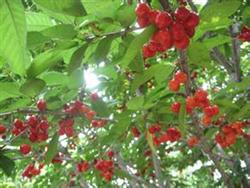
1. Selection of Orchard Site
Based on the characteristics of sweet cherry, such as drought tolerance, poor waterlogging tolerance, poor cold tolerance, poor saline-alkali tolerance, and shallow root system, the sweet cherry orchard site should be selected in areas with deep soil layers, loose loam or sandy loam soil, low groundwater level, no water accumulation, good drainage and irrigation conditions, and not prone to wind damage. Sweet cherry should not be planted in areas with high groundwater level, overly heavy and sticky soil, heavy summer rainfall that cannot be drained in a short time, or high pH value.
2. Main Cultivars and Pollination Cultivars
At present, the cultivars widely promoted in the Dalian area are Hongdeng, Hongmi, Hongyan, Jiahong, and Juhong, bred by the Dalian Academy of Agricultural Sciences. Cultivars being promoted include Zuishangjin, Gaosha, Zuotengjin, and Shamidou. These cultivars have excellent quality, attractive appearance, and high economic value. Generally, Hongdeng is used as the main cultivar. The proportion of pollinator trees should generally not be less than 30%. If 3 main cultivars can pollinate each other, each should account for 1/3. The pollinator cultivars that can be configured for different main cultivars are shown in Table 1.
Table 1 Main Cultivars and Pollination Cultivars of Sweet Cherry
Main Cultivar
Pollination Cultivar
Hongdeng
Hongmi, Bingku, Dazi, Jiahong
Dazi
Yantai No.1, Shuijing, Hongfeng, Naweng, Bingku
Naoweng
Dazi, Leini, Xianfeng
Leini
Naoweng, Bingku
Hongmi
Hongdeng, Hongyan, Zuishangjin
Hongyan
Hongdeng, Hongyan, Zuishangjin
Zuishangjin
Hongmi, Hongyan, Hongdeng
Nanyang
Shamidou, Zuotengjin, Beiguang
Zuotengjin
Nanyang, Shamidou, Zhengguangjin
Shamidou
Nanyang, Zuotengjin
Zhengguangjin
Nanyang, Zuotengjin
Dongxiangjin
Hongdeng, Zhengguangjin
3. Planting
Planting is generally carried out in spring after the soil thaws and before the seedlings bud. In the Dalian area, planting in late March results in a relatively high survival rate. Per 666.7 sq m, 83 trees can be planted (spacing 2 m x 4 m) or 56 trees (spacing 3 m x 4 m). Dig planting holes of 0.5 sq m according to the spacing, apply 30 kg of organic fertilizer per hole, and fill the hole with soil. Seedlings should be healthy 1-year-old seedlings free of injuries and diseases, with a well-developed root system, and should be trimmed. Before planting, soak the roots in water for 12 h, then dip the roots in ABT rooting powder solution. When planting, the graft union should be slightly above the ground; after watering and settling, the union should be level with the ground, then cover with plastic film. After trunk heading, cover with a plastic bag to enclose the shaping zone, tie the lower opening, which can prevent insects and also improve the survival rate.
4. Training and Pruning
The tree shapes generally selected for sweet cherry are the improved spindle shape and the multi-axis extension shape.
Improved spindle shape: heading height 40 cm. From early June to early August, keep one upward upright-growing new shoot as the central leader, and cut all other new shoots back to about 30 cm. The following spring, cut the central leader back to 60 cm, and cut the main and lateral branch leaders back 30-40 cm. From early June to early August, keep one upward upright-growing new shoot as the central leader, and cut the other new shoots back to 30 cm. Repeat 2-3 times, and in autumn bend the new shoots to a horizontal position. The third year is the same as the second year. The tree can be formed in 3 years, with a trunk height of about 40 cm, tree height of 2.5-3.2 m, 8-10 main branches on the whole tree, and 10-15 large fruiting branch groups directly borne on each main branch. This tree shape can rapidly increase the number of branches, has strong three-dimensional fruiting capacity, and high population efficiency. For 4-year-old trees, the branch number per 666.7 sq m can reach about 60,000, very suitable for cultivars such as Hongmi and Zuishangjin, which have a high germination rate, strong branching ability, and moderate tree vigor. In the 4th year, the yield per 666.7 sq m was 257.3 kg and 229.9 kg respectively, and in the 7th year, 1950.5 kg and 1625.8 kg.
Multi-axis extension shape: heading at about 45 cm. In mid-June of the current year, keep one upright upward-growing new shoot as the central leader; when the others grow to more than 30 cm, cut them back to 20-30 cm. The following spring, cut the central leader back to 50-60 cm, and cut the main branches back to 20-30 cm. In June-July, cut the vigorous new shoots of the first layer back to 20-30 cm. For the second layer of new shoots, except for one central leader that is not cut, cut the rest back to 20-30 cm. In August-September, bend the branches. For vigorously growing cultivars such as Hongdeng, the bending angle should be large (90 degrees or downward-sloping). For cultivars with moderate growth vigor such as Hongmi and Zuishangjin, the angle should be slightly smaller (70-80 degrees). The third year's pruning is the same as the second year. The tree can be formed in 3 years, with a tree height of 2-2.5 m, 12-15 main branches on the whole tree, 2-3 lateral branches on each main branch, and fruiting branches directly borne on the main and lateral branches. The tree is short and suitable for close planting. For upright cultivars with strong vigor such as Hongdeng, this tree shape can quickly bring the tree into the full fruiting period. In the 4th year, the yield per 666.7 sq m was 121.18 kg, and in the 7th year, 888.1 kg. For cultivars with moderate growth such as Hongmi and Zuishangjin, although they enter the fruiting period early, yield declines in the later stage and the tree body declines prematurely, so this shape is not suitable.
5. Water and Fertilizer Management
In the Dalian area, sweet cherry needs 4 irrigation periods per year. After petal fall, when the fruit is the size of a soybean (mid-to-late May), irrigate the "hard pit water." At this time, the sweet cherry tree has the most vigorous growth and development and is most sensitive to water. Irrigation can greatly reduce fruit drop (fruit drop rates with and without irrigation were 11% and 31% respectively), increase yield and quality, so irrigation should be frequent and sufficient. Around early June is the rapid fruit enlargement period; timely irrigation can increase yield by 30%-40%. After fruit harvest, flower bud differentiation is the main process. To restore the tree and ensure normal flower bud differentiation, fertilizer and water should be applied immediately after harvest, but the irrigation amount should be only enough to wet the soil surface. A short period of drought after irrigation is beneficial to flower bud differentiation. During the sweet cherry growing season, irrigation should not be excessive; generally, soil moisture should be maintained at about 70% of field capacity. In early November, irrigate "freezing water," and the amount should be sufficient. Three fertilizer applications should also be made well. Spraying 0.3% urea + 0.1%-0.3% borax + 600-fold monopotassium phosphate solution at flowering can increase the fruit-setting rate by 13.1%, and the fruit-setting rate of Zuishangjin cherry can be increased by 39.7%. About 10 d after sweet cherry fruit harvest, apply 200 kg per 666.7 sq m to fruiting trees, and 100 kg compound fertilizer plus about 2000 kg decomposed human manure and urine to young trees. In autumn, during the second root growth peak, apply 5000 kg organic fertilizer per 666.7 sq m, which can increase the stored nutrients in the tree.
6. Supplementary Pollination
Sweet cherry is a fruit tree with low self-fruitfulness. On the premise of configuring sufficient pollinator trees, supplementary pollination must be carried out. It can generally increase the flower fruit-setting rate by 43.2%, and releasing bees at flowering can increase it by 39.7%.
7. Application of Growth Regulators
3-4-year-old young sweet cherry trees generally have excessively vigorous vegetative growth. For cultivars such as Hongmi, Zhengguangjin, and Shamidou, summer pruning can effectively control their vegetative growth, balance reproductive growth and vegetative growth, and achieve the goal of early fruiting and early high yield. However, for cultivars with a tendency toward upright tree posture such as Hongdeng, although measures such as branch bending, delayed pruning, shoot tipping, and repeated pinching were adopted, their growth still could not be controlled, and the proportion of long branches still accounted for more than 30%, affecting flower bud formation on medium and short fruiting branches. In mid-August each year, 15% PP333 can be applied to the soil within the crown projection area of Hongdeng trees at 5 g/tree (5 sq m). On average, this can cause each lateral branch to form 9.6 more medium and short branches and 12.7 more flower buds, bringing the trees into the fruiting period earlier.
8. Overwintering Protection
Sweet cherry is a fruit tree that prefers warmth and is not cold-tolerant. It is prone to freezing injury at low winter temperatures, and after freezing it is very prone to shoot shriveling. This problem can be solved by using the antifreeze wax protective agent produced by the Jinzhou Paraffin Factory. From late November to early December, after the tree body has undergone cold hardiness acclimation, spray the whole tree with a concentration of 5 parts warm water to 1 part stock solution. For 2-year-old Hongdeng trees, the shoot shriveling rate of 1-year-old branches decreased from the original 34.4% to 1.6% (average of 5 trees).