What are the key points to note for summer pruning of cherry trees?
Pinching new shoots: To promote flower bud differentiation and prevent excessive vegetative growth, the method of pinching new shoots should be adopted for control. That is, pinch the new shoots that have not stopped growing, and the pinching position is generally at the half-leaf mark; after pinching, growth stops for 10 to 15 days and then secondary shoots emerge, and when they grow to 15 to 20 cm, a second pinching is carried out, at...
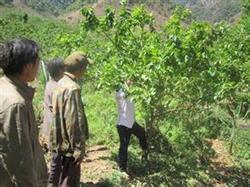 I. Pinching. Its purpose is to control vigorous shoot growth, increase the number of branches and branching order, promote the transformation of branch types, and expand the canopy. This measure is mainly used on young trees and vigorous trees. The best time for pinching is during the rapid growth period of new shoots; when the new shoots reach about 20 to 25 cm in length, the tender tips can be pinched off. If the tree is vigorous and the secondary shoots after pinching are still very vigorous, a second or third pinching can also be carried out. Timely pinching is an effective measure to promote early fruiting and early high yield of young cherry trees.
II. Branch bending. The purpose of branch bending is to adjust the angle of scaffold branches or auxiliary branches, moderate tree vigor, and promote early fruiting. Branch bending is carried out after the beginning of spring or after the fruit harvest in June. After one growing season, once the angle is basically fixed, the pulling ropes are untied. When bending branches, care should be taken to prevent large branches from splitting, and also to prevent the support point of the bent branch from being too high and the middle of the bent branch from arching upward, which causes a small waist angle or water sprout formation.
III. Thinning and heading back after fruit harvest. After cherry harvest, pruning should be carried out to adjust the tree structure and improve ventilation and light penetration inside the canopy. The pruning methods are mainly thinning and heading back. For vigorous large branches that seriously affect ventilation and light penetration inside the canopy and have no value for retention, they can be thinned from the base; for large branches that only affect local light in the canopy but still have some fruiting capacity, they can be headed back at a larger branch with a relatively wide branching angle and growth capacity; in specific handling, heading back is mostly used for large branches of lower order, while thinning can be carried out for branches of higher order.
In addition, from late May to early June, when new shoots have not yet become woody, twist the shoots of upward vertical branches on the back, competitive branches, and inward-growing vertical branches to facilitate flower bud formation and lay a good foundation for high-quality and high-yield production next year.