A Complete Analysis of the Key Technical Points of Cherry Cultivation
(1) Soil management. For soil management, a good foundation must first be laid before planting, and the soil must also be continuously improved after planting. 1. Expanding the planting hole and deep plowing. The method is to start from the edge of the planting hole and expand outward every year or every other year, digging a ring-shaped trench about 50 cm wide and 60 cm deep, until the deep plowing trenches between two trees connect. Deep plowing...
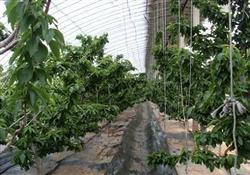 As the saying goes: cherries are delicious, but the trees are hard to grow. The difficulty of growing the trees is mainly determined by the characteristics of the cherry root system. The cherry root system is very shallow, so it is very afraid of drought; the root system has a relatively high respiration intensity and needs more oxygen than other fruit trees, and it is also most afraid of waterlogging. If water accumulates for even a slightly long time during the rainy season, it will affect root respiration, causing yellow leaves in mild cases and death in severe cases. If you want to plant cherries successfully and grow them well, you must do a good job in site establishment, planting, and the water management that follows.
1. Site selection. Choose a plot with high terrain, where water does not easily accumulate, and with a relatively low groundwater level, with neutral or slightly acidic sandy loam soil that is deep and has good aeration. If the soil quality is poor, deep plowing should be carried out before establishing the orchard, and soil improvement measures such as increasing the application of organic fertilizer should be taken, because cherries have very high requirements for ecological conditions. Only deep, active soil layers and relatively strong soil fertility can make the cherry root system well developed, the tree vigorous, and stress resistance strong, resulting in high fruit quality and yield. This is especially true for the soil in the root zone, which is very difficult to improve after planting and orchard establishment.
2. Irrigation and drainage design. There must be good irrigation and drainage facilities around the orchard to ensure timely watering during drought and timely drainage to prevent waterlogging during the rainy season. For newly built orchards, the main ditches and branch ditches should be scientifically designed. For orchards built on plains or large plots, ridge planting is best so that the ridge furrows can be used for irrigation and drainage. When water is applied through the ridge furrows, lateral seepage to the roots can also avoid soil compaction around the roots after watering, which is beneficial for seedling recovery and root development.
3. Scientific planting
1. Planting time: Cherries are best planted in autumn, because northern regions have spring drought, and traditional spring planting increases the difficulty of water management. Moreover, if spring planting is too early, the temperature is unstable and the plants are prone to frost damage; if spring planting is too late, buds sprout quickly while roots grow slowly, which can cause seedling death. With autumn planting, the plants can recover and sprout and grow in that same season, and in the following spring they sprout and branch early, making it easy to form strong seedlings. After autumn planting, before the soil freezes, soil should be mounded up to prevent freezing.
2. Planting method: The "small hole, deep planting, shallow burying method" should be used. The traditional fruit tree cultivation method of digging large holes is not suitable for cherries, because cherry roots are shallow and cannot tolerate waterlogging. If cultivated in large holes, the soil in the holes is looser than the soil around the holes, and waterlogging is likely to occur during the rainy season, causing seedling death in severe cases. The "small hole, deep planting, shallow burying method" means digging out three or four shovelfuls of soil, applying two shovelfuls of mixed manure, loosening the soil at the edge of the hole and mixing it evenly with the mixed manure in the hole, then placing the seedling (choose a thick, strong seedling with a well-developed root system), and covering with a layer of shallow soil just enough to bury the original soil mark on the roots. Then press the soil slightly firm so that the root crown is about 15 cm below the ground surface, forming a small tree hollow beneath the seedling. In this way, "deep planting" lowers the seedling's center of gravity and helps resist lodging, while "shallow burying" is good for root respiration, allowing the seedling to recover quickly and grow well.
3. Water management. After planting, water frequently, but avoid heavy watering. Combine this with the weather: during drought, water often with a small amount; during waterlogging, actively drain water, keeping the soil surface in the root zone alternating between drying and moistening.