Detailed Explanation of Hanging Vine Cultivation Techniques for Watermelon in Solar Greenhouses
Cultivation seasons: Early spring cultivation. Sow and raise seedlings in mid-to-late February, seedling age 35-40 days, use heated seedling raising, transplant into the greenhouse in early-to-mid April, go to market in early June. Autumn delayed cultivation. Sow in late July, seedling age about 20 days. Cover the greenhouse film in early September, add heat-preserving straw curtains in late September, go to market around October. Winter-spring cultivation...
Cultivation seasons: Early spring cultivation. Sow and raise seedlings in mid-to-late February, seedling age 35-40 days, use heated seedling raising, transplant into the greenhouse in early-to-mid April, go to market in early June. Autumn delayed cultivation. Sow in late July, seedling age about 20 days. Cover the greenhouse film in early September, add heat-preserving straw curtains in late September, go to market around October. Winter-spring cultivation. Sow in early October, begin harvesting melons at New Year's Day, finish harvesting after Spring Festival.
Selection and Treatment of Excellent Varieties
Select medium-early maturing varieties with tolerance to low temperature, tolerance to weak light, and good fruit-setting ability as scions, such as Texiaofeng, Fengguang, Xiaolongnv, Xiaobawang, etc. For rootstock, bottle gourd, calabash gourd, or black-seeded pumpkin can be used. First soak seeds in warm water: use warm water at 50°C in an amount 5 times the seed quantity, pour in the seeds and stir continuously until the water temperature reaches 30°C, soak for 24h, remove and place under 30°C conditions to promote germination; sow once the radicle emerges.
Preparation of Nutrient Soil
The nutrient soil is best composed of high-quality garden soil that has not grown watermelon for over 10 years and fully decomposed fine dry manure, each accounting for 50%, plus a small amount of finely crushed diammonium phosphate. If the garden soil is clay loam, about 1/3 of the total should also be added as cinder ash. Spread the prepared nutrient soil into a seedling bed 10cm thick.
Key Points of Grafting Technology
For grafted seedling cultivation of watermelon in solar greenhouses, locally bottle gourd and calabash gourd are generally used as rootstock. Grafting is best done on windless, sunny, warm days. 1-2h before grafting, water the rootstock and scion thoroughly, and prepare bamboo skewers, blades, grafting clips, nutrient pots, etc. Nutrient pots are 8cm in diameter, 10cm high, filled with 9cm of nutrient soil. Grafting methods include the approach grafting method and the insertion grafting method.
Approach Grafting Method
Sowing time: When sowing, watermelon should be sown 5-7 days earlier than the rootstock (bottle gourd, calabash gourd). Both rootstock (bottle gourd, calabash gourd) and watermelon seeds are soaked in warm water to promote germination, and sown separately in seedling beds. The bed soil should be loose, and the plant spacing should be larger to prevent injury when lifting seedlings.
Optimal grafting time: 10-12 days after sowing watermelon, when the first true leaf unfolds. Rootstock is generally grafted 3-5 days after sowing, when the two cotyledons unfold.
Grafting method: First lift the rootstock and watermelon seedlings from the seedling bed, injuring the roots as little as possible. Using an alcohol-sterilized bamboo skewer or blade, remove the rootstock's growing point and true leaves, and at about 1.5cm above the hypocotyl, about 1.5cm from the cotyledons, cut downward at a 30° angle, making an upward-slanting cut about 3/5 of the stem thickness. Place the cuts of the rootstock and scion together, with watermelon leaves on top and rootstock leaves below, preferably with the 4 leaves crossing in a cross shape, fix with a grafting clip, and immediately plant in nutrient pots and place in the seedling bed. When planting, note to separate the roots of the two seedlings and orient the watermelon roots in one direction, so that the watermelon roots can be cut later; plant at a spacing of 10cm×70cm. After planting, water promptly, insert bamboo arches and cover with film to raise temperature and retain moisture, promoting wound healing.
Insertion Grafting Method
Insertion grafting requires the rootstock to be sown 2-3 days earlier or at the same time. Generally, it is done 7-8 days after sowing watermelon, when the rootstock's first true leaf unfolds and the watermelon's two cotyledons unfold. During grafting, first use a sterilized bamboo skewer to remove the rootstock's growing point, axillary buds, and true leaves, then use the bamboo skewer to pierce downward 0.5-0.8cm from the base of one side leaf, without piercing through the outer epidermis of the hypocotyl. Then lift the watermelon seedling from the seedling bed, use a blade to cut downward from about 1-1.5cm below the cotyledons into a slanted surface, insert it with the slanted surface facing down into the rootstock, fix well with a grafting clip, and plant into the seedling bed.
Management of Grafted Watermelon Seedlings
The environmental management after grafting watermelon seedlings directly relates to the survival rate. Therefore, suitable environmental conditions must be created. To accelerate the healing of the graft union and the growth of seedlings, the main things to control are suitable temperature, humidity, light, and ventilation conditions.
Temperature Management
The suitable temperature for graft healing is about 28°C. After grafting, seedlings should immediately be planted into small arches. After the grafted seedlings are fully arranged, promptly press down the film around the edges to preserve temperature and moisture. Seedling bed temperature generally within 1-3 days after grafting: daytime 23-30°C, ground temperature 24-28°C, nighttime 18-20°C. After 4-6 days, begin ventilation and appropriately lower the temperature; daytime can be reduced to 22-28°C, nighttime to 15-18°C, ground temperature 20-25°C. After 10 days, daytime 23-25°C, nighttime 10-12°C, ground temperature reduced to 15-18°C.
Humidity Management
After grafting, the seedling bed should maintain suitable humidity to prevent the scion from losing water and wilting, which would affect the survival rate. However, 3-5 days after grafting, the humidity inside the arch should not be too high; it should be controlled at 85%-95% to prevent seedling rot.
Light Management
Initially, to prevent excessive temperature inside the seedling bed and to maintain seedling bed humidity, cover the outside of the small arch with sparse straw curtains and shade nets for shading, to prevent direct sunlight from causing seedling wilting. Insertion-grafted seedling beds especially need attention to shading and sun protection. When the temperature is on the low side, more light should be given to promote wound healing. Generally, 2-3 days after grafting, the covering can be removed in the morning and evening to receive scattered light, and shading should be covered before noon. After 7 days, shading can be discontinued.
Ventilation Management
Ventilation should be carried out 3-5 days after grafting when the grafted seedlings begin to grow. Initially, the ventilation volume should be small, gradually increasing. After 8-10 days, carry out large ventilation to lower temperature and harden the seedlings. However, attention should be paid to the growth of the seedlings. If wilting is found, ventilation should be stopped, and shading and water spraying should be applied.
After the grafted seedlings survive, the watermelon roots should be cut off promptly after 15 days. Generally, grafted seedlings can be transplanted when they have 4 leaves and 1 heart. After transplanting, when normal growth occurs, the grafting clips can be removed.
Cultivation Management: Transplanting
Apply 5000kg of high-quality organic fertilizer, 50kg of cake fertilizer, and 50kg of diammonium phosphate per 667 sq m, then deep plow and rake level. For hanging vine or trellis cultivation, plant spacing is 40cm×(90-100)cm, with 1600-1800 plants per 667 sq m.
Temperature Management
After transplanting and before fruit setting, focus on seedling control; maintain daytime 23-27°C, nighttime 13-15°C. After vines extend, hang strings. After mid-November, the weather gradually turns cold, so great attention must be paid to heat preservation, maintaining daytime 25-30°C, nighttime 14-17°C.
Fertilizer and Water Management
From transplanting to flowering is the period for promoting vine growth, requiring appropriate application of quick-acting chemical fertilizers to promote moderate growth of stems and leaves. Especially after the plant has formed a full cluster, decide whether and how much to fertilize based on leaf color, so that the plant can develop a suitable leaf area as quickly as possible. Grafted seedlings have well-developed root systems and strong absorption capacity, so they should be given appropriately less quick-acting nitrogen fertilizer than own-rooted seedlings to prevent excessive stem and leaf growth, which would delay flowering and fruit setting. After fruit setting, the root growth of grafted seedlings slows down, and the difference from own-rooted seedling roots becomes smaller and smaller. Due to fruit expansion, more and more water and nutrients are needed, so a heavy fertilization should be carried out. Fertilization is generally done 4-6 days after female flower pollination and fertilization, when the young fruit grows to the size of an egg, the surface fuzz gradually falls off, and the fruit surface shows obvious luster. This indicates that the watermelon has set and generally will not drop fruit again. Loss of fuzz also indicates that the watermelon has begun to enter the rapid fruit expansion stage. At this time, apply chemical fertilizer with irrigation water, using 20-30kg of compound fertilizer per 667 sq m. In the later stage, foliar fertilization is mostly used, spraying a mixed solution of 0.3% urea plus 0.2% potassium dihydrogen phosphate on the leaves, and watermelon-specific growth regulators and pesticides for disease and pest control can also be added at the same time.
On the basis of watering at the transplanting hole, after seedling recovery, water once heavily along the furrow, then pay attention to hoeing and soil moisture conservation. During the full cluster stage, combined with fertilization, water appropriately in the furrow of the cultivation bed to promote rapid plant growth. If the plant grows vigorously and is not lacking water, watering can be omitted, but whether water is lacking should not be judged only by the soil surface (surface moisture is often only an illusion), but should be judged from the plant's appearance and growth vigor. During the fruit expansion stage, water demand increases, generally requiring 2-3 waterings. Stop watering in the late fruiting stage to prevent low sugar accumulation, which would affect watermelon quality.
Plant Adjustment
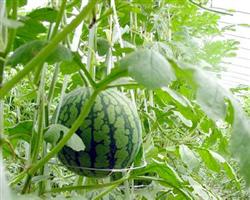
Three-vine pruning, retaining the main vine and 2 side vines. Use nylon strings to hang the vines. Because Shouguang solar greenhouses have three east-west tensioned steel wires (No. 24 or No. 26 steel wire) specially for hanging vines, on the east-west tensioned hanging frame steel wires, set up north-south trellis wires along the watermelon rows according to the row spacing in the greenhouse (generally using No. 14 iron wire); on the along-row trellis wires, hang nylon strings extending down to near the ground as hanging strings according to the plant spacing in that row. The lower ends of the hanging strings are tied to short bamboo poles inserted deeply between the plants, with the short bamboo poles 20-30cm above ground. When manually guiding vines onto the trellis, gently tie the watermelon vines loosely to the hanging strings. The main advantage of hanging vines is: by moving the distance between adjacent trellis wires set on the east-west tensioned hanging frame steel wires, the row spacing of the trellis stems and vines can be adjusted; and by moving the distance between adjacent hanging strings on the trellis wires, the plant spacing of hanging vines can be adjusted. In this way, stems and leaves can be distributed evenly, making full use of space and improving light transmission conditions between rows and plants. Protected cultivation must use artificial pollination, and a mark should be made after pollination. When setting fruit, remove the first female flower on the main vine; the rest can all set fruit, retaining 2-3 fruits per plant. The fruiting vine should be topped after 10-12 leaves before the young fruit. After the melon expands to about 2kg, use a straw ring or net bag to hang the melon up.
Management During Disastrous Weather
Disastrous weather refers to continuous cloudy rain, low temperature, strong wind, heavy snow, etc. under external environmental conditions that cause harm to winter warm greenhouse production. Cloudy rain, snow, and strong wind weather affect the normal growth of watermelon in the greenhouse during the overwintering period. The harm of disastrous weather is mainly freeze injury and "light starvation" seedling death caused by weak light. After disastrous weather occurs, active protective measures should be taken according to the situation to prevent unnecessary losses in the greenhouse. Protective measures for low-temperature freeze injury. During continuous cloudy days, first strengthen heat preservation, add straw curtains or rainproof insulation film to reduce temperature consumption in the greenhouse. When the temperature inside the greenhouse drops below 8°C, temporary heating should be considered. There are many heating methods, such as coal stove heating with a smoke exhaust pipe, charcoal brazier heating, and electric heating wire heating. When heating, pay attention to safety; first prevent gas (carbon monoxide) poisoning. When using a coal stove or charcoal brazier for heating, pay attention to the concentration of harmful gases and discharge them promptly. Some people mistakenly believe that burning charcoal does not produce gas, and when heating the greenhouse, take no protective measures, leading to poisoning incidents among operators. When using electric heating, prevent miswiring and broken wires that could cause casualties.
Management measures for insufficient light: On cloudy, rainy, and snowy days, do not fail to pull open even the straw curtains just to preserve heat, covering continuously for 4-5 days; this is extremely unfavorable to watermelon and will cause seedling death from light starvation. On cloudy days, the curtains should be opened; on rainy and snowy days, open the curtains as much as possible, and you can open one every other one, allowing a small amount of scattered light to enter, which is relatively beneficial. If conditions permit, hanging light bulbs in the greenhouse for supplemental lighting has a certain effect.
When encountering continuous cloudy and snowy weather for more than 4-5 days followed by sudden clearing, never open the straw curtains early or all at once, to prevent sudden temperature rise and sudden increase in light, which would cause "flash seedlings" and dead plants. Use "flower curtains" and spray warm water to prevent flash wilting and dead plants. That is, appropriately delay the time for opening straw curtains to receive light, and open one straw curtain every 1 or 2 curtains, so that the cultivation bed area in the greenhouse receives light and shade in alternating sections. When watermelon plants exposed to sunlight show wilting, immediately spray warm water at about 15°C, and re-cover the opened straw curtains while opening the still-covered straw curtains. Manage this way for one daytime, and the next day the straw curtains can be opened according to routine management, and there will be no wilting or flash seedlings. Shouguang vegetable farmers call this technique "continuous cloudy days, open flower curtains, spray warm water, prevent flash seedlings."
Disease and Pest Control
The main diseases and pests are: seedling-stage diseases such as damping-off and sudden wilting; during the growing period mainly viral disease, gummy stem blight, and anthracnose; pests mainly aphids. Chemical control should be adopted, with emphasis on prevention over treatment. For damping-off and sudden wilting, use 72.2% Previcur AS at 400 times dilution; for viral disease, use 20% Virus A powder at 500 times dilution; for gummy stem blight, use 40% DuPont Fuxing EC at 8000 times dilution; for anthracnose, use 60% Tanjuling at 600 times dilution; for aphids, use 20% Yibianjing at 2000 times dilution.
Harvest
After fruit setting, 45-50 days later the melon is basically mature and can be harvested and marketed at the appropriate time.