How to manage watermelon after flowering? Remember these three key measures
Hand-pollination. If the flowering and fruiting period of watermelon falls in a cold and rainy season, fruit setting becomes rather difficult. On one hand, cold and rainy weather is unfavorable for the activity of pollinating insects such as bees; on the other hand, heavy rain easily washes away the pollen on the stigma of female flowers or causes the pollen to burst and lose its germination capacity, making it difficult to complete fertilization...
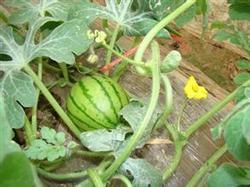
Hand-pollination
If the flowering and fruiting period of watermelon falls in a cold and rainy season, fruit setting becomes rather difficult. On one hand, cold and rainy weather is unfavorable for the activity of pollinating insects such as bees; on the other hand, heavy rain easily washes away the pollen on the stigma of female flowers or causes the pollen to burst and lose its germination capacity, making it difficult to complete the fertilization process. Therefore, hand-pollination is very necessary at this time. The specific method is: according to the local weather conditions, in the afternoon or evening before rainfall, cover the female flowers and male flowers that will open the next day with paper tubes, and when they open the next morning, remove the paper tubes and carry out hand-pollination. When pollinating, first pick off the male flowers, strip off the petals, leaving the anthers, and then gently apply the pollen to the stigma of the female flowers. During pollination, the movements must be gentle, and you must not touch the young fruit with your hands, so as to avoid mechanical damage that affects fruit setting.
After pollination is completed, cover the female flowers with paper tubes. Remove the paper tubes after 3 days, so as not to affect fruit enlargement. When flowering and pollinating, if a short shower occurs, you can, two hours after the rain, apply relatively dry pollen to the stigma of female flowers with no standing water. Generally, if it rains 3 hours after pollination, the effect on fruit setting is not great; if rain occurs in less than 3 hours, pollination should be repeated once.
In rainy weather, you can also pick off the male flowers that are about to open and place them indoors to let them open on their own. Cover the female flowers with tubes, and when pollinating the next morning, remove the paper tubes from the female flowers and take the male flowers that opened indoors for pollination; after pollination, cover the female flowers with tubes for protection.
Proper fruit retention and fruit turning
The choice of the node for retaining the fruit in watermelon has a great bearing on fruit size, yield level and commercial quality. The first female flower on the main vine, because of its low node position, produces small fruit, thick rind and irregular fruit shape, and is generally not retained; retaining fruit at a high node position results in a late ripening period, and the plant's growth often makes fruit setting difficult, so it is also rarely used. In production, the second and third female flowers on the main vine are generally chosen for fruit retention, at about the 15th-20th node. When late-maturing varieties and multi-vine pruning are used, the fruit-retention node can be higher; for early-maturing varieties and early-maturing close planting with few-vine pruning, the fruit-retention node should be lower.
Before and after fruit setting, if unfavorable conditions such as low temperature, drought or insufficient light occur, or if the plant's growth vigor is too weak, the fruit-retention node should be higher. Side vines serve as a backup after fruit setting; when the main vine is damaged and cannot set fruit, the first and second female flowers on the side vines can be selected for retention. The number of fruits retained per watermelon plant varies depending on factors such as cultivation method, variety and planting density. Generally speaking, under medium fertility and water conditions, using medium-fruit varieties, two-vine pruning, and planting 450-500 plants per mu, it is suitable to retain one fruit per plant; for sparse planting, small-fruited varieties, three-vine or multi-vine pruning, and good fertility and water conditions, more fruits can be retained as appropriate.
Turning the fruit means constantly changing the part of the fruit touching the ground, so that the fruit surface receives light evenly, the rind color is uniform, and the flesh ripens evenly. Fruit turning is generally carried out in the middle and late stages of the fruit enlargement period, turning once every 7-8 days, for 2-3 times in total. When turning fruit, note the following: First, the time for turning fruit is best in the afternoon of a sunny day; second, when turning the fruit, follow the lines on the fruit stalk (that is, the vascular bundles) and rotate accordingly. Do not twist forcefully, so as not to break the fruit stalk and stems and leaves; third, when turning the fruit, use both hands, one hand supporting the bottom of the fruit and the other supporting the top, and gently twist with both hands at the same time; fourth, each time turn the fruit gently in the same direction, and the turning angle at one time must not be too large, just enough to turn out the original ground-contact surface.
Judging ripeness and harvesting
The development of the watermelon fruit requires a certain amount of time. Generally, early-maturing varieties need 28-30 days from female flower opening to ripening, medium-maturing varieties need 30-35 days from female flower opening to ripening, and late-maturing varieties need 35-40 days. A watermelon of moderate ripeness is sweet, has good flesh color, crisp flesh with plenty of juice, few fibers, good flavor and good quality. At present, the main methods for judging watermelon ripeness are visual inspection, hand feeling or tapping, marking, and specific gravity.
1. Visual inspection. After the fruit ripens, the rind is hard and glossy, the pattern is clear, the navel end and stalk end of the fruit contract inward and become sunken, the shaded side of the fruit turns from white to yellow and becomes rough, most of the fuzz on the fruit stalk falls off, and the tendrils at 1-2 nodes before and after the fruit-setting node wither, etc. All of these can serve as signs of watermelon ripeness.
2. Hand feeling or tapping. A ripe watermelon feels smooth when touched by hand; an unripe watermelon feels astringent when touched by hand. In addition, when holding the fruit in the hand and knocking or flicking the fruit surface with a finger, if it gives a low, dull thud-thud-thud sound, it is mostly a ripe melon; on the contrary, if it gives a firm dong-dong-dong sound, it is mostly an unripe melon.
3. Marking method. It is based on the fact that each variety needs a certain accumulated temperature and number of days to ripen. After flowering and pollination, individual fruits are marked. According to the accumulated temperature or number of days required for each variety to ripen, the ripening period is calculated. By combining the marking of the fruit-setting date with cutting the fruit open for inspection, it can be ensured that the harvested watermelons reach suitable ripeness.
4. Specific gravity method. The specific gravity of a ripe watermelon and water differs at normal temperature. The specific gravity of water is 1, while that of a generally ripe melon is 0.9-0.95. Put the watermelon into water and observe. If the watermelon sinks completely, it indicates an unripe melon; if a large part floats above the water surface, it means the melon's specific gravity is less than 0.9 and the watermelon is overripe; if only a small part floats above the water surface, it indicates a ripe melon.
In practical application, in order to judge accurately whether a watermelon is ripe, various factors should be considered comprehensively, and it cannot be asserted on the basis of a single factor. The harvest maturity should also be determined according to market conditions. For example, for local supply, melons at nine-tenths ripe can be picked and supplied to the market that afternoon or the next day. For transport and sale elsewhere, melons at eight-tenths ripe can be harvested.
The watermelons currently supplied on the market are poor in quality. Apart from factors such as the variety's own characteristics and mixing and degeneration, harvesting unripe melons is an important reason. Besides lacking experience in identifying watermelon ripeness, this is mainly due to human factors. Some melon growers believe that early-season melons fetch a high price, unripe melons are heavy, and early harvesting benefits later growth and fruiting, without considering that unripe melons affect quality.