Detailed Guide to Key Grape Fruit Management Points in Summer
In July, grapes should be fertilized in a timely manner. Generally, one topdressing is applied at the early coloring stage of the fruit, mainly with phosphorus and potassium fertilizers. A sulfur-based ternary compound fertilizer can be chosen for soil application; foliar topdressing can also be used, with options such as a 0.5%-1% potassium dihydrogen phosphate solution sprayed 2-3 times consecutively. To improve the storability of grape berries, before harvest one can...
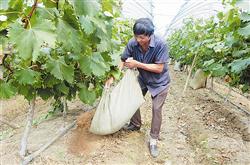 Fruit management is the core of summer management work.
1. During the flowering stage, spray calcium and boron nutrient elements on the leaves and flower clusters to increase the fruit-setting rate and improve fruit firmness.
2. At the bud stage before flowering, pinch off the tips and remove secondary tips so that the shape and size of the fruit clusters remain consistent.
3. When the berries reach the size of peas, thin out undersized berries, inferior and mixed berries, deformed berries, diseased and insect-damaged berries, densely clustered berries, and damaged berries. After thinning, the berries should be uniform and consistent, with 60-80 berries retained per cluster. After fruit and cluster setting, strictly and carefully spray one insecticide and fungicide treatment, and bag promptly after the solution dries. Choose high-quality double-layer paper bags, and remove the bags promptly before harvest to promote coloring.
Pest and Disease Control
Pests and diseases directly affect the normal growth and development of fruit trees, so in summer, grape pest and disease control should be carried out according to climatic conditions. June-July enters the rainy season, which is conducive to the occurrence and spread of many diseases such as downy mildew, white rot, black pox, and anthracnose. Seizing this critical period and reasonably selecting and applying pesticides for control is the prerequisite for controlling multiple disease threats and protecting young clusters, young berries, and leaves.
1. After flowering (mid-June), the key control targets are downy mildew, black pox, and white rot, etc. A single spray of 25% Amistar 2000-fold solution can be used. If rainfall is relatively heavy and humidity is high, and downy mildew, black pox, and white rot occur together, a mixed spray of 68% Jinlei or Medoke 600-700-fold + Score 2000-fold solution or 50% carbendazim 600-800-fold solution can be used.
2. During the fruit cluster formation stage (late June), the key control targets are downy mildew, white rot, and anthracnose, etc. On the basis of the above spraying, protective fungicides can be used for prevention, such as 1:0.7:200 Bordeaux mixture, or 75% Daconil (chlorothalonil), 78% Kebo, etc. at 600-700-fold solution for spraying.
3. The berry enlargement stage (early to mid-July) has entered the flood season and is a critical period for the occurrence of many diseases such as downy mildew, white rot, and anthracnose. Close attention should be paid to disease dynamics and weather changes, and corresponding measures should be taken. If downy mildew occurs, 68% Jinlei or Medoke 600-700-fold solution can be sprayed. If white rot and anthracnose occur, 10% Score 2000-fold solution or 50% carbendazim 600-800-fold solution can be used for mixed spraying. If the above diseases occur together, 10% Score 2500-fold solution mixed with 68% Jinlei or Medoke 600-fold solution can be used for spraying.