Kiwifruit: Guard Against High-Temperature Heat Damage and Protect the Orchard Well
Kiwifruit likes water but fears waterlogging, and likes light but fears scorching sun. In its natural distribution it mostly grows in shaded, moist places, and is almost absent on sunny slopes and in arid areas. Zhouzhi County has a history of more than 20 years of kiwifruit cultivation, and the high temperatures every summer have a very great impact on kiwifruit. Correctly understanding the adverse effects of high temperature on kiwifruit production...
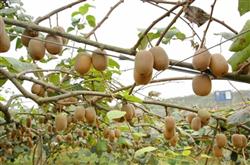
Kiwifruit likes water but fears waterlogging, and likes light but fears scorching sun. In its natural distribution it mostly grows in shaded, moist places, and is almost absent on sunny slopes and in arid areas. Zhouzhi County has a history of more than 20 years of kiwifruit cultivation, and the high temperatures every summer have a very great impact on kiwifruit. Correctly understanding the adverse effects of high temperature on kiwifruit production and taking corresponding preventive measures is of great significance to the development of the kiwifruit industry.
I. Effects of High Temperature on Kiwifruit
1. Effects on leaves. Every year in June and July, when the temperature reaches above 35°C, kiwifruit leaves lose their green color at the leaf margins after 5 hours of intense light exposure, and then turn brown and black. If such high temperature lasts more than 2 days, kiwifruit shows blackened, upward-curled leaf margins, appearing scorched. When sunburn is severe, it can cause early leaf drop, or even kill the tree.
2. Effects on fruit. Sustained high temperature can cause the parts of the fruit surface exposed to sunlight to turn brown and black, and the skin cells to become keratinized, thereby limiting fruit growth. Fruit with mild sunburn is smaller at maturity and has an unclean fruit surface, losing its proper commercial value. In severe cases, the fruit soft-rots or even decays.
II. Patterns of Occurrence of High-Temperature Sunburn
Sunburn caused by high temperature occurs mainly in young orchards that have just started bearing fruit and have weaker tree vigor. According to surveys, under the same conditions, the incidence of sunburn in 3-5 year old orchards can reach 15%-30%; in mature orchards over 5 years old, the incidence is only 2%-3%. Among trees of the same age, those with more than 20 new shoots have an incidence of 50%-8%, while those with fewer than 10 new shoots can have an incidence of 20%-30% or even higher. This shows that the orchard leaf area index is the key factor affecting the degree of sunburn occurrence. In addition, orchard ground management is also an important factor in the occurrence of sunburn. Under the same conditions, orchards overgrown with weeds suffer much less sunburn than clean-cultivated orchards. Mature orchards with grass in the orchard and more than 60% coverage generally do not develop sunburn. Even within the same orchard, individual weak trees develop sunburn while vigorous, healthy trees remain completely undamaged.
III. Causes of High-Temperature Sunburn
1. Related to the special structure of the leaves. Kiwifruit leaves are relatively large, and to a certain extent the leaves can provide shade, but the physiological structure of kiwifruit leaves is rather special. Because its stomata do not have two guard cells, it cannot effectively control the amount of water transpiration from the tree. When the temperature is too high and the water absorbed by the roots cannot meet transpiration needs, the water within the tree loses balance, and the first part to show water loss is the leaf margin, where the stomata are most concentrated.
2. Related to climate and phenological period. Because Zhouzhi is located on the Loess Plateau, the climate is relatively dry, and continuous high temperatures above 35°C begin to appear every June. This period is precisely the peak growth period of kiwifruit fruit; fruit development and new shoot growth both require large amounts of nutrients and water. At this time the leaves are relatively tender and the fruit skin is relatively thin. If nutrients and water are insufficient, the tree will become relatively weakened and its resistance will decrease. Therefore, June and July are the peak period for sunburn occurrence; entering August, the tree has luxuriant branches and leaves, and the maturity of leaves and fruit increases, so sunburn is reduced.
IV. Relationship Between High Temperature and Other Diseases
1. Sunburn and brown spot disease. The symptoms of sunburn and brown spot disease are very similar. In practice, growers often mistake sunburn for brown spot disease and spray pesticides to control it, often resulting in pesticide damage due to excessively high temperatures. In fact, as long as one observes carefully, the two can still be distinguished:
(1) Symptoms of brown spot disease. This disease is a fungal disease. In terms of symptoms, although brown spot disease can also cause leaves to turn black, the disease first produces black spots along the leaf veins and then on the sides, and afterward gradually expands. In the Zhouzhi area, it often begins to occur in August.
(2) Symptoms of sunburn. Sunburn is a physiological disease with no pathogenic bacteria. In terms of timing, it mainly occurs in June-July. The disease develops rapidly, and within a single day the leaf margin can turn black, but the color is lighter than that of brown spot disease; if the leaf margin turns black and curls upward, but the area inside the leaf margin is still green, then apart from pesticide damage and fertilizer damage, it is generally mostly sunburn.
2. High temperature and root rot. Root rot is a devastating disease of kiwifruit, and its pathogens are mainly fungi, as well as bacteria. Because the infected parts are underground, symptoms often appear on the tree only when the disease is severe, and the symptoms on the tree are mainly due to root damage restricting the absorption and transport of nutrients and water, causing the tree to show wilting symptoms and even death. High temperature can intensify the transpiration of kiwifruit, thereby intensifying the contradiction between water supply and demand, causing the tree to repeatedly show leaves wilting during the day and unfolding at night, and finally dying.
V. Measures to Prevent High-Temperature Damage
Adopting a grass-growing system is one of the effective ways to prevent high-temperature damage. According to comparative surveys of clean-cultivated orchards and grass-growing orchards, when the natural air temperature reaches 35°C, the temperature inside a clean-cultivated orchard can reach 45-48°C. The reason the temperature inside the orchard is higher than the natural temperature is that the orchard is affected by both direct sunlight and ground-reflected light, and the air humidity in the orchard is also about 5% lower than natural humidity. In recent years, Zhouzhi has promoted the grass-growing system, advocating and guiding fruit growers to plant hairy vetch in orchards, and the incidence of sunburn has been greatly reduced. The reason is mainly that it reduces reflected light from the orchard floor, lowers the temperature, and increases the air humidity in the orchard. According to measurements, in orchards with grass growing for more than 2 years, the air humidity inside the orchard is 15%-18% higher than natural humidity, and the moisture in the air compensates for part of the transpiration water. In addition, cultivating vigorous trees, retaining branches reasonably, and scientific summer pruning are also good ways to prevent high-temperature damage.