Summary of Experience in Kiwifruit Cultivation and Management Techniques
Bagging kiwifruit is a technique that has been promoted in recent years. Due to insufficient experience, many problems have also arisen. After receiving inquiries from association members, and in order to solve this problem, we investigated the current status of bagged kiwifruit in Zhouzhi and Meixian and identified some problems that urgently need to be solved. 1. Why does fruit drop occur after bagging? Investigation...
 1. Distinguish primary from secondary and select and pair good varieties: Give priority to the late-maturing varieties Hayward and Qinmei, and pair them with the early-maturing variety Hongyang, the mid-maturing varieties Xuxiang, Jinxiang, and Qiuxiang.
2. Standardize tree shape and train a single branch onto the trellis: Use a "T"-shaped trellis. After planting, cut back to the ground in the same year to promote a relatively vigorous, upright single main vine. Pinch the growing tip at 20-30 cm below the trellis surface, select and retain two robust shoots, cross them under the trellis, and fix them to the central wire to train them into two main limbs. On these, train one fruiting mother branch every 30-50 cm, and allow those extending beyond the trellis surface to hang down. Adult trees established by top grafting and with multiple main vines should also be gradually renovated according to the "T"-shaped trellis.
3. Increase organic fertilizer application and apply supplemental fertilizer reasonably: After composting farmyard manure, mix in 50-75 kg of superphosphate and 40-50 kg of ammonium bicarbonate per mu as base fertilizer. Apply 2000-2500 kg per mu in young orchards and more than 4000 kg per mu in mature orchards. Plant hairy vetch in the orchard and build biogas pits, and apply biogas residue to the orchard together with irrigation.
Reasonable supplemental fertilization: Kiwifruit is fertilized 3-4 times throughout the year. Before budbreak, mainly apply nitrogen and phosphorus, with 10-15 kg of urea and 20-30 kg of superphosphate per mu. During the fruit expansion period, in late June for early-maturing varieties and early July for late-maturing varieties, use potassium sulfate compound fertilizer (a three-element compound fertilizer with 15% of each nutrient), applying 35 kg per mu. During the growing season, combine pesticide spraying with 3-4 applications of foliar fertilizers containing trace elements such as calcium, iron, and zinc. The use of swelling agents is strictly prohibited.
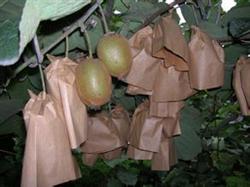
4. Regulate fruit load quantitatively to ensure high quality: For artificial pollination, pick male flowers when they are about to open, take their stamens, place them under constant-temperature dry conditions at 25 degC, and collect the pollen after 24 hours. After female flowers open, the best pollination times are 9-11 a.m. and 15-17 p.m. Methods such as point pollination, flower spraying, and mist spraying can be used. For mist spraying, add 50 g of pollen to 10 kg of a 0.5% sugar water solution, and use it up within 12 hours. For flower and fruit thinning: retain 3-5 fruits per branch, completed in three rounds, to reach 350-400 fruits per tree, with a leaf-to-fruit ratio of 8-9:1. For fruit bagging: spray a fungicide once 10-15 days after flowering, then bag promptly, and remove the bags 15-20 days before maturity for coloring.
Kiwifruit Cultivation and Management Techniques
6. Biological control and pest and disease management:
7. 1 Disease control: In March and April, spray the whole orchard with 3-5 degrees lime sulfur mixture, or Subu 600-800 times solution, or Longkejun 600 times solution to control canker. Use 100-150 ppm agricultural streptomycin or 5% Junduqing 500 times solution to control bacterial flower rot. Spray 40% carbendazim 1000 times solution to control black spot.
8. 2 Pest control: (1) Control of yellow-brown stink bug and brown-marmorated stink bug: remove or crush egg masses on the undersides of leaves. At the end of May, hang repellent stink bug nets in the orchard, hang 40-60 per mu, or use self-made smoke agents and kill by fumigation. (2) Control of spotted lanternfly and green leafhopper: in early spring, crush egg masses on the shaded sides of branches. During periods of heavy larval occurrence, spray Green Kung Fu 2000 times solution. (3) Control of mulberry scale: in winter or early spring, use a worn cloth or bamboo brush to wipe out adults on trunks and branches. At the peak hatching period of nymphs, spray the trunk and branches with 0.5% nicotine and sophora water-based formulation 800-1000 times solution, or spray 4.5% Libi 2500 times solution. (4) Control of small auger beetle and white-spotted flower chafer: spray 2.5% Green Kung Fu 2500 times solution. (5) Red spider mite: spray abamectin, methidathion, or Tianwangxing 3000 times solution. After leaf fall, remove branches carrying mulberry scale, leafhopper eggs, canker, and other pests and diseases during winter pruning, burn them in a centralized manner, and spray 3-5 degrees lime sulfur mixture to thoroughly clean the orchard.