How to identify and control kiwifruit branch blight
Kiwifruit branch blight, also called water-loss branch blight, is a physiological disease caused by climatic factors. It refers to the sudden wilting and death of fruiting canes or vegetative canes when the fruit tree has not suffered artificial fertilizer damage or pesticide damage, nor pathological root rot, branch rot, canker, and other such conditions. 1. Disease symptoms...
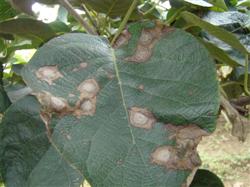
Kiwifruit branch blight, also called water-loss branch blight, is a physiological disease caused by climatic factors. It refers to the sudden wilting and death of fruiting canes or vegetative canes when the fruit tree has not suffered artificial fertilizer damage or pesticide damage, nor pathological root rot, branch rot, canker, and other such conditions.
1. Disease symptoms: The main symptom is wilting of the leaves on canes in the outer part of the canopy, followed by water loss and death of the entire cane, while the fruiting mother canes remain normal. In an orchard, disease affecting the whole orchard or the whole tree is relatively rare; branch blight usually appears in part of an orchard or on part of the canes of a single tree.
2. Time of onset: It generally occurs during the period of rapid new shoot growth of kiwifruit, that is, the spring-summer transition period from April to May. During this period, under spring drought conditions in northern regions, hot dry winds are often prevalent, which brings certain effects on kiwifruit, a broadleaf fruit tree.
3. Pattern of onset: It is generally easily induced during continuous spring drought. There are two conditions for its occurrence: first, spring drought; second, strong wind. Under spring drought conditions, if strong wind of level 6 or above occurs and lasts for more than 5 hours, kiwifruit trees can develop the disease. Young orchards aged 4 years or more that have not yet shaded and closed their rows are affected more severely, because at this tree age the growth vigor is relatively strong, the demand for water is more urgent, while the root system is relatively shallow, the absorption function is limited, and drought resistance is comparatively poor; once strong wind weather occurs, the disease is severe. Orchards with north-south rows are affected more severely, followed by east-west row orientations; border rows are severe, while inner rows are less so. The reason lies in the fact that in the Guanzhong region, east and west winds predominate in spring and summer, and tree rows at different orientations and inner versus outer positions have different wind-exposed surfaces and wind forces. In addition, orchards located in wind-gap areas or scattered orchards are affected more severely, while relatively concentrated contiguous orchards or wind-sheltered orchards rarely develop it, which is directly related to wind intensity.
4. Control measures: First, early pinching. This mainly aims at the outer fruiting canes to control apical dominance, accelerate cane lignification, reduce the windward surface, and improve wind resistance. Second, standardize branch tying. After winter pruning, the fruiting mother canes must be tied one by one and arranged in order, eliminating crossing, overlapping, and crowding, so as to prevent the fruiting canes, after they emerge, from being limited in space and growing densely, shifting in the wind, increasing friction, causing wounds, and reducing wind resistance. Third, pay attention to irrigation. Especially under severe spring drought and wind damage, irrigation is advocated to alleviate the damage to the tree's water physiological balance caused by increased ground evaporation and leaf transpiration under strong winds.