What are the soil requirements for banana cultivation?
Cultivation techniques. Banana is a perennial large herbaceous monocotyledonous plant, whose underground stem is a thick, large corm, from which the roots, stems, leaves, flowers, fruits and suckers (used for propagation) all grow. Banana prefers high temperatures and high humidity; its usual growing temperature is 20-35°C, the optimum temperature is 24-32°C, and the critical temperatures for its various organs are 10-12°C for leaves...
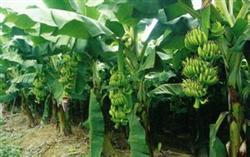 Bananas are not strict about soil conditions; they can grow in all types of soil, whether in plains or mountainous areas. However, the yields under different soil conditions also differ greatly. Plantain, Fenjiao, Niujiao and similar types have thick, robust root systems and relatively strong adaptability, whereas the banana's root system is relatively fine and tender and has stricter soil requirements. Under soil conditions containing clay, compacted, impermeable and lacking nutrients, the plants grow slowly and weakly, bear fruit late, and the yield is low and unstable, or only one harvest is obtained in two years. Saline fields, waterlogged fields and cold-water fields are all unsuitable for planting bananas.
Experience from various places shows that bananas should have the following soil conditions:
1. Good physical properties. Soil with good physical properties has more pores, which facilitates the infiltration of air and water. Whether it is alluvial loam, clay loam, sandy loam or silty loam, and whether it is in a plain area or on a hillside, plots with good physical properties are all suitable for planting bananas. Soil with poor physical properties, due to a lack of granular structure, often becomes severely waterlogged after rain and hardens like stone when dry, which is extremely unfavorable to the growth of the banana's shallow, fleshy root system. Even if bananas can grow in such soil, the yield will not be high.
2. A relatively low groundwater level. The groundwater level is an important condition for increasing production in plain banana orchards. If the groundwater level is too high, it affects the activity of soil microorganisms, the permeability of the soil and the soil's ability to retain fertilizer, thereby directly affecting the development of the root system. Generally, in banana orchards in water-network areas, the groundwater level should be below 45 cm. In areas with a high groundwater level, if a rainstorm causes flooding, it will lead to poor leaf development and reduced yield, and in severe cases can suffocate the root system and kill the entire plant.
3. Deep soil layers and rich soil organic matter. Soil depth is closely related to the soil's ability to retain fertilizer and water and its air permeability. A deep soil layer promotes good root system development and enhances the plant's stress resistance. If the soil surface layer is shallow, and iron-rust-colored water flows out when you dig down one chi, the banana root system cannot grow deep, the plant grows thin and weak, and it is easily affected by the external environment. This kind of soil must be improved by applying large amounts of garbage fertilizer and pond mud before planting.
When planting bananas on slopes and high ground, south-, east- and southeast-facing sites are best. North- and west-facing sites are both unsuitable, because a west-facing banana orchard is exposed to the scorching sun, the soil dries out easily, and the fruit is prone to sunscald, while a north-facing banana orchard is more likely to suffer frost and snow damage from north winds, which is unfavorable to banana growth. Choosing a well-ventilated site near a river for planting can reduce the danger of frost damage.
For high-quality and high-yield bananas, it is recommended to use the soil conditioner Mianshengeng, applying 200-400 grams per mu, mixed with 100-200 kg of water and sprayed on the soil surface. The effects of Mianshengeng: it increases the soil's permeability and porosity, facilitates the infiltration of air and water, thereby benefiting the growth and development of the banana root system and improving the banana's utilization rate of nutrients.