Detailed Explanation of Key Points for Banana Intercultivation and Weeding Techniques
The main diseases of banana include bunchy top disease, mosaic heart rot disease and leaf spot disease; the first two are both viral diseases transmitted by aphids. 1. Bunchy top disease, also known as bunchy top, banana male, shrimp banana, has symptoms of green veins on the leaf stalk, new leaves emerging narrower and narrower, crinkled, forming a clustered top, and unable to bear fruit. Diseased plants should be dug out and burned promptly, and...
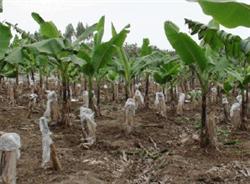 1. Intercultivation
(1) The role of intercultivation
Intercultivation is a measure to ensure that the banana plantation soil is soft and well aerated. If there is no loose soil and the soil layer is compacted, then the pores are small and aeration is poor, which is very unfavorable for the growth of bananas with fleshy roots. Poor root growth will in turn directly affect the growth of the aboveground part. In banana plantations, most of the weakly growing banana plants are closely related to poor development of their underground root system. Intercultivation (deep plowing) can destroy the structure of the soil's impermeable layer (that is, the compacted layer), creating a soil environment that is deep, loose, soft, breathable, well-drained and good at retaining water, so as to promote the growth of roots and underground stems and help improve banana production capacity. Intercultivation is especially important for clay banana plantations.
(2) Timing of intercultivation
Because banana roots are shallowly distributed, mostly within 15 cm of the topsoil, during the peak growth period of bananas even light intercultivation may injure the roots. Therefore, intercultivation should avoid the season of vigorous banana growth (March to November) and instead be carried out when growth is slow in winter or when all bananas in the plantation have been completely harvested and the next generation of plants is still young. Generally, intercultivation is done once a year, from the winter solstice to before the beginning of spring (December to February) being the suitable period, because under low-temperature and dry winter weather the horizontal roots in the topsoil layer have already contracted, so intercultivation injures fewer roots, while the winter sunlight allows the deeply turned soil clods to be fully bleached and weathered, which is beneficial to banana growth in the coming spring. After the Awakening of Insects (March), the soil can be broken up and the bed surface leveled.
(3) Scope and depth of intercultivation
During intercultivation, the whole area should be worked except for the area 30 to 45 cm from the banana base. The depth of intercultivation is 15 to 25 cm for paddy-field banana plantations and 25 to 35 cm for dry slope land or terraced banana plantations. For banana plantations that need mud applied after intercultivation, a small soil ridge (5 to 10 cm high) should be made around the edges of the bed so that the thin mud remains within the bed. At the same time, intercultivation should be combined with weeding and digging out old banana bases (the underground stems of the grandparent generation) to facilitate the growth and development of roots in all directions.
2. Weeding
Weeds in banana plantations not only compete with banana plants for nutrients and sunlight, but some are also intermediate hosts of diseases and places where pests inhabit, easily leading to the occurrence and spread of pests and diseases. Therefore, banana plantations need frequent weeding. Weeding in banana plantations is generally carried out from April to October, 6 to 10 times a year, especially in June and July, when it needs to be done twice a month. Weeding should be done on sunny days. In recent years, due to tighter labor availability and the higher cost of manual weeding, many banana specialist growers use chemical herbicides for weeding. If drugs such as gramoxone (paraquat) and glyphosate are used for weeding, the effect is good. Generally, gramoxone is mostly used for shallow-rooted, non-rhizomatous, broadleaf weeds, using 150 to 200 ml of 20% gramoxone per 667 sq m (mu), mixed with 750 to 1,000 kg of water; glyphosate is mostly used for deep-rooted annual and perennial weeds with underground stems, using 300 to 360 ml of 41% glyphosate per 667 sq m, mixed with 75 to 100 kg of water. If the banana plantation has both types of weeds mentioned above, gramoxone and glyphosate can be used alternately or mixed, and the weeding effect will be even more pronounced. When applying the chemicals, be careful not to spray onto banana suckers, banana stems or leaves, otherwise the banana plants and suckers will turn yellow and wither, with mild cases having growth inhibited and severe cases being killed. Therefore, when spraying, keep a certain distance from the banana plants as much as possible, point the nozzle downward, and it is best to do it when the wind is calm.