Detailed Explanation of Key Points of Freeze-resistant Cultivation Techniques for Loquat
I. Effects and Damage of Freeze Injury on Loquat. Loquat blooming in October to November is the "first bloom," which has the greatest chance of being frozen, but has a long growth period, large fruit, and good quality; blooming in November to December is the "second bloom," which has less chance of being frozen and a slightly shorter growth period, but its quality is not much different from the "first bloom"; blooming in January to February is the "third bloom...
I. Effects and Damage of Freeze Injury on Loquat
Loquat blooming in October to November is the "first bloom," which has the greatest chance of being frozen, but has a long growth period, large fruit, and good quality; blooming in November to December is the "second bloom," which has less chance of being frozen and a slightly shorter growth period, but its quality is not much different from the "first bloom"; blooming in January to February is the "third bloom," which has the least chance of being frozen, but has the shortest growth period, small fruit, and poor quality.
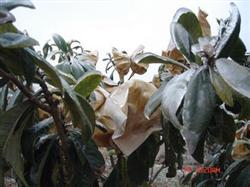
After loquat flowers are frozen, they are prone to internal rot; the flower axis turns brown and soft-rotted, and when the diseased part is squeezed by hand, a sticky liquid flows out; in the later stage, the flower axis shrivels, dries up, and appears wilted, resulting in flower rot. Low-temperature freeze injury inhibits the germination of loquat pollen grains, causing withered flowers and failure to set fruit; after young fruit is frozen, the fuzz on the fruit surface wilts and some of it falls off, making the fruit surface appear greenish and shiny; when freeze injury is severe, the young fruit turns gray-black or dark brown and drops; when the young fruit is relatively large and only lightly frozen, the flesh around the calyx tube becomes lignified, forming fruit corky skin disease. Loquat leaves are not easily frozen, but after freezing they wilt, turn yellow, and drop.
II. Cultivation Technical Countermeasures for Freeze Resistance in Loquat
(1) Choose flat land or gentle slopes with high, dry terrain, good ventilation and sunlight, and deep soil layers; avoid low-lying land subject to frost.
(2) Choose varieties with relatively strong cold resistance and good fruiting traits, such as 'Dawuxing' and 'Siyuehong'.
(3) Use grafted seedlings, selecting Photinia species and other rootstocks with well-developed root systems and strong cold resistance that can improve the freeze resistance of loquat.
(4) Adopt protected cultivation. Bamboo, miscellaneous wood, or steel pipes can be used to build frames and cover with plastic film. The covering time should be after full bloom of loquat or before freeze injury arrives. For loquat grown in greenhouses, the film should be uncovered at full bloom and covered again after full bloom. After covering with film, pay attention to changes in temperature and humidity inside the shed, and open doors and windows appropriately for regulation.
(5) Flower and fruit management. In orchards that may suffer freezing, the time for thinning flower clusters and fruit can be appropriately delayed, leaving no or few early-bloom fruits and keeping more "second bloom" fruits to avoid the frost period; or do not thin flower clusters, and wait until the weather warms before thinning excessive fruit clusters together with fruit thinning. Carry out bagging, or wrap the flower cluster upward with the leaves below the cluster, or bind young fruit exposed outside the canopy with straw bundles, then cover with rice straw. After young fruit is frozen, fruit thinning and bagging should be delayed; after the frost threat is removed, thin out young fruit whose seeds have turned black, and keep unfrozen fruit for bagging. For frozen fruit, spray a fruit-setting agent once within 10 to 20 days after freezing, and spray again 1 month later, which can achieve relatively high yield per plant and relatively large seedless fruit.
(6) Prune damaged branches and leaves. After the temperature steadily rises, take measures of picking leaves for minor injury, pruning branches for moderate injury, and sawing off trunks for severe injury.
(7) Cover the tree disc. Before frost, cover the tree disc with rice straw or plastic film, or earth up the tree disc to prevent freezing.
(8) Whitewash tree trunks. Use quicklime 1.5 kg + salt 0.2 kg + sulfur powder 0.3 kg + a little oil (to avoid being washed off by rain) + water 5 kg, mix into a paste-like whitewash and brush the tree trunks white.
(9) Air-dry the roots. Before flowering, dig away the soil and air-dry the skeletal roots for 7 to 10 days, then fertilize and cover with soil; this can delay flowering and reduce freeze injury to flowers and young fruit.
(10) Increase application of organic fertilizer. Increasing organic fertilizer can increase soil humus and improve granular structure, thereby raising ground temperature and preventing fruit tree roots from freezing. For frozen trees, fertilizer and water management should be strengthened; fertilizers should mainly be organic fertilizers such as human excrement and urine, chicken manure, cake fertilizer, and decomposed barnyard manure, combined with quick-acting fertilizers such as urea, compound fertilizer, and superphosphate; frozen trees have weak root fertilizer absorption capacity, so apply thin fertilizer frequently. After new branches and leaves mature, apply 1 to 2 foliar topdressings such as 0.2% urea + 0.2% monopotassium phosphate to restore tree vigor.
(11) Orchard smoking. Before frost or a cold wave arrives, make fires in the orchard with rice bran, wet firewood, weeds, and other materials to produce smoke. Smoking materials or smoke agents should be placed on the windward side of the orchard, with 6 to 10 piles per mu; the size and number of piles should depend on the smoking materials. In order to prevent frost promptly and effectively without wasting fuel, the arrangement of smoke piles and the timing of ignition should be based on meteorological forecasts and on-site observations.
(12) Post-disaster pest and disease control
After the tree body is frozen, tree vigor is relatively weak and disease resistance is reduced, making it highly susceptible to pest and disease damage. Therefore, strengthening pest and disease control is the focus of orchard work after a disaster, and fungicides and insecticides should be sprayed in a timely manner. Before bud break, apply fungicides such as 50-fold Asomate or 5-fold Fubiqing to the frozen trunk and the base of main branches twice, which can control rot disease.