Detailed Explanation of Key Points for Dwarf Cultivation Techniques of Chinese Bayberry
Dongkui Chinese bayberry is a premium variety native to Zhejiang and currently the Chinese bayberry variety with the largest fruit in China and even the world, making it one of the important Chinese bayberry variety resources in China. The Dongkui Chinese bayberry fruit is extra large; in Huangyan its ripening period is from late June to early July, with an average single fruit weight of 25 grams and a maximum fruit weight of 50 grams. The fruit is spherical, purple...
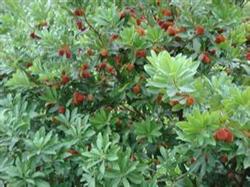 Dwarf close planting is the general trend in fruit tree cultivation worldwide today. It can enable fruit trees to bear fruit earlier, achieve early high yield and stable yield, and is an important cultivation model for obtaining high economic returns. By using dwarf cultivation techniques, controlling the canopy through trunk removal, pruning, rational fertilization, chemical regulation and other techniques, and converting vegetative growth into reproductive growth, early fruiting of Chinese bayberry can be promoted. Generally, it begins production 3 to 4 years earlier than conventional cultivation methods, and it effectively reduces the phenomenon of alternate bearing, increases yield, improves quality, and raises economic benefits.
The main technical measures for dwarfing Chinese bayberry are:
1. Proper close planting. Cultivation density should be set according to different varieties and different growth vigor: Dongkui 5 x 6 m, Ding'ao and Zaose 4 x 5 m.
2. Trunkless training. After planting, pinch the spring shoots and do not retain a main trunk. Keep 2 to 3 side branches to form the first scaffold limb. In the second year, select and retain 2 to 3 buds from the first scaffold limb to form the second scaffold limb. After 3 years of training in this way, the foundation of a dwarf tree form is formed.
3. Pruning and pinching to control height. Prune and pinch twice a year. Through pruning and pinching, remove vigorous growth and retain weak growth, promote balance, thin out dense growth and retain outer growth to expand the canopy, so that the interior of the canopy is ventilated and receives light, achieving the goal of lowering the tree form and expanding the canopy spread.
4. Rational fertilization to promote balance. Control nitrogen and increase potassium, fertilize according to tree condition, and follow the fertilizer requirement pattern of Chinese bayberry; each flush of new shoots consumes a large amount of nutrients. Apply fertilizer well three times a year, namely spring fertilizer, summer fertilizer and autumn fertilizer. The spring and summer fertilizers use special compound fertilizer for fruit trees and are applied before new shoots sprout. The autumn fertilizer is applied from late September to early October using soil and miscellaneous organic fertilizer.
5. Chemical regulation to promote flowers and fruit. For young fruit trees entering the fruiting stage, spray paclobutrazol on the canopy to control excessive growth of new shoots, keep new shoots at about 20 cm, make them the best fruiting branch groups, and promote flower bud formation.