What are the common pests and diseases of Chinese bayberry (Myrica rubra)? These several will affect tree vigor
Pests and diseases such as canker, brown spot, leaf roller, and pine caterpillar have a huge impact on the vigor and yield of Chinese bayberry trees. In production, prevention should be the main approach, with integrated control. In addition to measures such as increasing the application of organic fertilizer and potassium fertilizer and doing a good job of winter orchard cleaning, during the growing season effective measures should be taken promptly according to the occurrence patterns of pests and diseases to...
Pests and diseases such as canker, brown spot, leaf roller, and pine caterpillar have a huge impact on the vigor and yield of Chinese bayberry trees. In production, prevention should be the main approach, with integrated control. In addition to measures such as increasing the application of organic fertilizer and potassium fertilizer and doing a good job of winter orchard cleaning, during the growing season effective measures should be taken promptly according to the occurrence patterns of pests and diseases to eliminate them before major outbreaks.
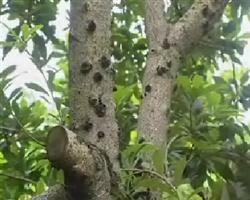
1. Canker disease, also called bayberry scab, is a bacterial disease that mostly occurs on the trunk and large branches and has a great impact on tree vigor and yield. The disease spreads through rainwater and invades through wounds. It begins to occur in late May. At the early stage of the disease, small milky white protrusions appear on the affected part, which then gradually swell to form black-brown tumors with a very rough surface. In terms of control, in addition to protecting the branches and trunk from injury, after rain in spring and autumn the tumors can be cut away with a sharp knife (until new tissue is exposed), and the wounds can be coated with "402" antibacterial agent at 50-100 times dilution, or agricultural streptomycin at 200 mg/L, 0.1% potassium permanganate, or 70% alcohol or copper sulfate at 100 times dilution for disinfection and protection. After half a month, apply once more, and collect the scraped tumor tissue and burn it.
2. Brown spot disease is a fungal disease that damages leaves. It occurs once a year, causing a large amount of leaf fall in autumn and winter and causing flower buds and small branches to die, with a great impact on tree vigor and yield. 20-30 days before fruit harvest and after fruit harvest, spray the canopy once each time with 1:2:200 Bordeaux mixture or 70% thiophanate-methyl at 800-1000 times dilution, 65% zineb at 600 times dilution, or other fungicides, and it can be controlled. When control is delayed and causes a large amount of leaf fall in autumn and winter, combined with foliar topdressing, spray the canopy with systemic fungicides such as 70% thiophanate-methyl at 800-1000 times dilution plus 2,4-D at 10-20 mg/L to control it.
3. Branch rot disease mostly occurs on old and weak trees. After the branches and trunk are affected, they rot and die, affecting tree vigor and causing the tree to decline prematurely. In production, methods such as scraping off the lesions early, sawing off dead branches, and applying disinfectant to the wounds can be used for control. The scraping method is the same as for canker disease.
4. Leaf roller occurs 2 generations a year, mostly damaging from late May to mid-June and from July to August. It spins silk to bind young leaves or tender shoots together and feeds on them in groups, affecting the growth of new shoots and photosynthesis. During the larval occurrence period, combined with the control of brown spot and other diseases, insecticides such as 90% trichlorfon at 800-1000 times dilution, or 2.5% deltamethrin (Decis) at 2000-3000 times dilution, or 80% dichlorvos at 800-1000 times dilution, or 1.8% abamectin at 2000-3000 times dilution, or 50% phoxim at 1000 times dilution can be sprayed on the canopy to control it.
5. Pine caterpillar occurs 1 generation a year. Larvae hatch in early April, and the larval stage lasts 35-40 days. Newly hatched larvae gather on new shoots and feed on the surface layer of tender leaves, leaving only the lower epidermis. Later they disperse and feed, and their food consumption increases greatly. In severe cases, only the leaf veins remain on the leaves. When larvae are found on trees in mid-to-late April, insecticides can be sprayed to kill them. The control agents are the same as for leaf roller.
6. Scale insects mainly include Lepidosaphes cupressi and camphor scale [Pseudaonidia duplex], causing dead branches and fallen leaves in Chinese bayberry trees. They occur 2 generations a year. The first generation of young scales occurs during the fruit enlargement period of Chinese bayberry (May-June), and the second generation occurs after fruit harvest (July-August). In order to reduce the impact of pesticide residues on fruit quality, control is mostly carried out after fruit harvest during the hatching period of the second generation of young scales. The agents can be 25% buprofezin at 1000 times dilution or laundry detergent at 80-100 times dilution, 40% dimethoate or Supracide at 1000 times dilution. For individual severely damaged plants, after fruit harvest, trunk coating with the systemic insecticide 40% dimethoate at 5-10 times dilution can be used for control.
7. Termites are mainly black-winged subterranean termites and yellow-winged large termites. These insects bore into the root crown and trunk xylem, causing weakened tree vigor or death, especially with the greatest damage to old tree trunks. April to October is the period of termite activity and damage. In production, methods such as digging out termite nests to kill the king and queen, pile-grass trapping (dig shallow holes in the orchard 10 cm deep and 50 cm in diameter, place tender grass sprayed with 90% trichlorfon or 48% chlorpyrifos at 1000 times dilution + 1% brown sugar, and cover with thin soil), and attracting and killing them by lighting lamps at dusk after rain in May-June can be used to eliminate them.
8. Longhorn beetles. The longhorn beetles damaging Chinese bayberry include brown longhorn beetle and citrus longhorn beetle. Their larvae bore into the trunk, causing tree decline or death. Adults mostly lay eggs from April to August. Methods such as whitewashing branches and trunks (whitewash branches and trunks 1 m above the ground from late March to early April to prevent adult egg laying), hooking and killing larvae in insect holes and chemical killing (when there is fresh frass in the bore holes, use a steel wire to hook and kill the larvae, or after removing the frass insert a cotton ball dipped in dichlorvos or dimethoate at 5-10 times dilution or gasoline, or inject with a syringe, and seal the insect hole with wet mud), spraying branches and trunks with chemicals (from April to August, spray the trunk with 40% dimethoate or chlorpyrifos at 500-1000 times dilution, about once every 15 days, to kill egg-laying adults and newly hatched larvae), and manual capture when adults occur in large numbers can be used for control.