How to grow longan seedlings? Detailed methods and techniques
Longan, also known as yuanrou or guiyuan rou, has the effects of tonifying the heart and spleen and nourishing the blood to calm the mind, and is a well-known bulk medicinal and edible delicacy. It is mainly produced in Fujian, Guangdong, Guangxi, Sichuan and Taiwan, China, and other places. Its cultivation can use two methods: seed propagation and grafting propagation. The seed seedling technique is introduced as follows: 1. Selection of nursery land The nursery...
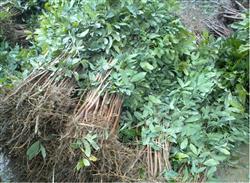
Longan, also known as yuanrou or guiyuan rou, has the effects of tonifying the heart and spleen and nourishing the blood to calm the mind, and is a well-known bulk medicinal and edible delicacy. It is mainly produced in Fujian, Guangdong, Guangxi, Sichuan and Taiwan, China, and other places. Its cultivation can use two methods: seed propagation and grafting propagation. The seed seedling technique is introduced as follows:
1. Selection of nursery land The nursery land should be chosen as gently sloping land or gently flat terraced land with good drainage, no water accumulation, the ability to irrigate (sprinkle) water during drought, and a slope of 5-10°, with deep, loose, relatively fertile sandy loam topsoil (heavy clay is not suitable as nursery land). After the nursery land is selected, it must be plowed and harrowed in advance, stones and weeds removed, and deep digging carried out to 25-30cm, with beds made 1-1.2m wide and about 20cm above the bottom of the furrow. After making the beds, open rows on the bed surface at a spacing of 30cm.
2. Apply sufficient base fertilizer
In order to cultivate robust longan seedlings, use 3000-4000kg of pig and cattle pen manure per mu, or 4000-5000kg of high-quality farmyard manure, 100-150kg of calcium magnesium phosphate fertilizer, and 100-130kg of lime. Mix the fertilizers and pile them for fermentation. After they rot, evenly scatter them into the bed furrows, mix them thoroughly with the topsoil, and then wait for sowing.
3. Treatment of seeds After the longan fruit flesh is peeled off (eaten), if the seeds are allowed to dry or are sun-dried, they lose their germination ability. Therefore, seeds used for raising seedlings must not be allowed to shrink from drying. The seeds must promptly be gathered together, mixed with fine sand, gently rubbed to remove the fruit flesh on the seed hilum, then rinsed in water to remove inferior seeds. Select fully mature, plump seeds and mix them with fine sand at a ratio of 1 part seeds to 2-3 parts fine sand (with a moisture content of about 5%) for germination promotion; alternatively, spread a 10-15cm thick layer of sand in the shade of a tree, then scatter the seeds on the sand, cover with another layer of sand (the sand should exceed the seeds by 1-1.5cm), and then cover with a layer of rice straw on top to prevent water evaporation, maintain moisture, and facilitate germination. During germination promotion, the temperature should be controlled at about 25°C. If the temperature is too high, sprinkle cold water to prevent the seeds from losing their germination ability. After 3-5 days of germination promotion, once the embryonic bud has grown 1-2cm, sowing can begin.
4. Sowing method Sow the germinated seeds in the opened row furrows (row spacing 30cm) at a plant spacing of 20cm, with 1 seed per hole. After covering with soil, cover the bed surface with sawdust or rice straw to prevent water evaporation, maintain soil moisture, and promote rapid growth after the seeds sprout. Generally, raising 8000-10000 seedlings per mu is suitable, and 6000-7000 is even better. If too dense, it will not only affect the thickening of the seedlings, but also affect the survival rate and growth of future transplanting, as well as the rapid expansion of the tree canopy.
When longan is sown, it is in the high-temperature period of early autumn, which is very unfavorable for seedling growth. According to the experience of farms in the Guangxi agricultural reclamation system, 45-60 days before sowing, sow green manures such as pig manure bean and soybean between the rows on the bed surface. By the time longan is sown, the green manure has grown to about 20cm tall. Using the green manure to form a shady microclimate environment can prevent longan seedlings from being scorched by the blazing sun during the seedling stage and improve the survival rate. In this way, there is no need to build a shade shed. After the longan seedling leaves age and the temperature drops, pull out the green manure and cover the bed surface with it.
5. Management of seedlings After longan seedlings grow 4-5 leaves and turn green, use a knife to cut off the tip of the main root to promote well-developed lateral root growth, laying the foundation for improving the survival rate of future transplanting and for the plants to bear fruit earlier.
When longan seedling leaves age and sprout again, pay attention to fertilizer and water management, timely topdressing and watering, to promote robust seedling growth and reach grafting standards as early as possible. In addition, longan has relatively many pests and diseases, so attention should be paid to timely control. Longan seedlings are afraid of frost; during cold winter periods, attention should be paid to preventing frost damage.
When seedling-grown plants grow to more than 30cm, if they still do not grow branches, artificial topping is carried out to inhibit height growth, make the stem thicken, and facilitate grafting. For seedling-grown plants tended for one year, more than 80% reach grafting standards (stem thickness at 10-15cm above the ground reaches 1-1.2cm), grafting can be carried out between August and September of the second year, and they can leave the nursery in spring or autumn of the third year.