What are the control methods for magnesium deficiency in citrus?
In recent years, as a large amount of rural labor has moved to cities and towns, the number of livestock raised by farming households has declined, and the sources of organic fertilizer have decreased significantly. Coupled with years of low fruit prices, fruit growers have greatly reduced or even stopped using organic fertilizer in fruit production, causing the phenomenon of nutrient deficiency in orchards to worsen continuously in recent years. This is especially true for the secondary element magnesium...
In recent years, as a large amount of rural labor has moved to cities and towns, the number of livestock raised by farming households has declined, and the sources of organic fertilizer have decreased significantly. Coupled with years of low fruit prices, fruit growers have greatly reduced or even stopped using organic fertilizer in fruit production, causing the phenomenon of nutrient deficiency in orchards to worsen continuously in recent years. This is especially true for the secondary element magnesium, which fruit trees need in relatively large amounts. When the soil's magnesium supply is insufficient, and in the red and yellow soil regions of southern China where heavy rainfall causes serious magnesium loss from the soil, the symptoms of magnesium deficiency in orchards become increasingly severe. In production, the correction of magnesium deficiency in citrus mainly relies on the application of magnesium fertilizer, but in recent years fruit growers have generally reported that the correction effect after applying magnesium is not obvious. According to the author's recent experiments summarizing different application methods of magnesium fertilizer, the key to correcting magnesium deficiency in citrus lies in the application method.
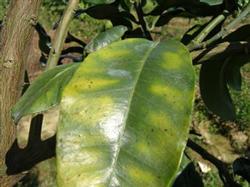
Magnesium deficiency in citrus first appears as yellowing of the plant leaves, with the green area at the leaf base forming an inverted "V" shape. The more fruit a plant bears, the more severe the yellowing. Afterward, the main vein and side veins develop swelling and suberization similar to boron deficiency, the entire leaf may turn bronze-colored, and the leaves drop prematurely, seriously affecting the local citrus yield and quality.
For the correction of magnesium deficiency in the red and yellow soil regions of southern China, where the soil pH is mostly 4.5-6, magnesium-containing fertilizers such as magnesium oxide, magnesium-containing lime, and calcium magnesium phosphate fertilizer can generally be applied to supplement the magnesium element in the soil. These magnesium-containing fertilizers have a relatively slow effect and are best applied as a base fertilizer mixed with decomposed pig and cattle manure, cake fertilizer, and other organic fertilizers in furrows near the drip line of the tree canopy. They are mainly used for the prevention of magnesium deficiency or for orchards with mild symptoms. The application rates per mu are: magnesium oxide 20-30 kg, magnesium-containing lime or calcium magnesium phosphate fertilizer 50-60 kg.
For orchards showing symptoms of magnesium deficiency, applying magnesium fertilizer once a year has an unobvious correction effect. The key is to use quick-acting magnesium sulfate and magnesium nitrate fertilizers, applying them 3-4 times a year for correction, and only after continuous application for two years will the yellowing symptoms be reduced and the effect become significant. Citrus fruit trees can be treated in combination with the winter base fertilizer, the pre-flowering or post-flowering fertilizer in February-March, the fruit-setting fertilizer in May, and the shoot-promoting and fruit-enlarging fertilizer in July. The annual soil application rate per mu is 50-60 kg. To increase the correction effect, after the spring shoot leaves have unfolded, spray once every 10-15 days with a 1% magnesium nitrate or magnesium sulfate solution, for 3-5 consecutive sprays, as foliar fertilization. After the magnesium deficiency symptoms are reduced, organic fertilizer should be increased every year, and both slow-release and quick-acting magnesium fertilizers should be applied to ensure a uniform supply of magnesium, so that a more thorough correction can be achieved.