How to prevent and control pear tree canker? Mastering these methods is enough
1. Strengthen the tree to prevent disease: (1) Reasonable load: According to the tree's growth condition and fertilization level, determine an appropriate fruit load. Do not let the tree bear too heavy a load, and even less should you adopt excessive measures such as branch bending and girdling to increase fruit production for short-term gain. Properly thin flowers and fruits so that both fruiting and tree growth are achieved. (2...
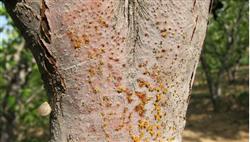
1. Strengthen the tree to prevent disease:
(1) Reasonable load: According to the tree's growth condition and fertilization level, determine an appropriate fruit load. Do not let the tree bear too heavy a load, and even less should you adopt excessive measures such as branch bending and girdling to increase fruit production for short-term gain. Properly thin flowers and fruits so that both fruiting and tree growth are achieved.
(2) Increase fertilizer and water: In the vast pear-growing areas of the north, fertilizer deficiency and water deficiency are relatively common phenomena. When fertilizing, pay attention to increasing the application of organic fertilizer, and increase the application of phosphorus fertilizer, potassium fertilizer and trace element fertilizers; at the same time, do not apply too much nitrogen fertilizer.
(3) Protect leaves and promote roots: Promptly control diseases and pests that cause early defoliation, such as pear scab, gray leaf spot, black spot, brown spot, as well as red spider mites, pear lace bugs, aphids, leaf roller moths, etc. At the same time, also pay attention to controlling various root diseases.
2. Avoid and protect wounds:
(1) Thoroughly control trunk and branch pests: Buprestid beetles, clearwing moths, longhorn beetles and other trunk and branch pests are not only the makers of wounds, but also the vectors that carry and spread pathogens. Thoroughly controlling these pests is quite important for the vast pear-growing areas.
(2) Prevent freezing injury and sunscald: The sunny side of pear tree trunks and branches has a relatively large temperature difference between day and night and is prone to freezing injury; if the sunny sides are not covered by leaves, the bark is prone to dying from sun exposure in summer. Relatively effective measures to prevent freezing injury are, first, whitewashing the trunk to reduce the day-night temperature difference; second, bundling straw around the trunk to cover and prevent freezing. A commonly used whitewash formula is 12-13 kg of quicklime, plus 2 kg of lime-sulfur mixture stock solution (about 20 degrees Baume), plus 2 kg of salt, plus 36 kg of clean water; or 10 kg of quicklime, plus 3-4 kg of soybean milk, plus 40-50 kg of water. Whitewashing can also prevent sunscald of trunks and branches.
(3) Protect wounds: Larger saw cuts should be smoothed flat, then coated with tung oil, varnish, or thiophanate-methyl ointment, S-921 antibacterial agent, etc. for protection. After larger diseased spots are cured, bridge grafting should be carried out promptly and protected.
3. Treat diseased spots promptly:
(1) Scrape the bark: Before pear trees bud, scrape off the curled bark and necrotic tissue, and after scraping combine this with applying medicine or spraying. You can spray 50% asomate wettable powder at 300 times dilution, or 1-3 degrees lime-sulfur mixture.
(2) Chemical treatment of diseased spots: After scraping off the diseased tissue, use 1 part 70% thiophanate-methyl wettable powder plus 2.5 parts vegetable oil, or 1 part 50% carbendazim wettable powder plus 1.5 parts vegetable oil, mix evenly and apply to the diseased area. You can also apply 5-10 degrees Baume lime-sulfur mixture, S-921 antibiotic at 20-30 times dilution, 40% asomate at 50 times dilution, or 30% FulanDi at 30 times dilution, 843 recovery agent stock solution, wuningmycin fermentation liquid at 5 times dilution, etc., to prevent recurrence of disease scars. For exposed xylem, you can apply coal tar or anti-rust paint; for larger disease scars on the trunk, carry out bridge grafting promptly to restore tree vigor as soon as possible. The scraped bark and diseased branches should be collected and burned.