Key Points of Simplified Pruning Technique for Pear Trees Trained to a Modified Central Leader Form
For pear trees trained to a modified central leader form, the trunk height is 60-70 cm, the tree height is 3.5 m, and 4-5 larger scaffold branches are borne on the middle and lower parts of the central leader. The spacing between scaffold branches is about 20 cm. The basal angle of the scaffold branches is 60 degrees. The waist angle is 30-50 degrees. The tip angle is upright; the scaffold branches extend in a single axis. On them are borne small and medium fruiting shoots or fruiting branch groups; the ratio of scaffold branch to trunk is controlled...
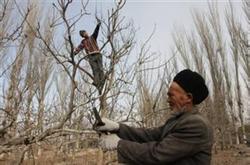
For pear trees trained to a modified central leader form, the trunk height is 60-70 cm, the tree height is 3.5 m, and 4-5 larger scaffold branches are borne on the middle and lower parts of the central leader. The spacing between scaffold branches is about 20 cm. The basal angle of the scaffold branches is 60 degrees. The waist angle is 30-50 degrees. The tip angle is upright; the scaffold branches extend in a single axis. On them are borne small and medium fruiting shoots or fruiting branch groups; the ratio of scaffold branch to trunk is controlled at 0.3-0.5:1. On the upper half of the central leader, the central trunk bears small and medium fruiting shoots or fruiting branch groups. Because there are no lateral branches on the middle and lower scaffold branches within the canopy, and no large branches (scaffold branches) in the upper part, ventilation and light penetration within the canopy are good. The simplified pruning method, namely the "three noes" pruning method: do not head back the planted nursery stock; do not cut back the tips of the central leader and scaffold branches of young trees during winter pruning; do not open the scaffold branch angle to more than 70 degrees to make them grow obliquely upward, but instead adopt "shaping along with growth" during the growing season, with the treatment of competing shoots as the main means.
1 Do not head back the planted nursery stock. If the nursery stock planted for orchard establishment has branches formed in the nursery or damaged parts in the upper portion, then prune off the branches or damaged parts (leaving a plump bud below the cut), but if it is a vigorous seedling with no branches at the tip or no damage, do not head it back. Practice has proved that as long as the nursery stock is robust, the leaf buds are plump, and the root system is well developed and intact, even if the planted seedling is not headed back, except for necrotic buds and a few latent buds at the base that cannot sprout, all leaf buds can sprout, generally 2-4 relatively vigorous shoots emerge at the top, and when the new shoots reach about 20 cm in May-June, they are regulated and controlled to ensure the absolute dominance of the growth vigor of the central leader tip. The method is: when the growth vigor of the terminal bud shoot shows obvious dominance, remove the 2nd-4th bud shoots (competing shoots or shoots with a narrow crotch angle); when the growth vigor of the terminal bud shoot shows obvious weakness, use a competing shoot to replace the terminal bud shoot as the branch tip, and likewise remove the new shoots below it that are in a competing position and have a small basal angle. After removing the competing new shoots and the new shoots with a narrow crotch angle, the basal angle of the lower sprouted shoots generally opens naturally to more than 60 degrees, and the lower new shoots are weaker and thinner than the competing shoots, making it easy to control scaffold branch thickness. In the first year after planting, the nursery stock produces more shoots, but the growth amount is not large, and the tree height in that year is about 1.8 m.
2 Do not cut back during winter pruning. As for the training and pruning in the 2nd year, during winter pruning (January-February), the tips of the central leader and scaffold branches are generally not cut back, and only individual lateral branches on the scaffold branches and branches confirmed as useless are removed. If the tips of the central leader and scaffold branches are damaged (such as by insect pests) and secondary shoots are produced, then during winter pruning the forked part should be cut off, leaving a plump bud below the cut. Except for necrotic leaf buds and a few latent buds at the base, even vigorous upright branches can reach a sprouting rate of 100% without being cut back, and several vigorous shoots (competing shoots) can emerge at the tip of an uncut branch. When these new shoots reach about 20 cm (May), regulate and prune them by removing the competing shoots and excessively vigorous shoots. Or use a competing shoot to transfer the leader and change the tip, maintaining the central leader tip growing upward alone and the scaffold branches extending in a single axis. In the 2nd year after planting, the growth amount of the nursery stock increases markedly, the average tree height reaches about 2.8 m, and some plants form flower buds.
3 Do not bend branches. As for continuing training in the 3rd year, after 2 years of training, the tree height has approached 3 m, and several larger scaffold branches have formed on the middle and lower parts of the canopy. The methods of winter pruning and summer training and pruning in the 3rd year are the same as the previous year, that is, during winter pruning the tips of the central leader and scaffold branches are generally not cut back, and competing shoots are treated in May. For the larger scaffold branches in the lower part of the canopy, they should be kept growing obliquely upward (waist angle 30-50 degrees), and they must not be opened to 70 degrees, still less bent to a horizontal position. For branches that are upright or even growing inward and holding their heads, their waist angle should be adjusted to 30-50 degrees. Under the premise of not cutting back, the more upright the tips of the scaffold branches and central leader are, the higher the sprouting rate, but only the 1st-3rd buds at the tip easily produce long shoots, while the other axillary buds produce short shoots and form flower buds. If the scaffold branches are bent flat, a row of water sprouts will emerge on their upper side and affect the growth of the scaffold branches. Through 3 years of training and pruning, the tree height can reach about 3.5 m, 3-5 larger scaffold branches are trained in the lower part of the canopy, medium and short fruiting shoots are distributed on these scaffold branches, and medium and short shoots are formed on the central leader in the upper part of the canopy, and the tree form is trained into a modified central leader form.
4 Pruning during the fruiting period. After entering the fruiting period, branch thinning is the main practice for the tips of the central leader and scaffold branches. Prevent the formation of lateral branches on scaffold branches, and prevent the central leader from growing larger branch groups. The number, orientation, and size of scaffold branches are artificially regulated according to the actual needs of growth and fruiting. During the fruiting period, the expansion growth of the canopy slows markedly, and pruning mainly controls the extension growth of scaffold branches and the increase in tree height. For renewing fruiting shoots and scaffold branches, the pruning methods of thinning, cutting back, and replacement are mostly used. Drop the head at the appropriate time, and control the ratio of scaffold branch to trunk thickness at 0.3-0.5:1. Oversized scaffold branches should be cut back at the appropriate time until they are removed (branch replacement).