Key Points and Technical Details for Spring Management of Pear Orchards
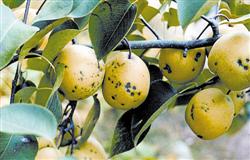
In mid-May, some fruit growers in Xinji, Shenzhou and other places found that after spraying pear trees with pesticides, the young fruit of some pear varieties developed black spots, affecting fruit quality. In order to investigate the causes of the black spots, on May 22, Ni Qunzhou of the Shijiazhuang Fruit Tree Research Institute of the Provincial Academy of Agriculture and Forestry Sciences, Liu Pingjun of the Jinzhou Forestry Bureau, and Xie Zhuang Technicians of Zhaoxian County...
 1. Training and pruning: Continue bending and training pear tree branches to regulate growth, which is conducive to ventilation and light penetration.
2. Apply pre-bloom fertilizer for pear trees well: Applying pre-bloom fertilizer for pear trees in a timely manner can rapidly raise the nutritional level of the tree, strengthen tree vigor, improve the stress resistance of flower buds, and make the newly sprouted shoots and flower buds robust. Pollen viability is strong, pollination and fertilization are good, and the fruit-setting rate is high. The specific method is as follows:
Before the pear flower buds break dormancy, generally 5-10 days around the Beginning of Spring, apply pre-bloom fertilizer, mainly organic fertilizer and phosphorus-potassium fertilizer. For fruiting trees over 5 years old, apply 15-20 kg of composted and thoroughly decomposed human, livestock and poultry manure, 1 kg of composted and thoroughly decomposed peanut vines, and 1.2-2 kg of potassium dihydrogen phosphate per tree. Dig 6-8 radial trenches under the canopy that are 15-20 cm deep, 30-40 cm wide and 80-100 cm long, mix the fertilizer thoroughly and evenly, mix it with the excavated soil, and then backfill it into the trenches. If dry weather occurs after fertilization, each tree must be watered with 60-80 kg of clear water to promote the dissolution and transformation of the fertilizer, supply root absorption and utilization, and improve fertilizer absorption and utilization. In addition, at the flower bud stage, spray the leaves 2-3 times with a mixture of 0.1% magnesium sulfate, 0.1% borax, 0.3% urea and 0.5% potassium dihydrogen phosphate.
3. Reasonable intercropping: Tall-stalk crops are strictly prohibited in pear orchards; only green manure and short-stalk crops (such as soybeans, mung beans, peanuts, etc.) may be planted.
4. Protect flowers and fruits: The fundamental measures for protecting flowers and fruits are strengthening the management of soil, fertilizer and water and pest and disease control. In addition, measures can be taken such as spraying 0.2%-0.4% borax solution or 800-fold vinegar essence solution at the flowering stage, releasing bees, hanging flowering branches, artificial pollination, shaking the trees after rain or on foggy days, and ring-barking vigorous trees and vigorous branches after flower fall.
5. Pest and disease control: Before flowering and after flower fall, use 800-fold Dasheng solution, 600-fold Xiansheng solution, 300-fold 25% carbendazim solution, and 1500-fold fenarimol solution to control pear rust, pear black spot, pear black heart disease, pear brown spot and flower rot, for 2-3 consecutive applications, once every 10-15 days. Use 800-fold 30% trichlorfon solution and 3000-fold 2.5% deltamethrin solution to control pear fruit borer, pear leaf roller and pear stem sawfly; use 40% dimethoate to control pear aphids.