What species of aphids harm pear trees?
The aphids that harm pear trees are mainly 3 species: the pear two-tailed aphid, the pear yellow powdery aphid, and the Chinese pear original-tail aphid. These 3 aphids harm only pear trees; the two-tailed aphid and the yellow powdery aphid occur commonly and severely, while the original-tail aphid rarely occurs and causes lighter damage. Their morphological differences are as follows: (1) Pear two-tailed aphid: ① The wingless viviparous female aphid is 2 mm long, green or dark green...
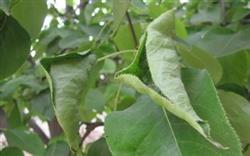
The aphids that harm pear trees are mainly 3 species: the pear two-tailed aphid, the pear yellow powdery aphid, and the Chinese pear original-tail aphid. These 3 aphids harm only pear trees; the two-tailed aphid and the yellow powdery aphid occur commonly and severely, while the original-tail aphid rarely occurs and causes lighter damage. Their morphological differences are as follows:
(1) Pear two-tailed aphid: ① The wingless viviparous female aphid is 2 mm long, green or dark green, and covered with white wax powder. The compound eyes are reddish brown; the ends of the antennae, the tail plate, the abdominal tube, and the ends of the femora and tibiae and the tarsi of each leg are all black; there is a dark green longitudinal band down the center of the back. ② The winged viviparous female aphid is 1.5-1.7 mm long, with a wingspan of about 5 mm. The head, thorax, antennae and abdominal tube are pale black; the abdomen is pale brown or yellowish brown, with brown markings. The middle vein of the forewing is divided into two forks, hence the name two-tailed aphid. ③ The nymph is small, green, wingless, and similar to the wingless female aphid. ④ The egg is about 0.7 mm long, oval, black, and shiny.
(2) Pear yellow powdery aphid: ① The pear yellow powdery aphid is a polymorphic aphid, divided into 4 types: the fundatrix, the ordinary type, the sexupara, and the sexual type. The fundatrix, ordinary type and sexupara are all female and reproduce by parthenogenetic egg-laying, and are similar in morphology. The body is 0.7-0.8 mm long, wingless, bright yellow, shiny, and long oval. It has no abdominal tube and no tail plate. ② The overwintering egg (which hatches into the fundatrix) is about 0.33 mm long and pale yellow. The egg that produces the ordinary type and the sexupara is 0.26-0.3 mm long, initially pale yellow, gradually turning yellow-green. The egg that produces the sexual type is 0.36-0.42 mm long and yellow-green. ③ The nymph is pale yellow and resembles the adult, but is smaller.
(3) Chinese pear original-tail aphid: The winged viviparous female aphid has a black head and thorax, a green or yellow-green abdomen, a short and small abdominal tube, and a short, small, round tail plate. The wingless viviparous female aphid is green or pale brown, with a short and small abdominal tube and a short, small, round tail plate.