Take good care of management in early summer for plum trees, and only then can the plums be high-quality and high-yield
Although the plum is a fruit tree with good yielding ability and strong disease resistance, due to poor management in early summer, it often shows severe alternate bearing, small fruit, and quality that cannot be guaranteed. Plum trees in full fruit period are mainly borne on short fruit branches and bouquet-like fruit branches. At present, plum fruit is in the fruit expansion stage. In order to enlarge the fruit, ensure uniform fruit size...
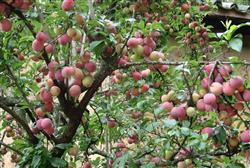
Although the plum is a fruit tree with good yielding ability and strong disease resistance, due to poor management in early summer, it often shows severe alternate bearing, small fruit, and quality that cannot be guaranteed. Plum trees in full fruit period are mainly borne on short fruit branches and bouquet-like fruit branches. At present, plum fruit is in the fruit expansion stage. In order to enlarge the fruit, ensure uniform fruit size, improve fruit quality, and prevent alternate bearing, we should strengthen management in three aspects: fertilizer and water, fruit thinning, and pest and disease control.
During the plum fruit expansion stage, a large amount of nutrients and water is needed to promote fruit development. For mature trees with strong vigor, 1 application of fruit-strengthening fertilizer should be applied in early May, while for plum trees with weaker vigor, 1 additional topdressing should be added. The topdressing should preferably be compound fertilizer with relatively high potassium content and plant ash, and can be applied in furrows 10 cm deep and 15 cm wide, with 1.0-1.5 kg of compound fertilizer per tree, and the soil should be covered promptly after fertilization. If drought occurs, irrigation should be carried out during the young fruit expansion stage.
After physiological fruit drop ends, fruit thinning should be carried out. At this time, large and small fruits are obvious. First thin out small fruits, densely clustered fruits, deformed fruits, diseased fruits, etc. The distance for leaving fruits should be based on fruit shape and size, preferably so that they do not affect each other and are staggered in growth. Generally, leave 1 fruit every 5-8 cm on fruit branches, and control the yield per mu at 1000-1500 kg.
Gummosis is a common disease on plum trees, and the peak occurrence period during the year is from May to August. The focus should be on enhancing tree vigor, strengthening orchard drainage, applying more organic fertilizer, and improving the tree's disease resistance; promptly control pests and diseases on branches and trunks to reduce pest and disease wounds; scrape off the gummosis areas, then apply 5 degrees Baume lime sulfur mixture, and finally apply a protective agent, which has a relatively good effect. At the same time, strengthen control of longhorn beetles. If frass holes of longhorn beetle larvae are found on the main trunk, they should be scraped out immediately.