Two essential points you must know for pruning plum trees
1. Root characteristics The plum tree has a shallow root system, most of which consists of absorbing roots, mostly distributed within the 20-40 cm soil layer, and the spread of horizontal roots is usually 1.2 times larger than the canopy diameter. The specific distribution range depends greatly on the variety and environmental conditions; for example, in deep sandy soil, vertical roots can reach more than 6 m. ...
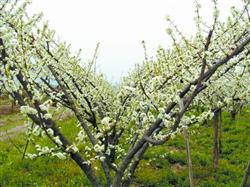 1. Attention must be paid to training. At present, the natural open-center form is mostly used in production. Its training is similar to that of peaches, and it must be started from the young tree stage, with the focus on light pruning, long shoot retention, thinning, branch bending, and opening the main branch angles to accelerate canopy formation. Generally, starting from the first year after planting, in July-August or during winter pruning, methods such as branch bending, propping, weighting, bending, and twisting are mainly used to leave long shoots unpruned to induce flowering and fruiting. 2. Attention must be paid to pruning. 1. Pruning time. Carry out comprehensive pruning in winter; in spring, during the flower bud swelling stage of the plum tree, properly cut off weak, overly dense, or overly long branches on the fruiting base branches; in summer, in June, carry out twisting, pinching, heading back, branch bending, and girdling on the upright main branches on the back of the inner scaffold branches and on branches with large space. Train them into sturdy base branches, and remove overly dense ones from the base. In autumn, around August, before the branch tips are fully lignified, bend the extension shoots of the relatively upright scaffold branches of young trees to open the branch angles, and bend flat the strong back-born branches with space on the scaffold branches to train them as fruiting base branches. Remove vigorous shoots, crossing branches, and overlapping branches that have no space. 2. Pruning methods. Plum trees mainly bear fruit on bouquet spurs and short fruiting branches. Pruning should adopt a thinning pruning system. In the young stage, the extension shoots of scaffold branches should be lightly pruned, cut back by 1/4-1/3 or left unpruned; as the tree age increases and fruiting increases, the pruning intensity should gradually increase, striving to maintain a balance between fruiting and growth. For the current-year vegetative shoots or long fruiting branches on scaffold branches, all overly dense ones should be thinned out, and the rest should be left unpruned or lightly pruned as future fruiting base branches. In summary, if farmers want their cultivated plum trees to have high and increased yields, high and stable yields, and obtain relatively high economic benefits, they must cultivate a certain number of fruiting bases each year; each time short fruiting branches and bouquet spurs are produced on them; by the third year and thereafter they flower and bear fruit, and after the fruiting branches have borne fruit for five years, they are cut from the base or with a stub left for rotation and renewal. Generally, about 1/5 of the fruiting base branches are renewed each year, so that the tree body each year has 3-5-year-old base branches accounting for 1/5 of the number bearing fruit; then after the adult tree enters the full fruiting period, it can maintain coordinated growth and fruiting, achieving the goals of high yield, stable yield, and increased efficiency.