Greenhouse Nectarine Management Techniques at a Glance
To prevent flower and fruit drop in greenhouse peach trees, start with the following points: strengthen comprehensive management and ensure nutrient supply. The fruit-setting rate and the development of young fruit are closely related to the supply of nutrients. First, late-stage management from the previous year must be strengthened to form good flower buds and raise the nutrient level, such as protecting leaves in autumn, ...
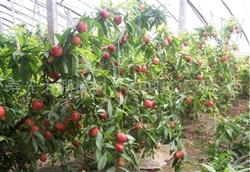 The nectarine greenhouse should be built in a spot that is sheltered from wind and facing the sun, with high and dry terrain, good drainage and irrigation, fertile soil, and sandy loam texture. It can be built in a 3-year-old peach orchard, or the site can be selected first and the greenhouse built before transplanting, depending on actual conditions. When building the greenhouse, use a bamboo and wood structure, build a single-slope greenhouse running east-west, with the back wall made of hollow cement bricks. The back of the greenhouse should be about 3 m high, 50-100 m long, and about 8.5 m wide, with 4-5 rows of supports and a column spacing of about 3 m. Use thick bamboo poles as crossbeams. Choose polyethylene non-drip film for the greenhouse film. Leave ventilation holes about 30 cm in diameter in the back wall every 10 m or so. Set a 60 cm x 60 cm skylight at the top center of the greenhouse every 8 m, and install ventilation windows at the front edge. At night, cover the greenhouse film with straw mats more than 3 cm thick for insulation.
1. Variety selection
Nectarines planted in the greenhouse should be early-maturing varieties, such as Zaohongzhu, Wuyuehuo, and others.
2. Seedling transplanting
For greenhouses built in a peach orchard, there is no need to transplant the peach trees; just strengthen fertilizer and water management. Before transplanting seedlings in a newly built greenhouse, deep-plow the soil and apply 4000-5000 kg of high-quality organic fertilizer, 20 kg of nitrogen-phosphorus-potassium compound fertilizer, and 10 kg of potassium sulfate per greenhouse. Dig strip planting trenches 60 cm deep and 80 cm wide. For transplanting, choose about 3-year-old seedlings with well-developed root systems, strong growth, and plump buds. Planting should follow a north-south row orientation, with a plant spacing of 1.5 m x 4 m and a ratio of main variety to pollinator variety of about 10:1. When planting, keep the root system spread out. After planting, water and cover with plastic film.
3. Training and pruning
Greenhouse nectarines are generally trained into a sloped population structure that is high in the north and low in the south. The northernmost trunk height is 45-50 cm, with a spindle shape and a tree height of 1.5 m, or an open-center shape with a tree height of 1 m. The middle gradually increases in height from south to north, and the two main branches in the east and west are trained into a "Y" shape.
Pruning before covering the greenhouse should focus mainly on thinning branches, leaving long branches and letting them extend, removing diseased and insect-damaged branches, drooping branches, water sprouts, and strong vegetative branches without flowers, so as to maintain good light penetration.
4. Fertilizer and water management
One month before covering the greenhouse, apply 3000 kg of organic fertilizer, 25 kg of diammonium phosphate compound fertilizer, and 10 kg of urea per greenhouse, then water once. After watering, hoe the soil and cover with plastic film. During the young fruit stage, spray 0.3% urea solution once; during the pit-hardening stage, in addition to spraying 0.3% urea solution, also spray 0.3% monopotassium phosphate solution. From covering the greenhouse to petal fall, it is not advisable to water; the humidity inside the greenhouse should be below 60%. Water once each during the pit-hardening stage and the fruit enlargement stage, but the amount should be appropriate and not too large, so as not to cause excessive new shoot growth and physiological fruit drop.
5. Temperature and humidity regulation
After covering the greenhouse in mid-December, raise the temperature gradually. In the first stage, pull the straw mats up to 1 m high so that only a small amount of light enters the greenhouse, keeping the daytime temperature at 8°C-13°C for 7 days; in the second stage, pull the straw mats up by 1/3-1/2, keeping the daytime temperature at 10°C-16°C for 7 days; in the third stage, pull up most of the straw mats, keeping the daytime temperature at 10°C-20°C for 7 days; afterward, until flowering, pull up all the straw mats and keep the temperature at 10°C-25%; during this period, pay attention to changes in soil temperature. During the flowering period, keep the daytime temperature at 18°C-24°C and about 10°C at night; from after flowering to fruit maturity, keep the daytime temperature at 22°C-28°C, not exceeding 30°C at the highest, and about 15°C at night, not lower than 10°C at the lowest. Keep humidity at 70%-80% before flowering, about 60% during flowering, and 50%-60% after flowering. In case of cloudy, rainy, or foggy weather, attention should be paid to implementing warming measures.
6. Disease and pest control
Disease and pest control for greenhouse nectarines should focus on prevention, with integrated control, and key control of peach bacterial shot hole, peach aphids, and mites. For diseases, lime sulfur mixture, mancozeb, zineb, and similar agents can be used; for aphids and mites, insecticides such as imidacloprid and Yamanjing can be used.
7. Flowering and fruiting stage management
The flowering and fruiting stage management of greenhouse nectarines is the key period and is directly related to economic returns. Therefore, only by strengthening management during this period can there be a bumper harvest. During the flowering period, artificial pollination should be carried out. During the flower bud stage, remove overly dense flower buds, remove one of each pair of flowers, and remove deformed flowers, excessively late flowers, and disease- or insect-damaged flowers. Begin fruit thinning 20 days after flowering so that the fruit are evenly distributed. Aim to leave a single fruit on short branches, two fruits on medium fruiting branches, and 3-4 fruits on long fruiting branches. During the fruit coloring stage, lift or prop up drooping branches to keep the tree well ventilated and exposed to light, improve light conditions in the tree canopy, and increase fruit color. At the same time, strictly control humidity inside the greenhouse to prevent fruit drop and fruit cracking caused by excessive humidity.