A Detailed Guide to Dragon Fruit Cultivation Techniques and Field Management Methods
I. Orchard Establishment Dragon fruit is relatively heat-tolerant, water-tolerant, and prefers warm, humid, sandy soil rich in organic matter. Before planting the seedlings, set up 100-110 square concrete pillars measuring 10×10×250 cm per mu at a spacing of 1.5 m × 2 m, with the concrete pillars buried 50 cm into the soil to support the climbing dragon fruit branches. On both sides of each concrete pillar, at 5-1...
I. Orchard Establishment
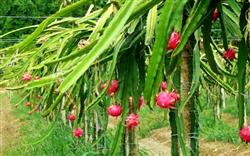
Dragon fruit is relatively heat-tolerant, water-tolerant, and prefers warm, humid, sandy soil rich in organic matter. Before planting the seedlings, set up 100-110 square concrete pillars measuring 10×10×250 cm per mu at a spacing of 1.5 m × 2 m, with the concrete pillars buried 50 cm into the soil to support the climbing dragon fruit branches. At 5-10 cm from the top on both sides of each concrete pillar, drill one straight hole on each side, and run two vertical iron wires in a cross shape for the dragon fruit branches to climb and hang on. To prevent the branches from breaking due to excessive weight or being blown down by wind, a fixed used tire should be placed on the cross frame to support the branches. On two opposite sides of each concrete pillar, dig one planting hole 10 cm deep and 20 cm long and wide, mix decomposed organic fertilizer with soil inside the hole, plant 1 plant per hole, and plant 3-4 plants beside each concrete pillar.
II. Planting
Dragon fruit can be planted in all four seasons. Plant 3-4 plants around each pillar and let the dragon fruit plants grow upward along the pillar. Calculating 4 fruit seedlings per pillar, 450 plants can be planted per 667 sq m, which can greatly improve land utilization, increase the fruit yield in the juvenile stage, and recover the investment cost early. Do not plant too deep (a depth of 3 cm is appropriate), and keep the soil moist in the early stage.
III. Water and Fertilizer Management
Dragon fruit is relatively drought-tolerant. Water once every 2-3 days at the initial planting stage, and afterward just keep the soil moist. The root system of dragon fruit is relatively shallow, so fertilizer should be applied in small amounts and frequently to prevent root burn and root rot. After the planted seedlings sprout, apply dilute human feces and urine in the planting hole about 10 cm away from the seedling, about 1 kg per plant. Afterward, each time it sprouts, apply human feces and urine mixed with 0.3% urea and 0.1% potassium chloride once, until the dragon fruit blooms. In the first year, apply fertilizer 6-8 times, mainly nitrogen fertilizer, combined with potassium, calcium, magnesium, and phosphate fertilizers. In winter, cover once with decomposed organic fertilizer or mushroom residue, about 10 kg per plant, to enhance the plant's heat preservation and cold resistance. After flowering and fruiting, apply fertilizer 3 times a year, namely the pre-flowering fertilizer in April, the fruit-strengthening fertilizer in August, and the overwintering fertilizer in December, mainly decomposed organic fertilizer and ternary compound fertilizer.
IV. Field Cultivation Management
Dragon fruit begins to bloom and bear fruit about 12-14 months after planting. It can bloom 12-15 times a year, with the fruiting period from April to November. Fruits can be harvested 30-40 days after the flowers fade, and the single fruit weight is generally 500-1000 g. In the second year after planting, each pillar produces more than 20 fruits. In the third year, it enters the full fruiting period. With a relatively high level of management, the yield per 667 sq m can reach more than 2500 kg, with good early fruiting and high yield performance.
Apply thin fertilizer frequently. Because the fruit harvest period is long, organic fertilizer must be heavily applied every year, and nitrogen, phosphorus, and potassium compound fertilizers must be applied in a balanced and long-term manner. During the flowering and fruiting period, potassium and magnesium fertilizers should be supplemented to promote sugar accumulation in the fruit and improve quality. Keep the soil moist during the fruiting period, and cover the tree disk with grass or mushroom residue. In dry weather, irrigate once every 3-4 days.
Shaping and pruning. Before the branches climb to the top of the concrete pillar, it is advisable to let them maintain single-branch growth. After they grow to the top of the pillar (1.3-1.4 m), pinch off the growing tips to promote branching, and let the branches droop naturally to accumulate nutrients and bloom and fruit earlier. Well-growing dragon fruit has a relatively high natural sprouting ability. Generally, each branch can send out 3-5 new branches. To increase or decrease strong fruiting branches, during the annual vegetative growth period, each branch can retain 1-3 robustly growing branches depending on the growth situation. During the reproductive growth period, to ensure the nutritional needs of fruit development, all newly sprouted branches should be removed.
Interplanting and artificial pollination. When planting red-fleshed dragon fruit, about 10% white-fleshed dragon fruit should be interplanted. Mutual pollination between varieties can significantly increase the fruit-setting rate. In rainy weather, artificial pollination should be carried out. Pollination can be done in the evening when the flowers open or in the early morning before the flowers close, using a writing brush to directly apply pollen onto the stigma of the female flower to increase the fruit-setting rate.
Flower and fruit thinning. Dragon fruit has a long flowering period and strong flowering ability. It blooms from May to October, and each branch produces an average of 2.7 flower buds per flowering season. After normal pollination and fertilization, the withered flowers can be cut off by the ring-cutting method (retaining the stigma and the sepals below the ovary). When the young fruit reaches about 2 cm in transverse diameter, begin fruit thinning. Keep one young fruit per branch that is plump, bright green, free of damage and deformity, and has a certain amount of growth space, and remove the rest to concentrate nutrients and promote fruit growth.
Fruit bagging. Before the fruit peel changes color, bag the fruit with waste newspaper or kraft paper bags to keep the peel evenly colored, prevent biting by birds, wasps, and other pests, as well as wind damage and direct sunlight exposure, and improve commercial value.
Timely harvesting. The fruit growth period varies with production season, geographical location, and variety. Generally, it can be harvested about 45 days after flowering. Harvesting too late will not only cause fruit cracking, but also cause localized blackening of the peel color, affecting commercial value. For fruits intended for long-distance transport or long-term storage, it is advisable to harvest before the fruit softens and the color darkens.