Key Points of Pitaya Cultivation Techniques in Solar Greenhouses
Pitaya, also known as dragon fruit, is a perennial tropical plant of the genus Hylocereus in the cactus family, native to South America. In order to grow a southern fruit in the north, Langfang City, Hebei Province introduced this fruit in 2002. Through experimentation, overcoming the effects of adverse climatic conditions such as high temperatures and drought in the early period and continuous overcast and rainy weather in the later period, they successfully produced the first...
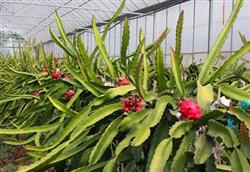
Pitaya, also known as dragon fruit, is a perennial tropical plant of the genus Hylocereus in the cactus family, native to South America. In order to grow a southern fruit in the north, Langfang City, Hebei Province introduced this fruit in 2002. Through experimentation, overcoming the effects of adverse climatic conditions such as high temperatures and drought in the early period and continuous overcast and rainy weather in the later period, they successfully produced the first batch of fresh fruit. In order to further promote cultivation, its product characteristics and key cultivation techniques are introduced as follows.
1. Application Value
The pitaya fruit is oval-shaped, covered with red scales, resembling a lion's head in shape. The flesh comes in two colors, red and white. It not only contains rich vitamin B1, B2, B3, and C, but also contains large amounts of natural cellulose, glucose, carotene, calcium, phosphorus, iron, and minerals needed by the human body. It is nutritious and also has effects such as detoxification, nourishing the intestines and stomach, purifying the blood, reducing internal heat, lowering blood pressure, lowering cholesterol, preventing vascular sclerosis, constipation, anemia, angular stomatitis, and colds. In addition, it is a special fruit for diabetic patients. Because it is a wild plant with very strong adaptability and disease resistance, it basically requires no pesticides and is a pollution-free green berry. Its fruit can not only be eaten fresh but also processed into various juices. The flowers of pitaya can also be used in cooking, stir-fried, made into soup, or served cold. The flowering and fruiting period of pitaya lasts as long as 3 to 4 months, with very high ornamental value. It can not only be made into indoor bonsai but is also an ideal ornamental plant, and it is also a raw material for winemaking.
2. Botanical Characteristics
The pitaya has no obvious taproot, with relatively developed lateral roots, and the horizontal distribution diameter can reach more than 2 m. Most of the root system is distributed in the top 10 to 20 cm of topsoil. Pitaya is an epiphytic succulent plant. Its leaves have degenerated into needle-like spines to adapt to the long-term arid environment, and the fleshy stems have replaced the function of leaves. The plant can reach 2 m in height. The stems are triangular, dark green, and much branched, 50 to 70 cm long and 5 to 6 cm thick. The flowering period is from May to November. The flowers are funnel-shaped and milky white, up to 25 cm in diameter and 30 cm long, with a fragrant scent. The fruit is oval-shaped, 13 to 15 cm long and 9 to 12 cm wide, red, with white or red flesh, aromatic, and containing 12 to 15 degrees of sugar. It blooms successively in 5 to 6 batches within a year. A single plant can bear more than 20 fruits, with a single fruit weight of 0.4 to 0.75 kg, and the high-yield period can last more than 30 years.
3. Selection of Greenhouse
Ordinary second-generation solar greenhouses can all be used for cultivation. The back wall of the greenhouse is 2 m high, the ridge height is 2.5 to 3 m, the span generally does not exceed 7 m, and the length is preferably about 50 m. The thickness of the wall base is 2 m, and the upper end is 1 m. A 50 cm deep cold-proof trench is dug in front of the greenhouse. Aging-resistant polyethylene drip-free film is used as the greenhouse film to improve light energy utilization. Thickened cold-proof straw curtains or paper quilts are added. Three heating stoves are installed inside the greenhouse to provide supplemental heating during overcast and snowy severe winter weather.
4. Requirements for Environment and Soil
(1) Temperature
Pitaya prefers warmth, and the optimal growth temperature is 20 to 30°C. A relatively large temperature difference between day and night is conducive to the accumulation of nutrients. Experimental data show that pitaya plants grow slowly at 8°C, suffer frost damage below 4°C, and enter dormancy or semi-dormancy when above 35°C or below 8°C.
(2) Light
Pitaya prefers light but is also relatively shade-tolerant. Sufficient light can make the plant strong and produce more flower buds; otherwise, it can cause excessive vegetative growth.
(3) Water
Pitaya plants have strong drought tolerance. The best air humidity is maintained at 60% to 70%. The frequency and amount of field watering depend on the different growing seasons. Generally, in spring, when soil temperature is low and evaporation is small, the plant grows slowly and consumes little water, so watering should be reduced. During the transition between spring and summer, with sufficient light and strong winds, evaporation is high, so watering should be appropriately increased. In midsummer, when sunlight is intense and temperatures are too high, the plant will enter short-term dormancy, so watering should be reduced, while shade nets should be added to cool the temperature, and attention should be paid to drainage and flood prevention. Water accumulation in the field should be avoided to prevent root rot. When autumn arrives, the temperature is suitable, and with a large temperature difference between day and night, the plant grows quickly, so watering should be appropriately increased. In hot weather and high-temperature seasons, watering in the morning or evening is better. During the peak growing season, frequent watering is suitable. During the fruiting period, it is advisable to keep the soil neither wet nor dry. Watering should be stopped 5 days before harvest to facilitate sugar accumulation.
(4) Soil
Pitaya has strong adaptability to soil, but loam soil that is loose and breathable, well-drained, strongly water- and moisture-retentive, and rich in organic matter is preferable. The suitable soil pH is 6 to 7. Black clay and red clay should be improved by mixing in sand, rice husks, sawdust, and peat.
For pitaya cultivation, fertilization at the seedling stage should mainly be nitrogen fertilizer, and after entering the flowering and fruiting stage it should mainly be phosphorus and potassium fertilizer. Decomposed livestock and poultry manure, leaf mold, soybean cake, peanut cake, bone meal, and shell powder are all good fertilizer sources, supplemented with a small amount of chemical fertilizer. When preparing the seedbed and making beds, apply 1500 to 2000 kg of decomposed organic fertilizer and 100 to 150 kg of superphosphate per mu. Mix evenly with the top 4 to 5 cm of soil. After cutting the planting stems, apply compound fertilizer once every 10 to 15 days along with watering, at 5 to 7 kg per mu. For field cultivation, apply 4000 kg of organic fertilizer and 100 to 150 kg of superphosphate per mu. During the vigorous growth period in spring and autumn, apply a nitrogen-based compound fertilizer once every 15 days. During the high-temperature period in summer, the plant enters a semi-dormant state, so fertilization should be suspended. After autumn when the weather turns cool, the physiological activity of the plant slows down, so only thin fertilizer water may be applied. In winter, when the plant is in a dormant state, fertilization should be stopped. Fertilization should be carried out on sunny mornings or evenings, and the effect is even better 2 to 3 days after rain. The fertilization concentration should follow the principle of frequent application of thin fertilizer. During the fruiting period, fertilizers rich in multiple trace elements should be applied to improve fruit quality.
5. Planting Methods
(1) Seedling Raising
Industrialized pitaya seedling production mostly uses the asexual propagation method of cutting nutrient branches. Excellent varieties are required, and the branches should be robust and free of pests and diseases. During cutting, the planting stems must undergo strict chemical treatment. The nursery should be selected from fields with fertile soil, good drainage, and good ventilation and sunlight. After the small seedlings are planted, water once every 7 to 10 days, and apply compound fertilizer once every 10 to 15 days. When the first plump fleshy stem has grown and the plant height is above 50 cm, it can leave the nursery.
(2) Field Planting
The bed surface width is 1.4 m. A 40 cm gap is reserved between two beds to make a 20 cm deep ditch. The soil in the ditch is evenly spread on the bed surface, so that the middle of the bed surface is high and the two shoulders are low.
(3) Planting Density
Taking a concrete pillar horizontal trellis as an example, the row spacing is 1.5 to 1.8 m, the plant spacing is 1.2 m, and one pillar supports two plants. Leave 600 to 700 seedlings per mu.
(4) Trellis Design
Bury concrete pillars in the middle of each bed, plant two plants on the south side of each concrete pillar, and use 10# iron wire at the top of the pillars to form a spatial net for hanging and securing fruit-bearing branches.
(5) Timely Planting
Pitaya can be planted throughout the year, but March to May is preferable.
6. Field Pruning and Branch Thinning
After the established pitaya seedlings are planted, they can sprout in 15 to 20 days. The plant grows rapidly, increasing in height by more than 2 cm per day on average. During the growth process, many bud scales will form. Therefore, attention should be paid to pruning. Generally, only one main trunk is retained in the early stage, and all other side branches are cut off. When the main stem grows to the required height (1.5 to 1.8 m), then top the plant. Promote the growth of side branches, which will later become fruit-bearing branches. The number of reserved branches is generally 10 to 15 per plant. As the side branches grow, space should be distributed reasonably. Excessively dense branches on the side branches should be cut off in time to avoid excessive nutrient consumption. Seedlings planted in May can bloom and bear fruit by May of the following year. Artificial pollination should be carried out, and flowers and fruits should be thinned, leaving 3 to 5 fruits per fruit-bearing branch.
7. Pest and Disease Control
Pitaya was a wild type in its place of origin and has a very strong ability to resist pests and diseases, but occasionally ants harm the growing points. Phoxim mixed with bran or rice chaff and diluted 1000 times with water can be poured at the roots, or 800 times trichlorfon solution can be sprayed at the roots. The most fundamental method is to start with improving cultivation conditions and artificially create a clean environment with good ventilation, sufficient light, and suitable temperature and humidity so that the plants grow healthily and their ability to resist pests and diseases is improved. Attention should be paid to strengthening scientific management, not applying undecomposed organic fertilizer, preferring thin fertilizer over concentrated fertilizer, and preventing water accumulation in the field. Commonly used fungicides include zineb (concentration 0.15% to 0.35%), carbendazim, or thiophanate-methyl (concentration 0.1%), etc.