Detailed Explanation of Early Spring Strawberry Management Techniques
1. Do not single-mindedly pursue large-fruited varieties. Large-fruited strawberries have become the goal pursued by many growers; however, the fruit size of the same variety varies within a certain range. Fruits from the primary inflorescence are all relatively large, and the higher the order, the smaller the fruit. Fruit size is not the only indicator for evaluating quality; one must also consider flesh firmness, soluble...
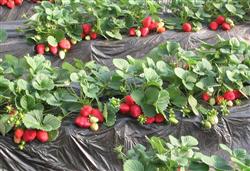 Strawberry is a perennial herbaceous plant, easy to propagate, simple to manage, and early to bear ripe fruit. It is an economic crop with low investment, quick returns, and high benefits.
I. Removing Cold Protection Materials
The strawberry germination and growth period is generally from late February to early March. In early spring, when the air temperature rises to 2-5°C and the soil at a depth of 10 cm stabilizes at 1-2°C, the root system begins to grow, relying on nutrients stored in the rhizome and roots, and new roots gradually form as the soil temperature rises. About 10 days after root growth begins, the rhizome starts to sprout, and new leaves appear one after another.
During this period, the field is required to maintain a maximum water-holding capacity of over 70%, with fertile soil, well-drained neutral to slightly acidic soil, and an air temperature above 5°C.
The first removal of cold protection materials in early spring should be carried out promptly after thawing. First remove the part of the cold protection material over the soil layer that has already thawed, to help raise the soil temperature. The second removal of cold protection materials can be carried out just before the buds are about to sprout; doing it too late easily damages the new strawberry stems. For plots where the lower layer is covered with plastic film for cold protection, it is best in March when buds sprout to break the film around each seedling and lift the seedlings above the film to grow.
II. Cultivation and Weeding
Strawberry roots are shallow and prefer moist, loose soil. Cultivating and loosening the soil and removing weeds help soil aeration and microbial activity, promote the decomposition of organic matter, and enrich and increase soil nutrients. After removing the cold protection materials and cleaning up in early spring, shallow cultivation should be carried out promptly. After rain, the cultivation depth should be 3-4 cm; other cultivation is usually arranged after irrigation.
III. Timely Topdressing
Strawberry likes fertilizer and has a relatively large fertilizer requirement, absorbing large amounts of nutrients from the soil each year. According to estimates, for every 667 sq m of land producing 750 kg of fruit, 10 kg of pure nitrogen, 2.5 kg of phosphorus, and 10 kg of potassium are needed. On the premise of applying sufficient organic fertilizer, after the soil thaws and before strawberry germination, carry out the first topdressing, applying 10 kg of urea or 15 kg of compound fertilizer per 667 sq m. The fertilizer must be dissolved in water before use to avoid root damage.
IV. Irrigation and Drainage
Strawberry has relatively high water requirements, and the soil in the plot should often be kept moist. Each topdressing should be combined with irrigation. After removing the cold protection materials in spring, carry out the first irrigation. Irrigation is best done in the early morning and evening each day, which is more favorable for strawberry growth and development and can reduce fruit rot. For plots with heavy clay soil, low-lying land, or high groundwater levels, special attention must be paid to drainage to prevent waterlogging.
V. Pest Control
In early spring, if underground pests (white grubs, mole crickets, cutworms, and wireworms, etc.) are found damaging strawberry roots and stems, the countermeasures that can be taken are:
① Carry out shallow plowing in early spring, which can effectively eliminate eggs and larvae on weeds and in the soil;
② Around the damaged plants, manually dig out and kill cutworms and white grubs;
③ For every 667 sq m, use 200 g of 90% trichlorfon crystals or 200-300 g of 50% phoxim emulsion, add 500-700 g of water, and then pour it around the roots;
④ Broadcast poisoned bait for control. The preparation method for the bait is to mix 50 g of 90% trichlorfon crystals with 1-1.5 kg of water, then mix in 2.5-3 kg of roasted wheat bran or cake crumbs, or mix in 10 kg of chopped fresh grass, and broadcast it.