Detailed Explanation of Key Cultivation Techniques for Watermelon in Early Spring Greenhouses
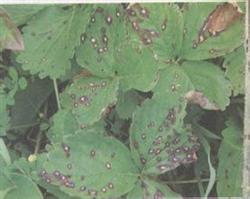
Strawberry snake-eye disease, also known as leaf spot disease, is a common disease of strawberries and occurs widely. When the disease is mild, it has no obvious effect on production; when severe, the incidence rate reaches 60%, and some leaves become necrotic and dry, significantly affecting strawberry yield. Symptom identification: it mainly damages leaves, petioles, fruit stalks, tender stems and seeds. On the leaves it forms small dark purple spots...
 I. Preparatory work before planting
(1) Land preparation: (1) Fertilization. Evenly spread 2000 jin of chicken manure, 80-100 jin of superphosphate, 30-40 jin of ternary compound fertilizer, 30-40 jin of potassium treasure, 1.5 jin of zinc fertilizer and 1.4 jin of boron fertilizer per mu into the soil. (2) Rotary tillage. (3) Ditching. The ditch width is 80 cm, the spacing is 1 m, and the depth is 40 cm. (4) Fertilization in the ditch. The fertilization amount is the same as above, then rotary till. (5) Backfilling soil. Fill soil into the ditch, leaving the ditch depth at 20-25 cm. (6) Forming ridges in the ditch. Form a ridge in the middle of the ditch, 30-40 cm wide and 15-20 cm high.
(2) Making planting holes. Spray herbicide, cover with plastic film, and make planting holes at a plant spacing of 37 cm.
(3) Building small arched tunnels. Use 2 m and 3 m bamboo strips to build two layers of small arched tunnels respectively, and cover them with film.
(4) Watering. 10-15 days before planting, water to create soil moisture and thoroughly water the ridges in the ditch.
II. Planting.
(1) The seedling age for planting is 35-40 days. Begin planting when the ground temperature exceeds 13 degrees for 3-5 consecutive days, generally around Yushui.
(2) Planting spacing is 37 cm, row spacing is 2.5--, and 660 plants are planted per mu.
(3) Choose continuous sunny days or weather at the end of a cold spell and the beginning of warmth for planting, which is beneficial for seedling recovery.
(4) When planting, the covering soil should be level with the seedling substrate, and the grafted part must not contact the soil.
(5) After planting, irrigate with 1 jin of medicinal solution (carbendazim 600-800 times dilution), and scatter bait around the plants to control underground pests such as mole crickets.
III. Management after planting.
(1) From planting to seedling recovery growth (seedling recovery period): 1. To promote pollen differentiation and increase the proportion of female flowers, light exposure should be provided daily at 8-9 o'clock; the air temperature should be kept at 25-35 degrees during the day and about 14 degrees at night; air humidity should be 50%-60%. During the seedling recovery period, do not water and ventilate little, only ventilate briefly to cool down when the midday temperature exceeds 35 degrees.
(2) From seedling recovery growth to before flowering (flowering period). According to the temperature and humidity inside the greenhouse, ventilate appropriately to regulate temperature and humidity. Air temperature should be 24-32 degrees during the day and not lower than 15 degrees at night; ground temperature should be 22-26 degrees during the day and above 14 degrees at night. Relative air humidity should be 50%-60% during the day and about 80% at night. During this period, focus on preserving soil moisture with plastic film, and keep soil water holding capacity at 55%-75%; avoid watering as much as possible. To improve watermelon quality, when topdressing at planting or the cluster stage, generally apply 70-100 jin of soybean cake and 20 jin of urea per mu in holes.
(3) From flowering to the peak fruit swelling stage. During this period, light should be increased. According to weather and seasonal changes, the small arched tunnels can be removed. The temperature inside the greenhouse should be 20-35 degrees in the morning, 40-45 degrees at noon, 32-22 degrees in the afternoon, and 20-15 degrees at night. Air humidity should be 50%-60% during the day and not exceed 80% at night. During this period, topdress twice in combination with watering. The first time is after the fruit sets, when the young fruit is the size of an egg, apply 60-70 jin each of urea and potassium sulfate per mu. The second time is 15-22 days after the first crop of fruit sets, spray quick-acting chemical fertilizer, micro-fertilizer and high-efficiency amino acid compound fertilizer on the leaves, once every 6-7 days, for two consecutive sprays. After harvesting the first crop of fruit, topdress once more to increase the yield of the second crop of fruit, using two-thirds of the amount used the first time.
During this period, artificial pollination is required, generally carried out from 7-9 in the morning. The specific operation method is to first pick freshly opened male flowers, remove the petals to expose the stamens, hold the male flower and gently smear it on the stigma of the female flower so that the entire stigma is covered with pollen. One male flower can pollinate 3-4 female flowers.
(4) Adjusting the plant
1. Pruning, retaining vines and removing side shoots. With the three-vine pruning method, in addition to retaining the main vine, select side vines on nodes 3-5 of the main vine. When the side vines extend to 20 nodes, top the side vines respectively, protect the leaf bud at the third or fourth node counting from top to bottom, and remove the rest. Retain the second female flower on the main vine for fruit set, generally around node 15. After fruit set, retain 5-7 leaves and top.
(5) Weed control
1. Before planting, use herbicide to spray the ground to control weeds. A commonly used herbicide is Jinduer.
2. At planting, use carbendazim solution (800 times dilution) to irrigate the roots.
3. After planting, scatter bait around the plants to control underground pests such as mole crickets. The bait is acephate mixed with bran.
4. If low-temperature weather occurs during the seedling recovery period, spray drought-resistant agents such as Tianda 2116.
5. Ventilate in time so that the humidity inside the greenhouse is 50%-60% and does not exceed 80% at night. If a layer of plastic film is laid inside the greenhouse, it can also effectively reduce humidity. Doing so does not create conditions for the spread of disease.
6. After seedling recovery, spray Amistar according to actual conditions to enhance the plant's immunity.
7. Timely discover abnormal phenomena in watermelon growth, diagnose accurately, and apply the right remedy.
III. Harvesting fruit at the appropriate time during the ripening stage
The harvest period for watermelon is relatively strict. Watermelons harvested at the appropriate time are sweet, juicy, brightly colored, good in flavor, large in single-fruit weight, and resistant to storage and transportation.
Methods for judging watermelon maturity include the timed ripening method: set a marker on the day of artificial pollination, and refer to the length of the fruit age period of different varieties to determine whether they are mature.
Maturity for long-distance transport: for a transport period of more than ten days, harvest at seven to eight-tenths ripe; for a transport period within one week, harvest at eight to nine-tenths ripe; for a transport period within five days, harvest at nine-tenths ripe.
The best time to harvest watermelon is in the morning or evening, because after the watermelon cools at night it releases most of its field heat, and after harvest it will not suffer quality decline or be unsuitable for storage and transportation due to excessively high body temperature and enhanced respiration. The method for harvesting watermelon is to forcefully cut from the connection between the fruit stalk and the vine, not tear it off from the base of the stalk.