What are the key technical points for skillful fertilization of jujube trees to promote high yields?
Only through scientific and rational fertilization can jujube trees be strengthened, their resistance to pests and diseases improved, quality enhanced, and yields increased. Fertilization of jujube trees is divided into base fertilizer and topdressing. The scientifically appropriate time for applying base fertilizer is from the jujube fruit ripening stage until the soil thaws the following year, while topdressing is carried out in three applications: before bud break, at the early full-bloom stage, and during the rapid fruit swelling stage...
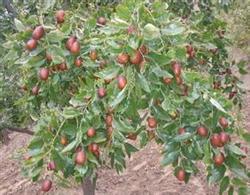
Only through scientific and rational fertilization can jujube trees be strengthened, their resistance to pests and diseases improved, quality enhanced, and yields increased. Fertilization of jujube trees is divided into base fertilizer and topdressing. The scientifically appropriate time for applying base fertilizer is from the jujube fruit ripening stage until the soil thaws the following year, while topdressing is carried out in three applications: before bud break, at the early full-bloom stage, and during the rapid fruit swelling stage. Base fertilizer Base fertilizer plays a crucial role in the growth of jujube trees. Bud break, flower bud differentiation, flowering and fruiting mostly consume the stored nutrients from the previous year. To increase the tree's stored nutrients, base fertilizer should be applied as early as possible. Applying base fertilizer at the jujube fruit ripening stage is best. At this time, the leaves still have relatively high photosynthetic efficiency, sunlight is abundant, the autumn air is crisp, and the temperature difference between day and night is relatively large. The fertilizer has a longer time to decompose in the soil, which is beneficial for the accumulation of organic nutrients and convenient for absorption and utilization by jujube trees the following spring during bud break, flower bud differentiation, branch and leaf growth, and flowering and fruit setting. Base fertilizer is mainly composed of fully decomposed high-quality barnyard manure, stable manure and other organic fertilizers, and may be appropriately combined with some quick-acting fertilizers. As for the application rate, young trees generally receive about 10 kg per tree, while fruiting trees are determined by yield, generally applied at a fixed rate of "one jin of fertilizer per jin of jujubes." Since livestock and poultry farming is relatively limited at present, resulting in a serious shortage of organic fertilizer, bio-organic fertilizer can be used as a substitute.
Topdressing Topdressing at the germination stage and full-bloom stage is mainly nitrogen fertilizer, generally applying 0.75 kg of pure nitrogen per fruiting tree; topdressing during the rapid fruit swelling stage is mainly phosphorus and potassium fertilizers. For jujube trees in the full fruiting period, apply 0.8-1 kg of diammonium phosphate and 1 kg of potassium sulfate per tree, mostly using the ring-shaped multi-point hole application method.
Foliar topdressing To save labor and investment, urea, monopotassium phosphate and certain other trace elements can be sprayed as foliar topdressing in conjunction with pesticide application for pest and disease control, water spraying at the flowering stage, and spraying of growth regulators, to promote jujube fruit growth.