Detailed Explanation of the Technical Points of a New Method for Green Branch Grafting of Grapes
Green branch grafting of grapes is a good method for rapid seedling propagation and for top-working old vines for renewal. The grafting time is in the slack farming season after summer sowing. Using lignified green branches, the grafting survival rate can reach over 95%. Each person can graft 500 to 800 seedlings per day. The new shoots that sprout after grafting can lignify before autumn, can overwinter safely, the graft union heals well, and the seedling quality...
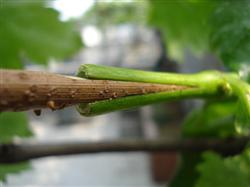
Green branch grafting of grapes is a good method for rapid seedling propagation and for top-working old vines for renewal. The grafting time is in the slack farming season after summer sowing. Using lignified green branches, the grafting survival rate can reach over 95%. Each person can graft 500 to 800 seedlings per day. The new shoots that sprout after grafting can lignify before autumn, can overwinter safely, the graft union heals well, and the seedling quality is high.
The technical points of the new green branch grafting method are as follows: change grafting with leaf stalks to grafting without leaf stalks, so that the wrapping is tight, airtight, and the survival rate is high. Change grafting leaf buds to grafting winter buds; winter buds are plump and strong, and the new shoots that sprout after the graft survives are robust and all lignify before autumn. After grafting, wrap the scion with thin plastic strips to make it airtight and prevent water loss, which facilitates survival, and use thick strips to tie the rootstock graft union tightly to facilitate healing.
The specific operation method is as follows:
1. Rootstock: use 2-year-old or 1-year-old Kyoho line seedlings with well-developed root systems and robust growth as the rootstock, planted in beds, with a row spacing of 50 to 60 cm and a plant spacing of 30 to 40 cm. Water after planting, and cut back promptly (leave two plump buds at the lower end of each seedling); after budding, keep only one strong bud per seedling to grow upward, remove tiller buds, and when the seedling grows seven or eight leaves, pinch off the top to make the seedling thick and strong.
2. Scion: select healthy branches of excellent varieties, disease-free, and of moderate thickness as the scion; remove the fruit clusters and secondary shoots on the branches used as scions 20 to 30 days before grafting.
3. Grafting time is generally from the end of May to June; earlier is better than later. Water the nursery once two or three days before grafting. Graft after 9 a.m. on sunny days. Use a single-edge razor blade as the cutting tool. The thickness of the rootstock seedling and the thickness of the scion branch should be roughly the same, and both must be semi-lignified, that is, the pith of the stem turns white. The scion should be used as soon as it is collected. If the scion must be collected from a long distance, it can be stored and transported in a wide-mouth thermos bottle with ice cubes inside to lower the temperature and preserve moisture, preventing the scion from losing water.
4. When grafting, cut the rootstock seedling into a flat cut at 10 to 12 cm above the ground, make a 3 cm downward cut in the middle of the flat cut; the cut should face north-south, and inserting the scion with its bud facing south is favorable for growth. The winter bud of the scion should be plump and round; remove the secondary shoot buds beside the winter bud, and then remove all leaf stalks below the winter bud. Each scion is 5 cm long, with 1 cm left above the scion bud and 4 cm left below; at 1 cm on both sides below the scion bud, cut downward wedge-shaped slopes 2.5 to 3 cm long, and the cut surfaces should be flat and smooth. Insert the prepared scion into the cut in the rootstock, align the cambium on one side, that is, align the bark layer, and wrap the rootstock with thick plastic strips 1 to 1.2 cm wide and 20 to 25 cm long, tying from bottom to top, then use thin plastic strips to wrap and tie the entire scion tightly, leaving only the bud exposed. After grafting, water thoroughly once, and thereafter water promptly whenever the soil dries. New shoots sprout 7 to 10 days after grafting. When the new shoots reach 20 to 25 cm high, insert stakes and tie them promptly to prevent wind from knocking them over. At ordinary times, remove the tiller buds on the rootstock. When the grafted seedling grows 7 to 8 leaves, pinch off the top, and remove tendrils and flower clusters. After pinching, new buds sprout from the leaf axils; keep the topmost bud to extend and grow upward, and pinch off the other leaf buds leaving one leaf (that is, pinching). Keep the topmost bud, and pinch off the top when it grows 7 to 8 leaves. After grafting, pay attention to pest and disease control, and spray a foliar fertilizer such as 0.2% potassium dihydrogen phosphate or Yemianbao once every 20 days, using it 2 to 3 times in succession. In the spring of the following year, remove the plastic band at the grafted site and transplant for final planting.