Three accuracy points for winter pruning of kiwifruit
Cultivation value: Kiwifruit originated in China, and because its fresh fruit is especially rich in vitamin C, it has become popular all over the world and has become an emerging fruit tree. In addition to vitamin C content being several to more than ten times higher than that of apples and sweet oranges, the fruit also contains vitamin P (rutin) and proteolytic enzymes, which can lower blood pressure and help...
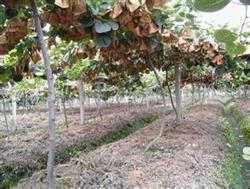 As the farming proverb says, "Though a pair of scissors is small, it can determine how much the fuzzy peach yields." This shows the importance of winter pruning. How to make kiwifruit pruning accurate and effective has become a concern for fruit growers.
Winter pruning of kiwifruit must achieve "three accuracy points."
Timing must be accurate
The winter pruning time for kiwifruit should start 10~15 days after the fruit trees shed their leaves, roughly from mid-December until before the Beginning of Spring the following year. The best time for winter pruning is around 20 days before and after the Winter Solstice. It should not be too early or too late, and it is best to prune in clear weather. If pruned too early, the nutrients in the branches have not yet finished flowing back to the roots, which will cause a large waste of stored nutrients; if pruned too late, when the branches sprout the following year, a large amount of bleeding sap will be produced, which will affect the tree's shoot growth and budbreak.
The pruning targets must be accurate
Winter pruning should be differently targeted according to variety, tree age, tree vigor, differences in soil conditions, and level of management, and must not be done blindly. The main task is to reasonably and moderately prune the fruiting canes of kiwifruit, and fully remove dead branches, thin and weak branches, diseased and pest-infested branches, overlapping branches, forked branches, as well as root suckers with no use value and water sprouts and vegetative branches with no potential for training. After pruning, promptly apply wound healing and preservative film to protect wound healing and tissue growth and prevent infection by pathogens.
The pruning positions must be accurate
Pruning for the multi-main-vine trellis type: during winter pruning, the past practice of leaving many branches should be changed to leaving fewer branches; the combination of long, medium, and short canes should be changed to leaving long canes in one go; and short cutting should be changed to long cane renewal, with more buds and fewer branches.
For the number of fruiting canes retained, with a plant spacing and row spacing of 3 x 4 m, retain 16~18 long canes per plant; with a plant spacing and row spacing of 2 x 3 m, retain 6~8 canes per plant. Generally, Actinidia chinensis retains more canes than Actinidia deliciosa. When there is space, leave moderate canes to fill gaps, and when pruning, leave plump buds at the cut. When there is space, leave water sprouts and short-cut them to 3~4 buds; the new shoots they produce can be trained into permanent main vines.
According to the growth vigor of the canes, determine the pruning length of the fruiting canes. Generally, strong canes retain more buds (about 8~12 buds), and weak canes retain fewer buds. For renewal pruning of perennial canes, local or whole-plant renewal should be adopted according to the aged part. Excess branches, such as dead branches, diseased and pest-infested branches, overly dense branches, crossing branches, and root-crown sprout branches, should all be cut off from the base.
Pruning for the single-trunk double-arm tree shape (straight-line type): on the main vine, leave one long fruiting cane every 25 cm, requiring more than 8 buds, continuing all the way to just beyond the outermost galvanized wire, extending 2~3 buds, forming a "bow" shaped fruiting pattern and expanding the fruiting surface. If there is a bare space within the canopy, 2~4 bud fruiting canes can be retained to fill it, forming flat fruiting. For the Hayward and Xuxiang varieties, the distance between fruiting canes on the main vine is generally 20~25 cm. After pruning, promptly tie the canes according to the above spacing, and the light transmittance should reach about 30%. The number of canes retained per mu is determined according to planting density. Water sprouts are retained if there is space, and if there is no space they are removed from the base without leaving stubs.